A new kind of comics criticism

David Brothers has just published a post on Comics&Cola, which talks about his frustrations with addressing racism and the like in comics and how there should be a place for a new sort of criticism in comics:

But the new criticism, the criticism that is largely coming from black and brown and Asian and Muslim and gay and trans and feminist circles and even more besides, doesn’t have an established place in comics yet. The culture is not used to it. The culture doesn’t know how to react to it, because it often comes from a deeply personal place and is accompanied by emotion instead of rote facts about first appearances and career milestones. The result is a constant diminishing of the concerns of the essayist and mocking of their context.

We talk about outrage culture and never stop to ask ourselves why someone saying “This hurt me, here’s why” is offensive, but a white man creating a comic where women are raped and non-whites are racially stereotyped is not. We scream “Free speech!” in the face of people who say “This is messed up.” We never examine why someone is angry before dismissing them for their anger. We demand perfection and eloquence from someone who has just been confronted with the unbridled contempt someone else has for them and everything they represent.

Much of what Brothers is talking about is of course the well known Tone argument: “I’m not going to listen to you as long as you’re shouting at me”. Another part comes from what Laurie Penney calls nerd entitlement, a toxic mix of historic victimhood and elitism that makes comics, perhaps more so than any other nerdy pursuit, hostile to everybody “not like us”, women and people of colour especially; the stereotypical nerd being portrayed as white and male even though women and people of colour have always been present.

That’s where comics particular history reinforces those already existing tendency. Because it’s been used so often as a scapegoat for all sorts of social problems like juvenile delinquency, has been the victim of official opprobium, has had retailers prosecuted for selling material “not suitable for kids” or artists put in jail for what they put on paper, any criticism based on larger societal concerns is immediately met with hostility. And it isn’t so much the fanboys that are the problem, attached though they are to certain questionable superheroine outfits.

No, rather it’s the critical press and the socalled art comix community that’s the problem. Unlike what’s been happening in related nerd fields like science fiction fandom, there’s very little attention within serious comics circles for issues of representation, diversity and the systemic effects of racism, transphobia, sexism or homophobia. Most of the serious commentary still seems to believe in art in a vacuum, without much attention for how it reflects or even encourages racism or sexism. There’s this very baby boomerish idea of the freedom of the artist to do what he wants, without much curiosity about why it is always he doing it. It’s why you get glitzy thrash like Fukitor published by Fantagraphics, something that’s supposed to be transgressive but only deals in the same tired stereotypes you could’ve found in an eighties Chuck Norris action movie.

What critical tradition (American) comics has had, has largely come around through the efforts of The Comics Journal: no other critical magazine has had its longevity and influence. Yet that influence isn’t always benign; molded after the personalities of its founders, Kim Thompson and especially Gary Groth, it’s always been macho, aggressive and sometime disdainful of concerns outside of pure art. So you get this sort of sneering too often, a defensive response without any attempt to understand what it is sneering at.

What comics needs is the equivalent of Racefail in science fiction fandom, when long simmering issues of representation and diversity came to a head and all the underlying racism & sexism boiled over. Science fiction finally had to come to terms with the idea that fans of colour weren’t rare, weren’t hidden and owned science fiction as much as anybody else. Comics still hasn’t woken up to this.
Your Happening World (January 9th through January 15th)

Sad puppies still not house trained

Brad Torgersen, in a move reminiscent of a Great War general deciding that this marching his men into the German machine gun fire will win him the battle, is calling on his fans to vote for a Sad Puppy slate again in the Hugos, cause that worked so well last time. Here’s a classic case of projection, courtesy of File 770, because no way I’m linking to Torgersen directly:

For those of you who don’t know what SAD PUPPIES is, it’s a (somewhat tongue in cheek) running effort to get stories, books, and people onto the Hugo ballot, who are entirely deserving, but who don’t usually get on the ballot. Largely because of the nomination and voting tendencies of World Science Fiction Convention, with its “fandom” community. In the last decade we’ve seen Hugo voting skew more and more toward literary (as opposed to entertainment) works. Some of these literary pieces barely have any science fictional or fantastic content in them. Likewise, we’ve seen the Hugo voting skew ideological, as Worldcon and fandom alike have tended to use the Hugos as an affirmative action award: giving Hugos because a writer or artist is (insert underrepresented minority or victim group here) or because a given work features (insert underrepresented minority or victim group here) characters.

So last year Torgersen and co got enough people to waste at least $50 on a supporting memberships to be able to get a lot of shite on the final ballot that otherwise would get nowhere near the Hugos, but came up with a big fat nothing when the awards were actually chosen, usually ending up last or second to last in their categories. Satisfying as that was, it did mean actually deserving books and stories got short shrifted as the Sad Puppies got on the ballot instead.

Now he wants to do it again, but it’s not him that makes the Hugos into an ideological purity test, oh no, it’s those nasty liberals. They force him into this sad spectacle, because of their constant nominating of inferior science fiction. Because honestly, you don’t actually think a writer of colour can be any good now can you? And you sure as hell don’t want to read about those people if you can read about manly men manly saving the universe for America. Again.

The truth is of course that all those socalled “affirmative action” nominations happened organically, because people actually liked the writers, books, stories and artists they nominated, actually like reading books not written by a white American writer doing the same old, same old done better three decades ago.

It’s a bitter pill to swallow and if there’s anything rightwingers are incapable off, it’s accepting bitter truths gracefully. Much better to throw a temper tantrum.

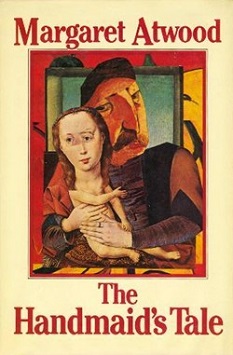
The Handmaid’s Tale — Margaret Atwood

Cover of The Handmaid's Tale


The Handmaid’s Tale
Margaret Atwood
308 pages
published in 1985

About a decade ago, when promoting her book Oryx and Crake, Margaret Atwood said some dumb things while distancing it and herself from science fiction, insising it was “speculative fiction” (ironically a term invented by that most hardcore of sf writers, Robert Heinlein when he tried to make sf respectable half a century before Atwood) and being dismissive about “talking squid in space”. Science fiction fandom has a long history for (imagined) sleights and while Atwood has long since walked back her remarks, sf fans tend to still be a bit grumpy about it. Yet Atwood does have a point that she isn’t writing for science fiction readers and therefore her books shouldn’t be judged by science fiction standards.

Which is fair enough. If you read the Handmaid’s Tale it soon becomes clear that though it is science fiction, it’s science fiction in the dystopian tradition of Orwell and Huxley rather than in the tradition of e.g. Heinlein’s If This Goes On…, another story of religious oppression in a future America. That has flying cars and blaster guns and other sfnal paraphernalia though no space squid, while Atwood’s story is set in what are still recognisable eighties suburbs.

Read more…