So well done.
#MetalGate: you’re joking, right?
I saw some brief references to #MetalGate on Twitter before the weekend and assumed it was GamersGate loons trying to stir shit. I was right:
Similar to how “#Gamergate” was coined by Adam Baldwin while linking to videos about Zoe Quinn’s sex life, then famously retconned to actually be about ethics in journalism, the origins of #Metalgate seem to be unimportant. #Gamergate has established a template. Throw a hash in front of a word and a “-gate” behind it, and you send out a veritable Bat-Signal to thousands of angry people on the internet: “Social Justice Warriors are doing… something. We may not be clear on what they’re actually saying or doing, but they must be stopped.”
Proof once more, if any was needed, that GamersGate is just another rightwing kulturclash project, just another attempt by “South Park Republicans” and professional culture warriors to seem even vaguely relevant and use the fears and prejudices of unthinking white men to get some sort of rightwing cultural backlash going, gain some foothold in youth culture. Yes, it’s all sound and fury and rape threats that accomplishes nothing except the harassment of more women but hey, it beats working for a living.
Furies — Lauro Martines
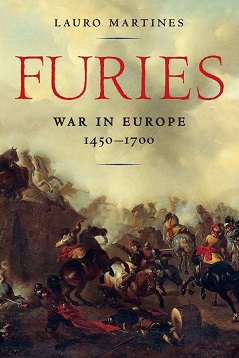
Furies: War in Europe 1450 – 1700
Lauro Martines
320 pages, including index
published in 2013
A lot of history books about war and warfare, even when they look at the impact war had on wider society, on the civilians and soldiers caught up in it, are remarkably clinical and dry about the violence it brings with it. Not so Furies: War in Europe 1450 – 1700. Before it’s good and well started, you get the first grizly massacre to process, no horrid detail spared, all the better to prepare you for the rest of the book. This is not an easy read, not your average military history wankfest, this is a book with a message and that message is that war in Early Modern/Renaissance Europe was hell, a total war where nobody cared if you lived or died.
That period from roughly 1450 to 1700 was one in which a military revolution took place, with Europe emerging from feudalism and war as a noble pursuit for knights and aristocrats giving way to mass warfare by any means necessary. It was a revolution brought about through the introduction of gundpower weapons making possible new ways of making war, as well as the growing strength of the emerging European nation-states. Add to that increasing religious schism and you have a recipe for warfare on an apocalyptic scale and Martines is not afraid to show what that meant on the ground, for the people caught up in the war.
Your Happening World (November 26th through December 8th)
- The Millions : A Year in Reading: 2014 –
- Best Books of 2014 : NPR –
- Emic, Etic, and the depiction of Otherness in SFF | Safe – SFF writers depict aliens and fairies in loving detail, giving them whole histories and complex societies and yet casually dismiss the Others in their midst with stereotypes, tired tropes that do not stand up to even casual scrutiny. This recursive, ouroboros-type, self-perpetuating mythology makes it obvious that the writer has been watching TV as research.
- Top Ten Tips for Being a Vigilante On a Budget – My friends and I got into a discussion on vigilantes this past weekend, or, more specifically, what it would be like to be Batman on a budget. It was fun throwing ridiculous ideas into the air but I started to really think about it.
- Dawson’s Heights, East Dulwich: ‘an example of the almost-lost art of romantic townscape’ | Municipal Dreams – Kate Macintosh designed Dawson’s Heights back in the Sixties when she was just 26 years old. If she weren’t very much alive and kicking – and still fighting the cause of high quality social housing – I’d call it a worthy memorial. It remains much more than that in any case. Beloved by architectural groupies and a striking presence on the local skyline, most importantly it has provided a decent home to many.
- The Wire – Drexciya: Fear Of A Wet Planet –
Twentyfive years ago today
Geneviève Bergeron (b. 1968), civil engineering student.
Hélène Colgan (b. 1966), mechanical engineering student.
Nathalie Croteau (b. 1966), mechanical engineering student.
Barbara Daigneault (b. 1967), mechanical engineering student.
Anne-Marie Edward (b. 1968), chemical engineering student.
Maud Haviernick (b. 1960), materials engineering student.
Maryse Laganière (b. 1964), budget clerk in the École Polytechnique’s finance department.
Maryse Leclair (b. 1966), materials engineering student.
Anne-Marie Lemay (b. 1967), mechanical engineering student.
Sonia Pelletier (b. 1961), mechanical engineering student.
Michèle Richard (b. 1968), materials engineering student.
Annie St-Arneault (b. 1966), mechanical engineering student.
Annie Turcotte (b. 1969), materials engineering student.
Barbara Klucznik-Widajewicz (b. 1958), nursing student.