- Divinity Wiki –
- Kenneth Goldsmith – If It Doesn’t Exist on the Internet, It Doesn’t Exist – It is our obligation as educators and intellectuals to make sure that the bulk of our production ends up there, preferably with free and unfettered access to all. This means not making materials available only for those affiliated with our institution, our students, or our colleagues, but giving free and unfettered access for all. Doing so means posting our works on the world wide web so that anyone, anywhere, at any time can have access to them. In this way, we will ensure that our work exists
- Free French sf –
- De post-betoging blues | Jan Blommaert (en z’n gedachten) – Meer nog: het is net het overweldigende succes van deze manifestatie dat moest worden verkleurd tot een antidemocratische ramp door media – wiens media, nietwaar? – die dit scenario al wekenlang in schetsen hadden gezet. De focus op de rellen is dan ook – paradoxaal – een signaal dat de betoging een gigantisch succes was. Zo’n succes dat zij die dit vervelend vinden erg bang geworden lijken te zijn en nu al, bij het begin van de hete herfst, tot extreem verdraaide beeldvorming moeten over gaan.
- False Steps | The Space Race as it might have been – Hi there. My name is Paul Drye and False Steps is my project blog for a history book of the same name which looks at the Space Race as it might have been. Beginning with what I think to be the very prehistoric beginning of manned space travel (the so-called Magdeburg rocket of 1932) I aim to trace the ways in which people tried to travel to space and came close to accomplishing it, all the way through Nazi German rocketry, the post-WWII fallow period, the crazy times of Sputnik through Apollo, the second down time of the 1970s, and the gradual revival of human space travel from then into the present day.
A History of the Vandals — Torsten Cumberland Jacobsen

A History of the Vandals
Torsten Cumberland Jacobsen
360 pages, including index
published in 2012
Of all the Germanic tribes invading the Roman Empire, the Vandals have the worst reputation for reasons that have little to do with what they actually did. Mostly this is of course due to the simple fact that they lent their name to vandalism, coined in the wake of the French Revolution to describe the destruction of religious artworks by revolutionairies by equating it to the infamous sack of Rome in 455 CE, which in itself had already been exagerrated by pro-Roman historians for various political reasons. The Vandals then have never had an even break, always been the bogeyman to an Europe much more inclined to identify itself with the grandeur of Rome than with the ‘barbarians’ that ended its reign.
This attitude perhaps explains why books about the Vandals are rare in English, with A History of the Vandals being the first general history of them in English. Then again it could also be because unlike the Franks or Lombards or Goths, the Vandals had their largest impact outside of Europe, in the empire they created in North Africa and hence can’t be used as semi-mythical ancestor tribe for a modern European nation. This, as well as the fact that for a century they were the most successfull of the ‘barbarian’ successor states to the Roman Empire could also explain why they and not those Goths or Huns were used and abused as the villains in the Fall of the Roman Empire.
James Nicoll’s Great Heinlein Juveniles Plus The Other Two Reread
With Podkaybe of Mars, does not end well:
Unlike Elsie, Jackie, or Peewee, poor Podkayne is cut off at the knees before her adventure begins. Podkayne can dream of commanding a space ship but she can never see that dream realized because her narrative purpose is to serve as a doleful lesson to readers. This is where misplaced female ambition can lead! Well, if not Podkayne’s misplaced ambition, then her mother’s. Where the classic Heinlein juveniles are about boys reaching for the stars, Podkayne of Mars is a hectoring lecture, telling women to stay in their place.
To be fair, it’s not just Podkayne of Mars James has problems with, as shown by the list of the other reviews, below. It’s abundantly clear that many of the problematic opinions Heinlein had in his later books towards the proper role of women, sex, incest and consent were not a product of his medical troubles nor a new development, but present already in his juveniles. For somebody lauded for being so forward looking, he sure is wedded to gender models already becoming obsolete at time of writing. With rare exceptions, women are there to be mothers or wives and while his heroes may often be overshadowed by their female companions, they still need to be satisfied with these roles once the story is over.
- Rocket Ship Galileo (1947):
“Depraved indifference” and “the uncle who used his relatives as living meat shields” are going to be book-ends for this series of reviews. - Space Cadet (1948):
It’s entirely possible that Matt is part of a terrible machine and too naïve to realize but at least, unlike my memory of Starship Troopers, the Patrol has ambitions of being lawful good. - Red Planet (1949):
By this point in his career, Heinlein was still sticking with the “girls are ick and moms are a drag” model; there’s a genially patronizing treatment of the female inability to handle math in a discussion of the air plants that made me idly wonder what that character’s throat would sound like if his wife stuck a knife in it in mid-sneer. - Farmer in the Sky (1950):
It’s pretty clear to me that George’s Plan A was to ditch Bill on Earth so George could secretly marry Molly and emigrate to Ganymede; given the difficulty of communicating with Earth, it’s possible Bill might not have found out about George’s new family for years, if ever. - Between Planets (1951):
I’ve never particularly noticed it before but there are parallels between the plot of this and the plot of Lord of Rings; Don is stuck with a ring of great importance and what he needs to do to save the day is get rid of it under the right circumstances. - The Rolling Stones (1952):
Heinlein paid lip service to the idea that women could be professionals but all that had to stop as soon as he married one of them, even if it meant poverty for the Heinlein family. - Starman Jones (1953):
This book stands out as possibly the first young adult novel I ever encountered that featured pretty transparent references to johns being rolled by prostitutes. - The Star Beast: (1954)
Of all the Heinlein Girls in Charge, The Star Beast’s Betty Sorenson is the girl most in charge and in Mr. Kiku we find an extremely uncommon figure for SF, a sympathetic career bureaucrat. - Tunnel in the Sky (1955):
Since the majority of Americans didn’t come to see mixed race marriages as acceptable until the mid-1990s, forty years after this book was written, that minor bit of business was pretty daring on Heinlein’s part. - Time for the Stars (1956):
Given that telepathy completely breaks relativity, I don’t know that it makes any sense to discuss whether the way he telepathic communication is affected by relativistic star-flight is realistic. - Citizen of the Galaxy (1957):
Purchased on an apparent whim by the beggar Baslim the Cripple, Thorby is rescued from a life of exploitation and abuse for one as the acolyte and adopted son of a man who is far more than he appears. - Have Spacesuit, Will Travel (1958):
For me, the highlight of the book is young Peewee Reisfeld, twelve years old — almost — and willing to take on an alien invasion single-handed if she has to. Peewee might be the finest example of Heinlein’s girls in charge. Peewee is smarter than Kip, she is just as brave, she manages to escape (temporarily) from the wormfaces before she ever meets Kip, something she keeps up through the book, and she saves Kip on a number of occasions. - Starship Troopers (1959):
The book opens as Juan Rico nerves himself to murder alien civilians, “Skinnies”, as he calls them. Heavily armed and armoured, Rico and his human confederates rampage through the Skinny city, destroying infrastructure and leaving a trail of bodies behind him (including what may be a substantial fraction of the congregation of a church).
Does this mean these books aren’t worth reading? Not entirely; certainly the best of the bunch like Citizen of the Galaxy have charms that make their flaws easier to overlook, but the overwhelming sexism does sour a lot of the fun in these.
If you like these reviews, you can commission your own review from James.
A Night in the Lonesome October — Roger Zelazny
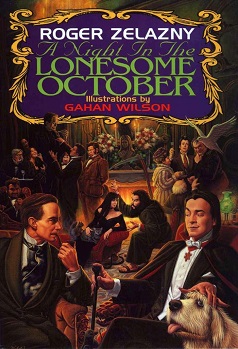
A Night in the Lonesome October
Roger Zelazny
280 pages
published in 1993
A Night in the Lonesome October took me all of October to read, not because it was such a long or difficult book, but because I read each chapter on the day it took place. This has been an ancient tradition in online fandom, or at least it was when I was hanging around rec.arts.sf.written in the late nineties (and I see Andrew Wheeler at least remembers this tradition too). It’s an interesting way to read a novel you’d otherwise read in a day or so. It also constituted my (semi) annual allowed read of a new Zelazny novel; I ration my reading of a “new” Zelazny as he’s one of my favourite authors and the supply is after all limited.
A Night in the Lonesome October in fact is the last solo novel he completed before his death two years later. Sadly to say, it’s also one of his few late novels that’s any good, unlike say his collaborations with Robert Sheckley. Like so many other grandmasters Zelazny had declined somewhat in his later years, for a variety of reasons, but A Night in the Lonesome October was a return to form. Witty, well written and with the characteristic inventiveness of Zelazny’s best work; it’s no wonder it became a cult favourite.
Living in the future

Is when you can keep up with the attempt to land a probe on a comet half a billion kilometres away from Earth by updates to a popular online comic.
And seeing the excitement online about the landing today, it puts to shame the notion that we need manned space exploration to keep people interested.