- BBC News – Cat Watch 2014: What’s it like being a cat? –
- The Radical Ellen Willis | Dissent Magazine – Maybe we’re oblivious, or maybe just stretched thin, but not enough people are talking about this. The late cultural critic Ellen Willis did—and years before the worst of it hit. With a clarity of thought and the kind of fury that pangs and never scabs over, she diagnosed, snarled, and illuminated what she considered a central plague of her day: the way our economy limits our creative expressions. As she put it in her essay “Intellectual Work in the Culture of Austerity”: “On the crudest level, the lives of American intellectuals and artists are defined by one basic problem: how to reconcile intellectual or creative autonomy with making a living.”
- Black and Blue. – Free Online Library – The violence perpetrated by the P.G. cops is a curious development. Usually, police brutality is framed as a racial issue: Rodney King suffering at the hands of a racist white Los Angeles Police Department or more recently, an unarmed Timothy Thomas, gunned down by a white Cincinnati cop. But in more and more communities, the police doing the brutalizing are African Americans, supervised by African-American police chiefs, and answerable to African-American mayors and city councils. In the case of P.G. County, the brutality is cast against the backdrop of black America's power base, the largest concentration of the black middle class in the country.
- kankedort: On Diversity: Two Sadnesses and a Refusal – don't refuse the issues. I accept them fully. But I refuse the sense of scarcity and shrinkage. I refuse a world this small. I refuse to believe that there are only so many seats at the table, that I have to fight for scraps against all other possible representatives of diversity. You guys, I refuse this EVEN IF IT'S TRUE. Daniel José Older and Saladin Ahmed, who were mentioned in the Nation piece, are my friends. I'm thrilled for them. Is it possible to recognize that there is a problem with women of color being ignored, and still be thrilled for them? I intend to believe the answer is yes.
- Marooned Off Vesta: Confusion and understanding: one post about The Stone Boatmen – Though I try always to extend sympathy at least, it is difficult for me to approach any new work of sf with anything other than suspicion. But very early on in my first reading of Sarah Tolmie's The Stone Boatmen — I am no longer able to say when or where, exactly — I decided to trust: to have faith in the work, and in Tolmie's ability and above all responsibility in pursuit of it. Or — can this really be characterized as a decision? Perhaps better to say that I found myself trusting her, that something palpable but not quite locatable in or between her words made such trust not only possible but natural, even unavoidable. Tolmie does not betray this trust.
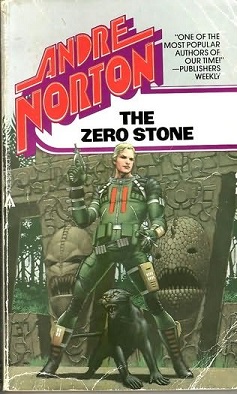
The Zero Stone — Andre Norton
The Zero Stone
Andre Norton
221 pages
published in 1968
You can’t accuse Andre Norton from starting her stories slowly. When The Zero Stone opens, its protagonist, Murdoc Jern is fleeing through a primitive town on an alien planet, barely one step ahead of a mob of religious fanatics wanting to kill him. They already killed his boss when the priests of a local cult indicated the both of them for their next ritual victims, but Murdoc managed to escape. He finally manages to reach the dubious safety of a free trader ship, where his only friend is the ship’s cat, but when it falls pregnant after ingesting a strange stone on the traders’ first stopover and he himself falls ill of a strange plague once the cat gives birth, he learns not only that the trader’s crew plan to abandon him on an airless moon, but also that they had been hired to kidnap him. Luckily for him, the cat’s mutant offspring turns out to be a mysterious and powerful alien intelligence who calls himself Eet and who sets out to save Murdoc from his predicament.
The reason for Murdoc’s continuing bad luck turns out to be the old memento that was the only thing he’d taken from his adopted father’s home, who had been not just a gem trader but also a retired crime Guild boss. This memento is a ring too large to be worn and containing a dull, lifeless stone; it was found on a corpse drifting in space but Murdoc’s father could never find out anything more about it, which is why he called it the zero stone. As you’d expect in a story like this, his son has more success in finding out at least some of the story behind the stone, if only by being dragged behind it in a series of increasingly desparate escapes from danger, aided and abetted by his alien companion.
A proper love story
Now here’s a great soppy love story I ran across when reading Jan Morris’ Wikipedia entry, about how she was forced to divorce from her wife after her gender reassignment surgery and how they got remarried again in a civil partnership in 2008:
. In a touching story of constancy, they stayed together after Morris’s trip to Morocco in 1972. He went as a man, and came back as woman. The law, then, did not allow same-sex marriages, so the couple were obliged to go through an amicable divorce. Morris used to describe her as her “sister-in-law”, but on BBC Radio 4’s Bookclub yesterday, she revealed that the relationship was closer and more enduring than that implied.
“I haven’t told this to anybody before,” she said, “I’ve lived with the same person for 58 years, I married her when I was young and then this sex-change thing – so-called – happened and so we naturally had to divorce, but we’ve always lived together anyway. I wanted to round this off nicely so last week Elizabeth and I went to have a civil union.”
The ceremony was held at the council office in Pwllheli on 14 May, in the presence of a couple who invited them to tea at their house afterwards.
“I made my marriage vows 59 years ago and still have them,” Elizabeth told the Evening Standard. “We are back together again officially. After Jan had a sex change we had to divorce. So there we were. It did not make any difference to me. We still had our family. We just carried on.”
I was looking at her Wikipedia entry because I just bought her Pax Brittanica history trilogy, which were still credited to “James Morris” but did have this dedication in them:
During the writing of the Pax Brittanica trilogy James Morris completed a change of sexual role and now lives and writes as Jan Morris.
Which is, changing language aside, a decent thing to do and it goes on to consistently talk about her as female, but the edition I have is from 1980, some eight years after her public gender switch and I wonder why they kept her old name on the books.
Probably rubbish, but still…
Might be good. Probably won’t. But the idea of a seventies sort of retrofuture O’Neill space station comedy is intrigueing. (Via File 770.)
Diversity doesn’t mean Tobias Buckell should write magic realism
Tobias Buckell talks about being light but not white, diversity and how it can become mired in cliche:
But even as that happens, I also get annoyed with narratives that try to require me to fit into a certain ‘type’ of diversity. It seems the white power structures like immigrant narratives and magical realism from brown-identifying folk. Man, is that ever true, and even allies can fit into this. There’s been a heavy pressure on me to drop doing the action and to write about magical immigrants. I’ve been offered book deals and better money, and it’s funny, I’ve had three editors in the last ten years point blank sketch out the outline of the same novel: immigrant from the Caribbean arrives in the US and does something magically realist.
The reasoning here seems to be: Buckell is from the Caribbean, that’s almost Latin America and Latin American writers write magic realism, not technothrillers or space opera. It’s a Small World diversity, with your cultural background reduced to a series of cliches and no clue that you might want something else instead. It’s the dominant culture looking for the exotic, the thrill of the novel but only within rigidly defined borders.
In science fiction, as in much else, the dominant culture is American and American assumptions about race, gender and culture drive much of the debate about diversity. Somebody like Tobias Buckell who can (ugh) “pass as white” can fall through the cracks. Not exotic enough that he can be easily pigeonholed, but not “assimilated” either. A novel like Hurricane Fever is driven by assumptions and a worldview an American writer wouldn’t share, even if at first glance it’s just a technothriller.
As readers we should always be wary of cliches, of the conscious and unconscious ways we ourselves think about various cultures. It’s not just that we expect writers to adhere to certain cultural cliches, it’s also that we may see them where they aren’t. We’ve seen that with dialect and the use of “non-standard” English in science fiction, not just dismissed as a literary trick by some, but also seen as racist when writers use e.g. African-American vernacular English.
I’m not innocent of these things myself; I’ve tried several times to get into Nalo Hopkinson’s Brown Girl in the Ring but keep getting stuck on the first few pages, by the way one of the characters talks. Similarly, with several of Aliette de Bodard’s science fiction stories which draw on Vietnamese history and culture, I’ve felt they came uncomfortably close to cliche images of despotic and authoritarian, hivebound Asia, but is this her fault or am I guilty of seeing a much more complex setting through orientalist lenses?