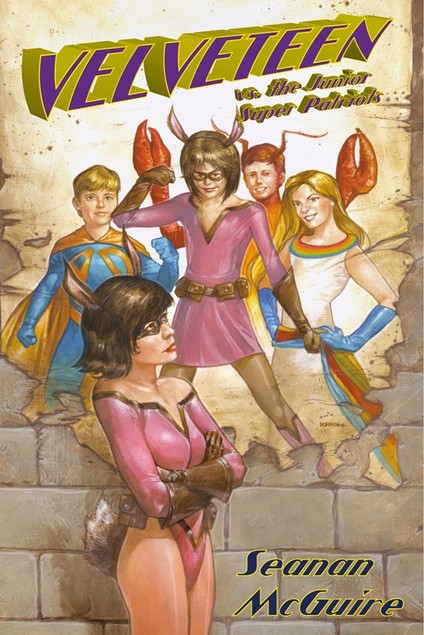
Velveteen vs the Junior Super Patriots/Multiverse — Seanan McGuire

Cover of Velveteen vs the Junior Super Patriots


Velveteen vs the Junior Super Patriots/Multiverse
Seanan McGuire
312 pages
published in 2012, 2013

I had been following Seanan McGuire on her Livejournal for donkey ages, but I only got around to reading her Velveteen stories when they were linked from MetaFilter. Bad Martin. No biccie. Of course I then inhaled all the linked posts in less than an afternoon (not at work of course, nooo) and found I had to buy the actual ebooks, if only to be able to burble about them here.

I haven’t read anything else of Seanan McGuire/Mira Grant yet, so it may seem strange that this got such a hold on me, but it just perfectly fit the story crack receptors in my brain. Well told, short superhero stories done with flair and invention, lots of drama and emotional rollercoasters, no fear of consequences or of looking silly. Velveteen is a young superheroine just let go of the most famous superhero team in the world, the Junior Super Patriots, looking to start a new life without superheroing as long as the sinister marketing company behind 90 percent of superheroes lets her. Greatly lacking in self confidence and trust in her powers — which consists of being able to bring to life and manipulate toys — she thinks herself barely qualified to cope with real life, let alone the challenges walking away from the Junior Super Patriots have brought her.

Read more…

LonCon3: A Queerer War

Duncan Lawie, S. J. Groenewegen, Tanya Huff, Ann Leckie

Consideration of sexuality has been part of military SF since at least The Forever War, but while it’s easier than it used to be to find militaristic SF novels that address queer experience — Adam Roberts’ New Model Army, say, or God’s War by Kameron Hurley — they remain uncommon. Let’s talk about the implied or assumed links between combat, straightness, technology and morality, and how science fiction has succeeded and failed at complicating its understanding of the sexuality of war.

Wanted to go to this because it was about mil-sf and because it featured Tanya Huff and Ann Leckie. Managed to confirm my suspicion that the former was deliberately checking off milsf subgenres in her Confederacy series. There was an interesting debate between the panel and the audience (Jo Walton in particular) about whether or not The Forever War could’ve been published today. Jo argued that having queer characters is no longer a taboo, but I think that the way homosexuality is portrayed in that novel is too much at odds with modern sensibilities to have been written that way had Haldeman written it now.

There was also a bit of a Twitter debate about Tanya Huff’s remark that all her characters were bisexual unless stated otherwise, which I asked her whether that meant that yes, they are bi, or whether the reader just shouldn’t make any assumptions. It turned out she meant the former. On Twitter somebody took exception to this and I can sort of see his (iirc) point; you could argue it’s just as erasing as assuming everybody is straight or gay. But then again, it’s only one author.

LonCon3: An Anthology of One’s Own

Alex Dally MacFarlane, Jeanne Gomoll, Alisa Krasnostein, Ann Vandermeer, Julia Rios

Thanks in large part to the efforts of publishers like Aqueduct and Twelfth Planet Press, and the increasing use of crowdfunding platforms such as Kickstarter, we are in the middle of a small wave of feminist SF anthologies – including the Twelve Planets series and the Lightspeed Women Destroy X special issues, and with Alex Dally MacFarlane’s Mammoth Book of SF by Women and the VanderMeer giant anthology of Feminist SF still to come. Such anthologies are part of a tradition stretching back at least to Pamela Sargent’s Women of Wonder anthologies in the 1970s. How have they helped to shape contemporary understanding of SF? To what extent have they been successful at rewriting the narratives of SF history (and breaking what are often cycles of discovery and elision)? And have they left any blind spots of their own?

Interesting discussion that went somewhat beyond its brief to look more broadly at diversity in science fiction.