Credit where credit is due

I really like J. Caleb Mozzocco’s handy little guide to the characters in Guardians of the Galaxy and their creators:

And, if a lot of people make a lot of money and there are a lot of accolades being thrown about, then a lot of credit is going to go to a lot of people, from whoever cut those winning trailers to the designers and animators who got Rocket’s fur to look just so to Gunn himself. If comic book people get any credit, chances are it’s going to be as a collective (i.e. “Marvel”) or under a “Special Thanks” near the end of the end-credit scrawl (IMDb has comics writers Dan Abnett and Andy Lannning receiving writing credit; if that’s on the screen near the “written by” credit, then that’s awesome).

I especially like his idea of making a donation to The Hero Initiative equal to the cost of the movie ticket, to help that charity help out comics creators screwed over by the comics companies. Of course it would be better if the comics industry as a whole, and especially the Big Two, should treat their employees better and let the people who actually created the characters that are now making millions in movies for them have a little bit of the slice as well. Still, it was nice that Marvel arranged for a private screening of the movie for Bill Mantlo.

Remember Bill Mantlo? Marvel’s most prolific writer in the eighties, about the only one who could make something as uninspiring a toy as ROM into an actually readable, perhaps even good comic. When Shooter was ousted, Mantlo got less and less work, dropped out of comics to try and become a lawyer, then had a car accident that left him paralysed and penniless. Thanks to the Guardians movie, no less a newspaper than the New York Times wrote about Mantlo:

Like millions of moviegoers over the weekend, Bill Mantlo watched “Guardians of the Galaxy,” the Marvel Studios space adventure that sold more than $172 million in tickets worldwide in its first four days of release.

The film’s success is particularly meaningful to Mr. Mantlo, 62, a comic-book writer who helped create one of the movie’s main characters: the foul-tempered, gun-wielding anthropomorphic Rocket Raccoon.

Mr. Mantlo did not see “Guardians of the Galaxy” in a theater, but in his bed at the nursing home where he is being cared for after a 1992 accident in which he was hit by a car and left with brain damage.

Michael Mantlo, his brother, said Bill owed his health partly to Medicaid and partly to the grass-roots efforts of comics fans, who not only made donations on his behalf but also brought attention to his involvement in creating a character whose value to Marvel had suddenly mushroomed.

As Michael explained in a telephone interview, the focus on his brother has encouraged the studio to reconsider its obligations to him. “The more often Bill’s name gets mentioned, and the more often he is given public credit for something that he did, the easier it is for me to go to Marvel and say, ‘You might want to consider raising your offer.’ ”

It was only the negative publicity around the first Superman movie that finally got Siegel and Shuster a small part of the millions DC/Warner had made of their characters, it’s good to see Michael Mantlo taking advantage of that for his brother here. Bill Mantlo deserves it.
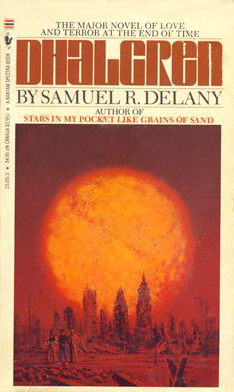
Dhalgren — Samuel R. Delany

Cover of Dhalgren


Dhalgren
Samuel R. Delany
879 pages
published in 1975

Question: what are the two places man will never reach? Answer: the heart of the sun and page 100 of Dhalgren.

A corny old joke, with a kernel of truth because Dhalgren is not an easy book to read. Almost 900 pages long it’s a monster of a book, even more so when you remember it was published at a time when any science fiction novels over 200 pages was a bit on the long side. And unlike certain modern novels of that length, Dhalgren demands your attention on every page; you can’t get through it on the autopilot. It’s therefore no wonder that it took me most of February to read it, with no time for other books. But it was worth it as even almost forty years later this still is one of the most ambitious and challenging science fiction novels ever written.

Some people think it’s the symbol of everything that went wrong with science fiction. That “joke” I opened is less a joke than a sneer, repeated by people still mad at what the New Wave did to science fiction though they were born long after it. According to them Dhalgren is dense, impenetrable and unreadable, elitist fodder for literary snobs. What really sticks in their craw though is that Dhalgren was one of the biggest science fiction bestsellers of the seventies, going through fifteen printings between 1975 and 1980. Somebody must’ve liked it; in fact, like Dune or Stranger in A Strange Land, much more palatable bestsellers to these embittered fans, it must’ve appealed to people outside science fiction’s core readership.

Read more:

Your Happening World (August 2nd through August 6th)

Finally

Wiscon has permabanned Jim Frenkel. It’s about time. This is something that should’ve been done last year, not at the end of a cackhanded “process” seemingly more designed to provide the illusion of concern rather than any real understanding of what needed to be done. With another, unrelated harassment case still being decided, Wiscon isn’t out of the woods yet. Far from it in fact, even when the second case has also been resolved.

Wiscon has shown itself not be serious about protecting its members against harassment and far too understanding of the needs of the harassers. It now needs to rebuild trust in the community and show that it can learn the lessons of this disaster, as Readercon did before it.

Liking problematic writers

I don’t know when I first started reading science fiction, but it must’ve been no older than seven or eight years old, going to the library on friday evenings with my mum and browsing the children’s bookshelves (that is until, inevitably and like so many others, I’d read everything in them and went on to the adult stacks). The first books I can remember reading were by Isaac Asimov: Buy Jupiter, I, Robot and a bit later the Foundation trilogy. One of the first books I bought for myself was The End of Eternity. I read everything of Asimov I could get my hands on and thanks to his writer, got to discover Clarke and Heinlein and Bradbury and all those other sf writers I’ve read since.

One of the things that made his collections so great was how chatty he was in them, writing introductions to each story, talking about how his life was going at that time, how he got to write those stories etc. From those, especially those in his later books, I slowly got the impression he was a bit of, as he would also call himself, a dirty old man, a lecher, somebody who had an eye for the women, all those other things we’d used to call men who were a bit dodgy regarding women, a bit too randy but harmless, and really, what’s the harm in being hold down by two strangers so dear old Isaac can grab your breasts?

Now of course you always hear that you shouldn’t judge the work by the person, but the more I hear about how much of a serial harasser Asimov was, the less comfortable I become keeping his books on my shelves. Fortunately for me I can justify it for myself because a) he’s dead and b) every one of those had been bought secondhand, so it’s not like I’ve been directly given money to a harasser…

A more difficult example is Elizabeth Moon, who back in 2010 said dumb, xenophobic things about Muslims. Which was one of those things I didn’t pay a lot of attention about at the time, but since then I’ve been reading a lot of Elizabeth Moon and it worries me now. Partially because, you know, I’d rather not give money to wingnuts if I can avoid it but also because that sort of politics has a tendency to bleed into a writer’s novels. Case in point: Dan Simmons.

Luckily again, Moon seems to have behaved since that outburst and so far her politics, as far as they appear in her novels may be on the conservative side, but nowhere near wingnut territory. Therefore I can justify keeping her books, which is a good thing, as I like them. unlike say Orson Scott Card, who has awful politics and who doesn’t write books anymore I like anyway. For the most part I’ve been lucky that the writers I like aren’t arseholes and those that are I don’t like.