Dhalgren — Samuel R. Delany

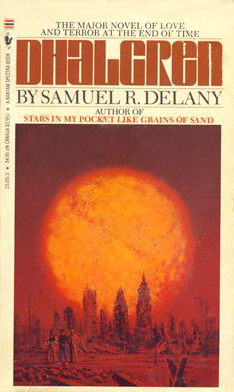
Cover of Dhalgren


Dhalgren
Samuel R. Delany
879 pages
published in 1975

Question: what are the two places man will never reach? Answer: the heart of the sun and page 100 of Dhalgren.

A corny old joke, with a kernel of truth because Dhalgren is not an easy book to read. Almost 900 pages long it’s a monster of a book, even more so when you remember it was published at a time when any science fiction novels over 200 pages was a bit on the long side. And unlike certain modern novels of that length, Dhalgren demands your attention on every page; you can’t get through it on the autopilot. It’s therefore no wonder that it took me most of February to read it, with no time for other books. But it was worth it as even almost forty years later this still is one of the most ambitious and challenging science fiction novels ever written.

Some people think it’s the symbol of everything that went wrong with science fiction. That “joke” I opened is less a joke than a sneer, repeated by people still mad at what the New Wave did to science fiction though they were born long after it. According to them Dhalgren is dense, impenetrable and unreadable, elitist fodder for literary snobs. What really sticks in their craw though is that Dhalgren was one of the biggest science fiction bestsellers of the seventies, going through fifteen printings between 1975 and 1980. Somebody must’ve liked it; in fact, like Dune or Stranger in A Strange Land, much more palatable bestsellers to these embittered fans, it must’ve appealed to people outside science fiction’s core readership.

Read more:

Your Happening World (August 2nd through August 6th)

Finally

Wiscon has permabanned Jim Frenkel. It’s about time. This is something that should’ve been done last year, not at the end of a cackhanded “process” seemingly more designed to provide the illusion of concern rather than any real understanding of what needed to be done. With another, unrelated harassment case still being decided, Wiscon isn’t out of the woods yet. Far from it in fact, even when the second case has also been resolved.

Wiscon has shown itself not be serious about protecting its members against harassment and far too understanding of the needs of the harassers. It now needs to rebuild trust in the community and show that it can learn the lessons of this disaster, as Readercon did before it.

Liking problematic writers

I don’t know when I first started reading science fiction, but it must’ve been no older than seven or eight years old, going to the library on friday evenings with my mum and browsing the children’s bookshelves (that is until, inevitably and like so many others, I’d read everything in them and went on to the adult stacks). The first books I can remember reading were by Isaac Asimov: Buy Jupiter, I, Robot and a bit later the Foundation trilogy. One of the first books I bought for myself was The End of Eternity. I read everything of Asimov I could get my hands on and thanks to his writer, got to discover Clarke and Heinlein and Bradbury and all those other sf writers I’ve read since.

One of the things that made his collections so great was how chatty he was in them, writing introductions to each story, talking about how his life was going at that time, how he got to write those stories etc. From those, especially those in his later books, I slowly got the impression he was a bit of, as he would also call himself, a dirty old man, a lecher, somebody who had an eye for the women, all those other things we’d used to call men who were a bit dodgy regarding women, a bit too randy but harmless, and really, what’s the harm in being hold down by two strangers so dear old Isaac can grab your breasts?

Now of course you always hear that you shouldn’t judge the work by the person, but the more I hear about how much of a serial harasser Asimov was, the less comfortable I become keeping his books on my shelves. Fortunately for me I can justify it for myself because a) he’s dead and b) every one of those had been bought secondhand, so it’s not like I’ve been directly given money to a harasser…

A more difficult example is Elizabeth Moon, who back in 2010 said dumb, xenophobic things about Muslims. Which was one of those things I didn’t pay a lot of attention about at the time, but since then I’ve been reading a lot of Elizabeth Moon and it worries me now. Partially because, you know, I’d rather not give money to wingnuts if I can avoid it but also because that sort of politics has a tendency to bleed into a writer’s novels. Case in point: Dan Simmons.

Luckily again, Moon seems to have behaved since that outburst and so far her politics, as far as they appear in her novels may be on the conservative side, but nowhere near wingnut territory. Therefore I can justify keeping her books, which is a good thing, as I like them. unlike say Orson Scott Card, who has awful politics and who doesn’t write books anymore I like anyway. For the most part I’ve been lucky that the writers I like aren’t arseholes and those that are I don’t like.

Books read July

Because I decided to go to Loncon as you may have noticed, this month my reading was dominated by Hugo related works, but I still managed to fit three more novels than last month in:

Hurricane Fever — Tobias Buckell
A fast moving near future thriller set in a Caribbean menaced by almost constant hurricanes. Read because Tobias Buckell was kind enough to provide a review copy.

The Lives of Tao — Wesley Chu
Wesley Chu is one of the candidates for the Campbell Best New Writer award this year and this provided as part of the voting package. A decent adventure read, but nothing special.

A Stranger in Olondria — Sofia Samatar
Another candidate for the Campbell, Sofia Samatar got my vote on the strength of this novel, a fantasy travelogue set in a world that’s not your average medievaloid setting.

Three Parts Dead — Max Gladstone
Another candidate, this was a great secondary world/urban fantasy story about a chartered accountant (more or less) investigating the death of a god.

Moon over Soho — Ben Aaronovitch
An urban fantasy murder mystery set in contemporary London; part of a series.

Six Gun Snow White — Catherynne M. Valente
My vote for the Best Novella Hugo, this retelling of the Snow White fairytale set in the Wild West, was published as a short novel. (And would’ve been a normal length novel forty years or so.)

Deep Wizardry — Diane Duane
Second in the Young Wizards series. This almost made me cry. Almost.