The Hugo Awards: things I won’t consider (I)

I’d been dithering about going to the Worldcon this year, even though it’s rare that it’s held inside Europe, partially because it’s been such a long time that I’ve been to a proper con and would I not feel uncomfortable going to the biggest of them all. However when Rose Fox turned out not to be able to go and offered their membership for sale I took the chance. So now I just need to book a hotel and a train journey and I’m there.

Oh, and I have slightly longer than a month to decide what to vote for in the Hugo Awards.

Here’s how I’m going to do this: I’m of course going to blog about it, so I’m laying down some ground rules. First, I’ll have to address the rightwing attempt to turn the Hugos into a propagandafest. That’s easily solved: everybody on this slate is disqualified and won’t appear on my ballot.

This includes:

  • Best Novel: Warbound, Book III of the Grimnoir Chronicles by Larry Correia (Baen Books)
  • Best novella: The Butcher of Khardov by Dan Wells (Privateer Press)
  • Best novella: The Chaplain’s Legacy by Brad Torgersen (Analog, Jul-Aug 2013)
  • Best Novelette: The Exchange Officers by Brad Torgersen (Analog, Jan-Feb 2013)
  • Best Novelette: Opera Vita Aeterna by Vox Day (The Last Witchking, Marcher Lord Hinterlands)
  • Best editor Long form: Toni Weisskopf
  • Best fanzine: Elitist Book Reviews edited by Steven Diamond

All these won’t be taken into consideration, won’t be read, won’t appear on my ballot.

There’s one other borderline entry on the Hugo ballots,The Wheel of Time series, which is slightly dodgy for two reasons. One, it’s a complete series put on the novel ballot under the idea that it’s one single book split up in parts and two, people campaigned for it in honour of Robert Jordan. The latter I have no problems with, as the people who nominated it did it out of a genuine appreciation of Jordan and his work. Remains the question, is it a single book?

Not to me. I find this stretches the definition of single book too far and hence won’t be putting it on my ballot. To be fair, even if had put it on the ballot I’ve read enough of the series to know it would’ve finished dead last. I like Jordan and will always appreciate The Wheel of Time for getting me through some dark times, but it’s not good enough for a Hugo Award.

So those are the works that drop off immediately for me. In the next post: which categories to exclude. I have opinions.

(Updated for pronoun errors.)
Hipster racism

Ironic racism, Lester Bangs nailed more than three decades ago:

Another reason for getting rid of all those little verbal barbs is that no matter how you intend them, you can’t say them without risking misinterpretation by some other bigoted asshole; your irony just might be his cup of hate. Things like the Creem articles and partydown exhibitionism represented a reaction against the hippie counterculture and what a lot of us regarded as its pious pussyfooting around questions of racial and sexual identity, questions we were quite prepared to drive over with bulldozers. We believed nothing could be worse, more pretentious and hypocritical, than the hippies and the liberal masochism in whose sidecar they Coked along, so we embraced an indiscriminate, half-joking and half-hostile mindlessness which seemed to represent, as Mark Jacobson pointed out in his Voice piece on Legs McNeil, a new kind of cool. “I don’t discriminate,” I used to laugh, “I’m prejudiced against everybody!”

‘E that were tense

So the first half was shaky enough already and then the Mexicans scored and so up until the 88th minute I thought “this is it, we’re going home. And then Sneijder scored a wonder goal to keep us in, Robben did his usual dancing around the box, tripped over a defender’s leg and got a fortunate penalty, roughly like this:


And of course it was Klaas Jan Huntelaar, left on the sidelines until now, who took the penalty and scored. Watching the buildup was as nerve wrecking as anything I’d ever seen in football, so tense I had to call my mum, who was also watching. And then of course it was buttock clenching time until the end whistle went.

But we did it.

Your Happening World (June 27th)

  • The Transformers and the Middle Ages – Having been a boy of a certain age in the 1980s, I was one of the many, many fans of the cartoon show The Transformers (confession – I still watch the show on occasion, and have a collection of the toys in a box in my basement). Now, as the fourth live-action Transformers film hits the screens, I want to take you back to when the Autobots and Decepticons went medieval!
  • Sibilant Fricative: Ian Watson, Mana (Lucky’s Harvest, 1993; The Fallen Moon, 1994) – I’ve been holding back writing about Watson’s two Mana books, for reasons to do with that mode of debilitation called ‘but where to start?’ Given my peculiar academic background, and the topic of my PhD, excuse me if I open with a completely left field comparison to Robert Browning. A critic once described Pauline, Paracelsus and Sordello as like ‘three dragons, guarding the entrance to the gold of Browning’s mid-career poetry’. You see what he means: however much you enjoy ‘My Last Duchess’ and ‘Andrea Del Sarto’, you know that you can’t get a proper sense of Browning’s work without tackling the three brontosaur-sized texts with which he commenced his career.
  • Britain’s Nuke-Proof Underground City – The Daily Beast – As the world held its breath during the Cold War, England built a top-secret underground city to save its government in case of nuclear attack. For half a century, "Burlington" lay ready.
  • Is Ann Leckie the Next Big Thing in Science Fiction? | Riverfront Times – The Nebula, Arthur C. Clarke and Hugo awards are the Triple Crown of science-fiction writing. If Ancillary Justice claims the Hugo, it will become the first novel to win all three. After years toiling in obscurity, Leckie's given up trying to wrap her mind around how quickly she and her gun-slinging, galaxy-traversing heroine, Breq, have climbed to critical and popular adoration.
  • Trinity: The Black Fantasy. – But who could blame Harmony? What black woman wouldn’t envy Storm? Storm had no need of relaxers or sunny Saturdays spent beneath the searing metal of her grandmother’s pressing comb. She never sat patiently while a beautician sewed blonde ringlets to her head to hide her tightly woven brown cornrows from view. Her hair was naturally straight. Her hair was naturally light. She was born conforming to the majority of our society’s beauty norms. She was born not looking like all the other little black girls. And because of that, she was lauded as beautiful. Because of how not black she appeared to be.

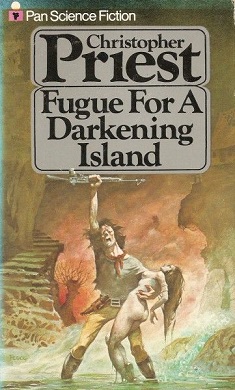
Fugue for a Darkening Island — Christopher Priest

Cover of Fugue for a Darkening Island


Fugue for a Darkening Island
Christopher Priest
125 pages
published in 1972

There are certain protocols you have to take into account as a reviewer when discussing the books of a new, young writer. Protocols that are still in effect when the author has aged more than forty years since the first publication of his novel and has become a grand old man in the meantime, prone to gently correcting younger writers. Anything that can be said about Fugue for a Darkening Island has to be tempered by the realisation that it is a fortytwo year old novel, not necessarily indicative of the writer Priest now is.

But the truth remains that Fugue for a Darkening Island is a problematic work, a novel with its heart I think in the right place, but which features certain unfortunate themes in Priest’s work that will return in later novels, somewhat muted. I’m thinking of last year’s The Adjacent, featuring a near future Islamic Republic of Great Britain as well as the much earlier A Dream of Wessex which had parts of Britain as a caliphate, but also of The Separation and its naive story of a better world created by a separate peace between nazi Germany and Britain. In short, Priest sometimes goes for settings you’d sooner expect to see in the stories of the more reactionary Baen writers and A Fugue for a Darkening Island is one of those novels, a near future Britain ripped straight from the front pages of National Front propaganda, as the country is flooded by a never ending stream of African refugees destroying the British way of life, its hero a decent middleclass Englishman trying to find a new home for him and his family.

Read more…