Colouring in the science fiction canon

Chauncey de Vega is one of the smartest bloggers I’m currently following and he’s not wrong about the science fiction canon:

The Real History of Science Fiction is an example of how the idea of “canon”, i.e the required “serious” work written by “serious” people that all “serious” students should learn and model themselves after, and that the public embraces as “important” because someone who is “smart” told them so, perpetuates “unintentional” white supremacy (as well as sexism, homophobia, and other types of discrimination).

“The canon” is the result of a type of path dependent decision-making that normalizes the world as seen from the perspective of the in-group–while ignoring the foundational question(s) of how disparities of Power have naturalized what is understood by them (and some others) to be commonsense, matter of fact, taken for granted, reality.

Which raises the question of how to build up a more representative canon, when people of colour have been writing science fiction for as long if not longer as white people have yet are rarely recognised beyond Butler, Delany and possibly Hopkinson.

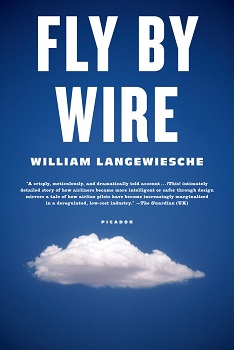
Fly by Wire — William Langewiesche

Cover of Fly by Wire


Fly by Wire
William Langewiesche
193 pages
published in 2009

I bought Fly by Wire because Alex raved about it a while back. It’s subtitle, “The Geese, The Glide, The ‘Miracle’ on the Hudson” might clue you in that it’s about that US Airways flight that had to crashland in the Hudson back in 2009, after having been hit by geese. Langewiesche is a reporter who has written several books about aviation and here he explains not just what happened that day, but also what made it possible for the pilot, Captain Sullenberger, to land it the way he did and how this fits in with a more general philosophical debate on airplane controls.

An interesting subject, but to be honest I was a bit disappointed with the book as I was expecting something more in-depth after Alex’s review. What it instead reminded me off was one of those interminable New Yorker articles which take a single incident to illuminate a larger social trend. Langewiesche tracks the accident as it evolves, then cuts away to explain one aspect, goes back to the accident, cuts away, ultimately ending when Sullenberger has set down the plane and the rescue boats have brought everybody to the shore. On the whole it was decently done and not nearly as annoying to read than if it had been spread out over ten pages in an online article, but it could’ve done with a bit more depth. Also footnotes.

Read more…

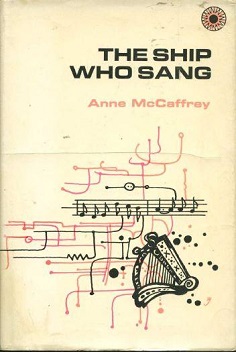
The Ship Who Sang — Anne McCaffrey

Cover of The Ship Who Sang


The Ship Who Sang
Anne McCaffrey
205 pages
published in 1969

Some writers you can only appreciate if you discover them in the golden age of science fiction — twelve — because at that age you’re less likely to notice the two dimensional characters, slipshod plotting or obnoxious politics you would’ve noticed as a more experienced reader. McCaffrey is such a writer for me. I loved her books when I was twelve and reading them from the local library, but trying my hand at some of her later works ended in disappointment. There’s also the danger of rereading cherished childhood classics and finding that in hindsight, they’re not so great after all. With McCaffrey’s early Dragonriders novels I already took that gamble and got lucky, now I’ve reread perhaps her best known novel outside that series and see if The Ship Who Sang was as much of a tearjerker as I remembered.

Sentiment is an underrated emotion in science fiction, something we’re a bit embarrassed about, but which plays a greater role than you’d expect in such a “rational” genre. Quite a few classics thrive on it — “Helen O’Loy”, “Green Hills of Earth”, “Faithful to Thee, Terra, in Our Fashion” all spring to mind — and as I remembered The Ship Who Sang, it positively wallowed in it, in this story of a severely disabled girl whose only hope for any sort of life was to become the “brain” of a spaceship, who then found love in the arms of her “brawn” partner only to lose him to cruel, cruel fate. The perfect sort of story for a sensitive twelve year old, but would it hold its appeal?

Sadly, no

Reclaiming Heinlein

Natalie Luhrs is unhappy about John Wright’s invocation of Robert Heinlein to bolster claims of witch hunts against rightwing science fiction writers:

So when someone like John C. Wright holds up Heinlein as the best SF writer ever, I have to wonder what world they’re living in. An important writer in the genre, absolutely. The best ever? Really? Way to declare the race over before everyone’s even gotten to the starting line, buddy.

Because that’s what he’s doing, right? He’s trying to draw a line around SF. In Wright’s world, there’s no room in SF for people who aren’t like him and, furthermore, no one’s work can ever come close to that of a man who died in 1988. That’s just. No. I don’t want to read that kind of SF anymore. I did my time there and it’s well past time to move on.

It all started when Wright flounced out of the SFWA claiming to have been subjected to harassment, though refusing to provide evidence of this. Wright went on to further clarify his motivation and the situation science fiction was in through a long post at the Intercollegiate Review, claiming that Robert Heinlein could not win a Hugo Award today:

At one time, science fiction was an oasis of intellectual liberty, a place where no idea was sacrosanct and no idea was unwelcome. Now speculative fiction makes speculative thinkers so unwelcome that, after a decade of support, I resigned my membership in SFWA in disgust. SFWA bears no blame for all these witch-hunts, or even most; but SFWA spreads the moral atmosphere congenial to the witch-hunters, hence not congenial to my dues money.

In his article Wright provides several examples of people supposedly chased out of sf fandom or otherwise punished for their opinions, a veritable who’s who of rightwing jackasses confusing criticism for harassment, including Vox Day, Larry Correia, Orson Scott Card and Elizabeth Moon. (The truth is of course rather different than how Wright presents it.)

In her own response to Wright’s article, Rachael Acks wonders why Wright’s so sure a modern Heinlein would’ve been held the same opinions as people like Day or Orson Scott Card in he first place:

I’m also forced to wonder at the implied assumption that, had Robert Heinlein been born in 1977 (or 1967) instead of 1907, he would be writing the exact same stuff in 2014 that he wrote in 1954 (The Star Beast) or 1964 (Farnham’s Freehold–holy shit, I hope not!). Feels kind of insulting to him that if he’d grown up in a different time he wouldn’t have maybe had some different opinions, but I guess that shouldn’t be surprising coming as it is from someone who has attitudes about gender roles that might have been more at home in the Victorian era.

In his article Wright also talked about law and custom and the differences between them, which annoyed somebody who actually makes her living as a lawyer enough to strike back with Heinlein references of her own:

As an aside? I don’t think Dr. Harshaw would agree with your superficial assessment of law versus custom. (Nor with your extensive ramblings on morals, given his comment on “Customs, morals – what’s the difference?” followed by his description of what you consider moral absolutes as “the psychotic taboos of our tribe.” In fact? You’re a textbook example of Harshaw’s definition of a prude: a person who believes “his own rules of propriety are natural laws.” Dr. Harshaw could admit that his own tastes were not the arbiters of what is correct for all people. You cannot.) Yeah, people who think like you don’t have a lock on allusions to Heinlein’s body of work, any more than you have exclusive license to make 1984 references. You will, as they say, deal.

Heinlein died in 1988 so it’s been easy for rightwingers like Wright to hijack his image and twist it into a caricature of the man, into somebody who of course would agree with them and by on their side in their culture wars. But the truth is that Heinlein was always much more complex than that, willing and able to change his views when he needed to and more likely to have laughed at Wright’s pretensions than agreed with them. He may have been rightwing, but he was never the small minded hobgoblin his “fans” want to make him into.

Heinlein after all was the man who went from “homosexuality is a disease” in Stranger in a Strange Land to having his characters not bothered about the gender of the people they slept with in Time Enough for Love and sequels. He’s the man who saw reds under the bed and argued for continued nuclear tests to keep America strong, but who also made the hero of Starship Troopers Filipino, the protagonist of Tunnel in the Sky black.

You cannot reduce Heinlein to a one dimensional “greatest science fiction writer ever”, you have to take his influence warts and all. He was wrong often, but he wasn’t wrong always and he was willing to learn when he was wrong. Science fiction is richer for his contributions, but not if we hold him up as a model to slavishly follow; he himself would be the first to know that would be pointless.
Books read April

As I seem to be complaining each time I do these, I still read too little. This time it’s only been five books.

Blood Trail — Tanya Huff
The second Blood urban fantasy novel, where ex-policewoman Vicki Nelson is hired by a family of werewolves to find out who is killing them.

A Biography of No Place — Kate Brown
The 2oth century history of the historical borderlands between Poland and Russia, now in the heartlands of Ukraine and how they were shaped from multi-ethnic borderlands into largely Ukrainian lands.

Zero Sum Game — SL Huang
Debut novel of a blogger who kept saying sensible things on her blog, so I got this from Kobo Books; first ebook I’ve ever bought. This is a technothriller about a math savant whose math skills are so instinctive that they allow her to dodge bullets.

A Soldier’s Duty — Jean Johnson
Yes, I have a weakness for even dodgy mil-sf. I know literally nothing about this book or its author when I picked it up, but it looked interesting. A precog fifteen year old girl sees a future in which the entire galaxy is laid to waste and the only chance of humanity’s survival is if she becomes an interstellar marine.

Blood Lines — Tanya Huff
Third novel in the Blood series. After vampires and werewolves, what is more logical than to feature that other classic Universal monster, the Mummy?