Aaaaaaaciiid!


So I’ve gotten a bit obsessed with this song the past week, which anybody of the right age will of course recognise as one of the first house megahits, Coldcut featuring Yazz with Doctorin’ the House, from that great 1988-1990 period when suddenly house broke into the pop charts. I turned fourteen the year this was a hit so at the perfect age to appreciate this revolution in music, had I not been a teenage metalhead already. Real appreciation for house would only come years later and it was only by going through the Popular archives that I realised what a golden age the late eighties and early nineties were for electronic dance music. Take this for instance:


That’s the other song that’s been obsessing me, the one that seemed to kick it all off at the time. The first acid/house song I’d ever heard and which set the pattern for all those other hits that would follow:


(That’s Krush, with house arrest, briefly making Sheffield fashionable). Danceable beat, preferably using some old soul classic as the base, lots and lots of samples, some electronic weirdness and a pretty woman doing the vocals. Though of course the woman in front may not actually be doing the vocals you hear on the record. Case in point:


No, that’s actually the voice of Loleatta Holleway, whose vocals from minor hit Love Sensation were chopped up and moved about to create a much tighter. arguably better song, the only problem being that she wasn’t credited for it until she made a fuzz about it; a later mix of Ride on Time would have Heather Small sing instead. Let’s end on a high note though, with the most mellow hit of 1990, about halfway through the transformation of ex-Housemartin’s Norman Cook into Fatboy Slim, Beats International with Dub be Good to Me, which took the formula of reworked soul classic with danceable beat, crazy samples and female vocals and perfected it:


EDIT: is this really already twentyfive years ago? But that would mean the Second Summer of Love is now older than the original Summer of Love was at the time. Which would mean I’d be turning forty this year and that’s clearly wrong.
Rather than give wingnuts the benefit of the doubt, try these

John Scalzi gets it wrong with the Hugos:

Please also keep in mind that even if you believe that the list is a cynical exercise, there are people and work on that list who may be well worth consideration, who may or may not have even known they were part of (or would have consented to) being part of a cynical exercise. Consider that you would be doing them (and the Hugos) a disservice to dismiss them out of hand. I’ve seen rumblings of people suggesting they’ll put everyone on the Correia/Day slate below “no award” no matter what, but if you’re doing that, you’re making these fellows’ alleged point for them. Again: Why do that? It’s nearly as easy to read a work (or at least, read as far as can) and decide it’s just not for you. And if it is for you, well. Surprise!

No, you can’t and shouldn’t attempt to judge books or stories on merit that are on the shortlist as a political gesture. You can’t take the politics away and any gesture at judging on “merit” is naive or disingenious. If you don’t want the Hugo to become yet another front in the rightwing war on culture, the only sane thing to do is reject any and all of these nominations. Pretending that doing anything else is value neutral or objective harms those this stunt was aimed at, the women, people of colour and others whom the initiators want to drive out of science fiction. As Rose Lemberg argues, doing so also marginalises yet again exactly those voices:

Also, conciliatory statements often have the effect of diverting the attention yet again (along with the accompanying social praise and support) from the marginalized voices to the power brokers, thus increasing the social capital of those who already have it, while marginalized voices go unpromoted and unsupported – unsupported often in context of vicious attacks from those who deny Diversity Age fans their personhood.

People like Vox Day and Larry Correia and, yes, John Scalzi already get too much attention and consideration just for being straight white males, with all the privileges that entails (something which Scalzi to his merit of course has long realised). Even being outraged at the Correia/Day stunt is once again talking about the same sort of people we always talk about, rather than the people we should be talking about more.

So who and what should we be talking about? Here are some suggestions for further reading:

Anything else that should be on this list?

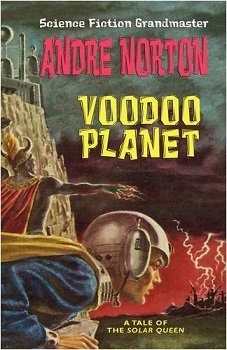
Voodoo Planet — Andre Norton

Cover of Voodoo Planet


Voodoo Planet
Andre Norton
192 pages
published in 1956

Genre science fiction got its start in the pulp magazines of the twenties and thirties and many of its early writers were just pulp authors writing the same old stories they’d always written, just with some sf flavourings. So instead of the brave sheriff depending on his horse and trusty six gun to fight off the bandits out in the Oklahoma badlands, you got the brave space marshall depending on his trusty rocket and raygun to take out the bandits hiding out in the Martian badlands. It’s this what fans meant when they talked about space opera, before that got co-opted for something more respectable, crappy fake science fiction stories that might just as well have been westerns. As the field matured and new writers moved in actually interested in science fiction as a genre, these stories quickly disappeared.

Or did they?

Tintin versus the big noses

Rudi de Vries’ dissertation Comics and co-evolutions : a study of the dynamics in the niche of comics publishers in the Low Countries, attempting to explain why the Dutch comics industry lags behind that of France and Belgium, sounds interesting:

Hergé’s exciting but wholesome adventures of Tintin were originally published in a refined Catholic magazine, and soon found their way to France and the Netherlands. The ‘big nose’ style favoured by Dupuis, publisher of the Robbedoes comic strips, became very popular, inspiring Goscinny and Uderzo, the creators of Asterix. De Vries: ‘The fierce rivalry that developed between the Belgian publishers only served to stimulate production.’ Cartoonists like Hergé (Tintin), Morris (Lucky Luke), Peyo (Smurfs) and Franquin (Guust Flater or Gaston) grasped this opportunity to exercise their influence on the development of comic culture.

[…]

The Dutch comic culture is lagging behind the rest of the world. The swift rise of comics in Belgium and France can be traced back to historical developments. Back then, Dutch publishers were happy with translations of foreign comic strips. De Vries: ‘There are other reasons for Dutch comics failing to thrive, but they are more difficult to pinpoint. I think it has something to do with our Calvinistic outlook on life.’

The complete dissertation can be downloaded from the University of Groningen website. Found via Dutch comics journalist/blogger Michael Minneboo through the interview (Dutch only) he did with de Vries last year.

Kick out the jams motherfucker!


So in 1989-1990 when the KLF broke through with their Illuminantus! influenced house I was in the perfect position to be susceptible to them, having just myself gotten Robert Anton Wilson and Robert Shea’s classic hippie drugs, sex and conspiracy out of the secondhand bookstore myself. For a while when I was fifteen-sixteen it was my bible (could’ve been worse, at least it wasn’t Ayn Rand), so hearing the Justified and Ancients of Mummu refered in dance music just knocked me off my feet. It felt dangerous and modern and nerdy but in a cool way.