The Dispossessed — Ursula K. LeGuin

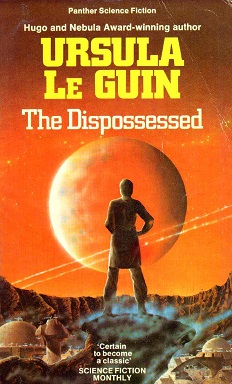
Cover of The Dispossessed


The Dispossessed
Ursula K. LeGuin
319 pages
published in 1974

After the Earthsea trilogy and of course The Left Hand of Darkness, The Dispossessed is arguably Ursula LeGuin’s most famous novel. It was one of a small group of novels in the early seventies –including e.g. Joanna Russ’ The Female Man that took the American New Wave and science fiction as a whole into a much more explicit political direction. It’s a novel that’s still controversial today, or at the very least can still lead to heated debates. The Dispossessed has been hugely influential in radicalising whole generations of fans, while there are plenty of conservative science fiction fans for whom its is a symbol of everything that went wrong with science fiction in the seventies.

The Dispossessed, firmly in the utopian tradition of Herland and looking Backward is a travelogue, set on the double planets of Urras, stand-in for seventies America and Anarres, the “ambiguous utopia” of the subtitle. The protagonist Shevek is a brilliant young physicist whose passion for science leads him to travel from his anarcho-syndicalist home planet to Urras because there he hopes to find the support he needs to finish his thesis. In alternating chapters we get to see his journeys to and on Urras as well as his upbringing and life on Anarres.

Read more…

Comics by mail

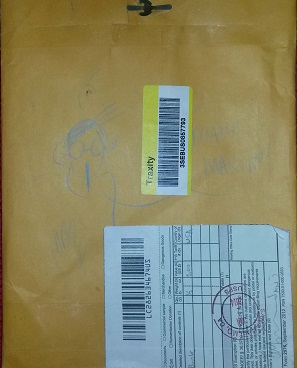
mystery envelope

It’s always a nice surprise to come home and find an international mail envelope on the doormat, especially when it comes with a drawing on the outside (barely visible above). Who was Sophie Yanow and why was she sending me mail?
three comics by Sophie Yanow

Well, it turned out this mystery envelope contained three comics and then I remembered. Back in december Tom Spurgeon had linked to her because she had her laptop stolen and was holding a sale to replace it. I’d looked at her site, liked the comics I saw so the choice to get some comics from her wasn’t too hard.

What made it even easier, and which is something I would like to see more professional publishers do, is the way Yanow has set up her online shop. No bother with setting up accounts, just let paypal handle everything. Shipping charges, often horrendous when dealing with importing comics from the US (their annual sale is the only time I can actually afford buying directly from Topshelf), were reasonable as well, only six dollars.

Self promotion: threat or menace?

Adam Roberts doesn’t like the modern science fiction writer’s habit of self promotion. John Scalzi gets a bit defensive about it and explains why a little bit of self promotion is cool, but it shouldn’t be too much. Enter Amal El-Mohtar, who gets annoyed by both of them and explains why these attitudes about self promotion hinder writers coming from marginalised groups:

No hand-wringing or tut-tutting about reading widely or behaving with dignity or integrity or what have you is going to end the practice of brash, confident people telling other people, often and obnoxiously, to vote for them. But, crucially, the hand-wringing and tut-tutting does have an effect: it discourages the people who already feel silenced and uncomfortable from ever talking about or taking pride in their achievements.

You cannot with one breath say that you wish more women were recognized for their work, and then say in the next that you think less of people who make others aware of their work. You cannot trust that somehow, magically, the systems that suppress the voices of women, people of colour, disabled people, queer people, trans people, will of their own accord stop doing that when award season rolls around in order to suddenly make you aware of their work. You MUST recognize the fact that the only way to counter silence is to encourage speech and make room for it to be heard.

To be honest the self promotion of writers like John Scalzi has always annoyed me, all that relentless hyping and huckstering doesn’t fit the fandom I grew up with. Yet Amal El-Mohtar has a point here. Not everybody’s voice is equal in fandom and some people need to shout twice as loud to get their voice heard. And if nobody else does it, you have to do it yourself. Mohtar’s post is where it clicked for me how complaining about self promotion and crass commercialism can be privilege talking, especially in the context of the Hugo Awards.

The truth is that science fiction fandom, certainly that part of it that is defined by e.g. the Hugo Awards, still isn’t as welcoming and diverse as it should be, while the world of science fiction as a whole is much much larger than encompassed by the Worldcon/Hugo Award tradition. I’ve long held that the Hugos have lost much of their relevancy because they’re stuck with a voting audience no longer representative of science fiction as a whole. If left alone, these will keep voting for the same sort of writers they always vote for. Efforts to promote new and underrepresented writers therefore should be lauded, not scoffed at.

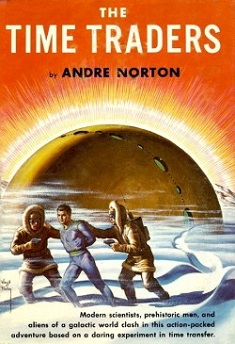
The Time Traders — Andre Norton

Cover of The Time Traders


The Time Traders
Andre Norton
191 pages
published in 1958

If it wasn’t for Project Gutenberg I might’ve never read this novel. Though Andre Norton was one of the most prolific US science fiction writer, mostly writing what we’d now call young adult novels, she never was translated into Dutch much so was missing when I went through my personal Golden Age. It’s only in the last couple of years that I’ve started to catch up with her, in no small part thanks to Gutenberg’s collection of her works. Because until roughly the seventies, American copyright was only valid for a limited time and had to be explicitly renewed, a lot of science fiction pulp and early paperback stories entered the public domain. In this case, the copyright on the original 1958 hardcover publication of The Time Traders was never renewed, making it fair game for Gutenberg.

I picked this out of the available Nortons for two reasons: it was the first book in a series and more importantly, it was a time travel story. It had been a while since I’d last read a good, old fashioned time travel story and this seemed to fit the bill perfectly. After all, it has time agents who have to travel undercover through prehistoric times to find the ancient civilisation from which the Soviets are getting sophisticated weaponry and technology they couldn’t have possibly produced themselves.

Read more…

We will make it to the ships


Those are my people and this is the attitude C.S. Lewis warned against in That Hideous Strength because his grubby little provincial mind could not understand it, other than as blasphemy born out of hubris. It’s the attitude that led generations of fans to set up slan shacks or Ozark breeding camps, led us to try out every kook idea that offered a shortcut to the stars, from the Dean drive to Velikovskism, but it’s also what drives hundreds upon thousands of scientists and engineers to dedicate their lives to building, guiding and following unmanned probes to the far reaches of our Solar System, on missions that seem to mock our own aspirations to ever get there ourselves as they reveal how hostile even our benign corner of the universe is and how big.