Those are my people and this is the attitude C.S. Lewis warned against in That Hideous Strength because his grubby little provincial mind could not understand it, other than as blasphemy born out of hubris. It’s the attitude that led generations of fans to set up slan shacks or Ozark breeding camps, led us to try out every kook idea that offered a shortcut to the stars, from the Dean drive to Velikovskism, but it’s also what drives hundreds upon thousands of scientists and engineers to dedicate their lives to building, guiding and following unmanned probes to the far reaches of our Solar System, on missions that seem to mock our own aspirations to ever get there ourselves as they reveal how hostile even our benign corner of the universe is and how big.
Books read December
And with ten books read in December, we say goodbye to a year that was somewhat disappointing in the quantity of books I read, if not the quality. Too much time spent on other interests, especially gaming, led to both reading and reviewing less. Of the eightyone books I managed to read in 2013, I’ve so far only reviewed twelve, plus three more from earlier years. It’s not doing much to reduce my backlog of to be reviewed books.
Turning to what I read in 2013, threequarters (61 books) of it was fiction: twothirds (40) science fiction, with the rest made up of fantasy (19) and detectives (2). The non-fiction (21) was mostly history (6) and warfare (7). I’ve had years with more diversity in my reading.
As ever since I discovered how few female writers I read, I’ve made an conscious effort to include as many as possible, at least in fantasy and science fiction. In science fiction, of the twentythree writers I read, five were male and eighteen female, including one writing duo (Sharon Lee & Steve Miller). In fantasy there were nine writers, with only Terry Pratchett on the male side of things; there were also two trans women included, Jan Morris and Caitlín R. Kiernan, though that was coincidence rather than deliberate inclusion.
What I want to do in 2014 is to continue to include more diversity in the writers I read, read more unknown writers, as well as make a dent in the backlog of old favourites I have. I also want to read more non-fiction, but that very much does depend on what I’ll find.
Anyway, here’s the last batch of books read in 2013:
Grail — Elizabeth Bear
Third and final novel in the Chill series. After centuries of being stuck in transit, the generation ship finally reaches its destination, only to find somebody else was there first.
Rosalind Franklin — Brenda Maddox
The biography of the woman who actually discovered DNA but was written out of the story by Francis Crick and co.
Voodoo Planet — Andre Norton
You know that if you read a lot of Golden Age science fiction, it becomes obvious that a lot of it is pulp adventure stories reworked to take place in space? Yeah, sometimes it’s really obvious, as with this story of a big hunt in pseudo Africa gone wrong and how western space science has to overcome superstition manipulated by an evil medicine man. (Has there ever been a non-evil one?)
Afrofuturism — Ytasha L. Womack
Afrofuturism is an art/political movement with roots in funk, science fiction and the black experience in America. This is a somewhat breathless exploration of the movement in all its facets, one of the most interesting and innovative things to happen to science fiction in the past few decades.
Crashcourse — Wilhelmina Baird
Wilhelmina Baird is an interesting writer: wrote some short science fiction at the dawn of the New Wave (as Kathleen James), then returned in 1993 with this, a cyberpunk inspired novel with overtones of the sort of fifties satirical sf Pohl and Kornbluth wrote. She wrote three more novels, two sequels to this, then disappeared.
The Defiant Agents — Andre Norton
A sequel to Time Traders, though not the direct sequel. A group of “Red Indians” (sic) is transported to an alien planet to colonise it, after first having lived through their past lives by way of racial memory to make them more suited to frontier living. Unfortunately the real Reds are their too, with a horde of Mongols as their slaves…
Operation Northwind — Charles Whiting
A disappointing history of the last German offensive in WWII, in Alsace. Whiting is too vague in his descriptions to give a clear picture of the fighting, somewhat too involved in his story of heroic yanks, dastardly Germans and waffling French.
Moxyland — Lauren Beukes
This was her debut novel, a dystopian (what else) cyberpunk story set in a not too distant future South Africa. Chillingly plausible is I think the best way to describe this.
Neptune’s Brood — Charlie Stross
A post-human historian-accountant stumbles over a thousands years old conspiracy spanning dozens of star systems that leads her to seek sanctuary with a colony of communist uranium volcano mining squid.
Then Will the Great Ocean Wash Deep Above — Ian Sales
Third in the Apollo Quartet of alternate history Cold War space exploration; not as good as the first two, sadly.
Remnant Population — Elizabeth Moon
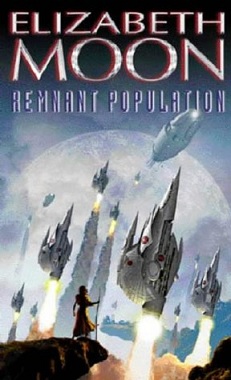
Remnant Population
Elizabeth Moon
360 pages
published in 1996
Elizabeth Moon is a writer I didn’t pay much attention to until a year or two ago. I’d read one or two of her books and they were competently written military science fiction, better written than those of a David Weber or John Ringo, but nowhere near as good as Lois McMaster Bujold’s. When I decided I needed to read more female science fiction writers, Moon was one of the writers I was giving a second chance. Since then I’ve read roughly half a dozen or so of her novels and my initial impression of her has remained roughly the same. She’s a better writer than she needs to be to sell the sort of stories she usually writes and there’s a bit of hidden depth in her mil-sf stories that’s missing from many of her colleagues, that hint at a greater potential. Yet she seems content to keep on writing the same sort of adventure science fiction and fantasy.
Not always though. On two occasions Moon has attempted to write something else than military science fiction, something more ambitious. The most well known of these two novels is of course her Nebula and Arthur C. Clarke winning 2002 novel, Speed of Dark. The other one is Remnant Population, which is a novel about First Contact, between the hitherto unknown indigenous population of an alien planet and the last remaining inhabitant of a failed human colony. As such, it’s a good case study of Moon’s strengths and weaknesses.
The Joy of ABBA
I’m mostly agnostic about ABBA: good pop music I’ve no real desire to put on myself but I wouldn’t turn off the radio if they came on. They were omnipresent when I was growing up and I know most of their hits. One thing I noticed a long time ago however is that they were far more sophisticated than their reputation as purveyors of plastic pop made them out to be. Many of their songs are actually deeply ambiguous about love and being in a relationship, even their most simple ones. The Joy of ABBA, shown above, is a BBC4 documentary which argues the same. I thought it might be interesting to look at some of their hits in this light.
Crashcourse — Wilhelmina Baird
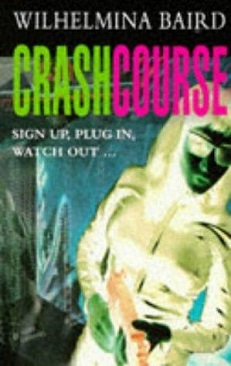
Crashcourse
Wilhelmina Baird
277 pages
published in 1993
Wilhelmina Baird is an interesting writer: wrote some short science fiction at the dawn of the New Wave (as Kathleen James), then returned in 1993 with this, a cyberpunk inspired novel with overtones of the sort of fifties satirical sf Pohl and Kornbluth wrote. She wrote three more novels, two sequels to this, then disappeared. She’s obscure enough not to even have a Wikipedia entry, so it’s unclear if she stopped writing or just couldn’t get published anymore. I vaguely remember that her second novel, Clipjoint, was hailed as a minor classic when it came out, but that’s all I knew of her writing when I first got this.
In the world of Crashcourse the population is divided in a small ruling class of Aris, slightly more Techs and Arts to serve and entertain them, with the vast mass of people being unemployed umps. Cass, Moke and Dosh are three of them, trying to earn enough (illicit) money to get off Earth, Cass as thief, Moke as artist and Dosh as whore. Caught up in a love triangle, with Cass loving Dosh who loves Moke who loves Cass, only wanting to leave if all three of them can leave together. That is, until Dosh is roughed up once too many by one of his clients and temptation comes calling in the form of an Aris with a film proposal.