Exclusion in comics

So Frank Santoro and Sean T. Collin discuss comics criticism, mentioning in passing the lack of women in this, prompting Heidi MacDonald to write a piece arguing that actually, they and the Comics Journal were part of the problem, in turn inspiring Annie Murphy to talk about what bothers her about the Journal’s culture:

So I’m saying, all this relates to the environment of comics at large, the confidence of women artists, and the inclusion of people besides just straight white men. Groth’s comment about what is ‘good’ or not is the rule, not the exception. I cannot tell you how many women, queers, people of color have told me that they used to draw but stopped completely after someone told them their drawing was not ‘good’, because it did not look like what the straight white men were drawing. I’ve heard this from dozens and dozens and dozens.

What Annie Murphy talks about here struck me as not too dissimilar from what we’ve seen in science fiction fandom, gaming or the skeptics community in the past couple of years, which is not too surprising as these all share the same DNA, the same makeup. These are or were all male dominated spaces, where women (and everybody not white and male) have always been treated with a certain hostility, tolerated if they fit in and pretended to be one of the boys. Some of this is done consciously, by the more meatheaded parts of comics fandom, but much of it is systemic and built into how the industry and the critical community are established and operate.

There’s a lot of unexamined privilege, a lot of systemic racism and sexism at work in the comics industry and not just at the big, commercial publishers; people who point that out are not always welcomed with open arms. In science fiction fandom similar problems are slowly being addressed, but I feel that comics fandom and the comics industry are years behind at this point

To get back to the Journal specifically, it’s culture has always been aggressive, from the Blood & Thunder lettercolumn to the famous Groth editorials. It’s an environment that punishes mistakes harshly and where people take pride in their toughness, again not dissimilar to e.g. programming culture, where it’s long know that this contributes to the lack of diversity within programming.
Norm Geras is dead

So it turns out Norm Geras has died. To be honest this wouldn’t matter to me one way or another, if not for the fact that his death has caused otherwise sensible people to behave as if a great intellectual has passed away (reaching dizzying heights here). It’s a repeat of what happened when Hitchens died, with even less justification.

Even the backhanded compliment flyingrodent gave that he “can’t imagine blogs without the Professor — Normblog really should be seen as the archetype of the form” is giving him too much credit. What Norm Geras did is no different from what the rightwing and “decent left” US warbloggers did and do: smear, lie, distort to manufacture outrage. The only thing Geras added was to play up his seventies marxist credentials to imagine how Marx and Engels would’ve totes supported the War on Iraq. Oh, and of course a certain sort of (imagined) upperclass English loquaciousness (e.g.).

In short, my opinion of Geras remains unchanged after his death, a bullshitter who used his writing talents to help make the world slightly worse, though only a minor offender compared to people like Hitchens.

Glory Glory Hallelujah

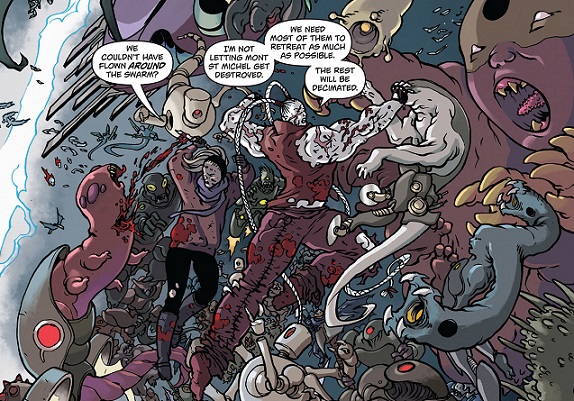
Glory in full fight

Stop me if this sounds familiar. Take an old Rob Liefeld superhero title, which never had been any good but had sold on hype back in the nineties, put some young up and coming creators on it, then make sure that whatever they do is nothing like what anybody expected when they first heard about the revamp, but is critically well received. This time it’s Glory, not Prophet we’re talking about. Sadly Glory didn’t quite have the same success as Prophet has had and it’s already been cancelled, but don’t let that stop you from trying it: there are only two trade paperbacks to pick up, for a total of twentyfive bucks, telling a complete if perhaps slightly rushed story.

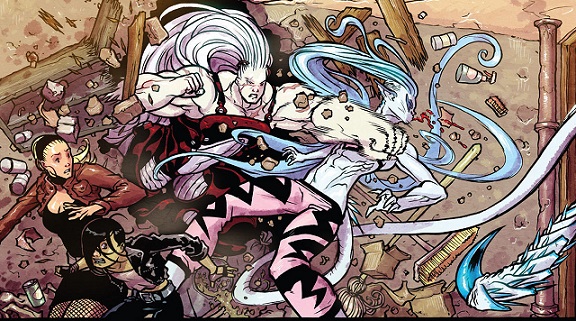
Glory meets her sister

Originally Glory was nothing more than a Wonder Woman clone with bigger tits and no personality. I’d forgotten that Jo Duffy handled the writing on her original series, but anything interesting she did was let down by the subpar artwork, by Mike Deodato and later on Ed Benes, two artists I’m continually surprised are still getting work. There also was an aborted relaunch around 2000, when Alan Moore was briefly working with Liefeld and proposed a new backstory for Glory, which only lasted two issues or so.

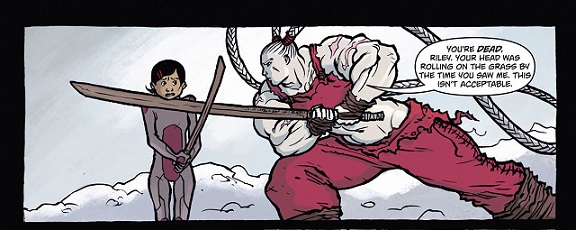
Riley and Glory

I didn’t know Joe Keatinge or Sophie Campbell’s work before I picked up the first Glory trade, but Sophie Campbell’s artwork looked interesting while people had said good things about Keatinge’s writing. Campbell’s Glory is huge, sticking head and shoulders above the other characters, massive,muscled arms and legs. Meanwhile the reader’s viewpoint character, Riley, is tiny, supposedly a young adult woman, but looking more like a child than anything else even amongst the human characters. As I said before, there’s a lot of gore, but Campbell is also good at drawing quieter scenes; I like her facial expressions, especially when people are laughing. Her artwork is manga influenced, but not in the usual way

Riley meets Glory

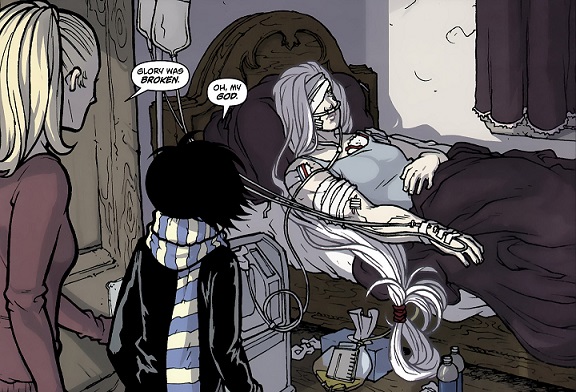
Riley has been haunted by dreams of Glory since she was a child, now she’s looking for Glory, whom nobody has seen in years or decades. She ends up in Mont St Michel, where she meets Gloria West (a nod to the Alan Moore series) who used to be Glory, but not anymore. The real Glory we first see in bed, injured, “broken”. She’s a victim of the war between her mother, ruler of a warrior clan once considered gods and her father, king of a people so savage they were once called demons. There’s more to this war than is at first revealed and Riley may have been drawn to Glory as to stop as to help her; Glory becomes a literal monster if pushed too far, while Riley’s dreams of Glory have reached the future and it’s not nice.

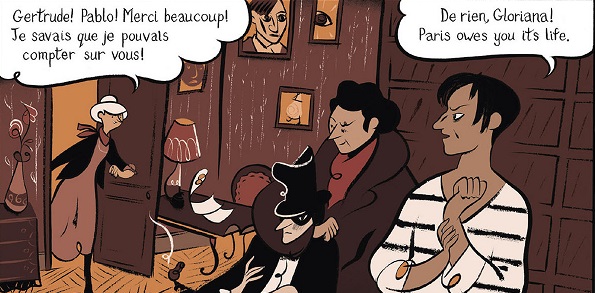
Glory with the Lost Generation, fighting Fantomas

But it’s not all doom and gloom; there are flashbacks of Glory running around 1920ties Paris with the Lost Generation fighting Fantomas. There’s Henry, the demon-medic with a fondness for ancient photo cameras. There are the allusions to her past adventures, some very lighthearted and silver agey. There are also Glory’s younger sisters, who are both awesome. But what impressed me the most was the casual, matter of fact lesbian relationship between Glory and Emilie, her sidekick/the Etta Candy standin, as well as later with Riley. In all, it’s a shame the series had to end so quickly, but at least we got a complete story.

UPDATE: since Sophie Campbell has gone public with her transition, I thought it only decent to update her pronouns here.

Two years

sandra watering the garden

Today it’s two years ago that Sandra died. Not a day has gone by that she hasn’t been in my thoughts. So much of who I am has been shaped by living with her, so much of my daily routine has its origins in hers. A part of her will always be with me.

The picture above was taking at my brother’s birthday in 2008. He has a gorgeous, large garden and Sandra was always a gardening enthusiast, so no wonder she took it on herself to water the plants. That year was the last year she was in anything resembling good health; she would get ill at the end of the year and start dialysis the next. This is how I like to remember her.