Books read October

I finally picked up the pace somewhat this month, with seven books read.

Fledgling — Sharon Lee & Steve Miller
Another free novel set in their Liaden universe, this is a classic coming of age science fiction novel, amusing but perhaps better read when you’re twelve.

1938 Hitler’s Gamble — Giles MacDonogh
A very useful overview of the political and military events that shaped the last year of peace before World War II, showing how opportunistic Hitler’s policies were.

Filthy English — Peter Silverton
An amusing overview of bad language of all kinds.

Vast — Linda Nagata
Hard science fiction of a subgenre that also includes Alastair Reynolds’ revelation Space and Paul McAuley’s Eternal Light: humantiy stumbles over the remains of a millions of years old war and is hunted to extinction by the left over killing machines of the war. I hadn’t read anything by Nagata yet, save for perhaps some short stories but on the strength of this she’s a writer I need to read more off.

The Battle for the Rhine 1944 — Robin Neillands
An overview of the campaign in western Europe from Normandy up until the Battle of the Bugle and very concerned with putting the record straight with regards to Montgomery’s part in the war.

The Eye with Which the Universe Beholds Itself — Ian Sales
Second chapbook in the Apollo Quartet, this is alternate history hard science fiction about a slightly more ambitious Apollo programme.

Child of the Grove — Tanya Huff
I like her military science fiction so I thought I’d check out her fantasy work as well. A decent but weirdly paced novel.

Gory Glory

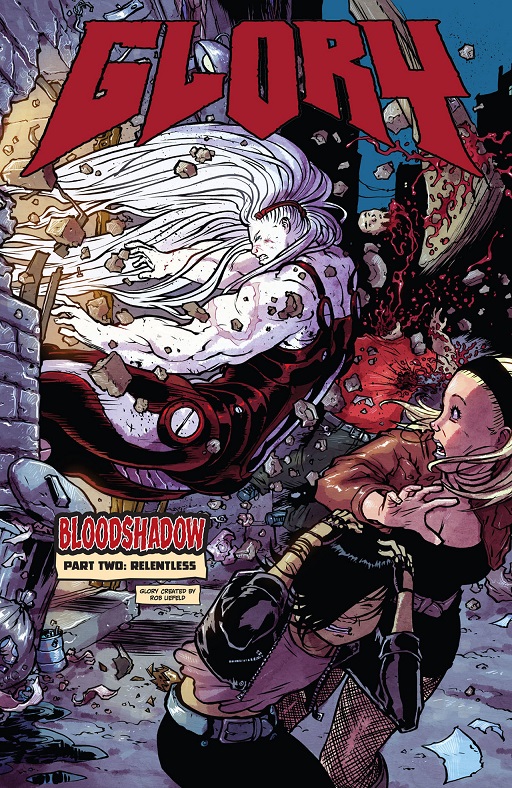
Something that annoys me a lot is when a supposedly adult television show bleeps out swearing. It feels so childish to swear and than cover it up, as if nobody can figure out what was said. In comics it’s even more obnoxious, as seen in this example from Glory #30:

panel from Glory #30 showing swearwords blacked out

Then the very next page this happens:

panel from Glory #30 showing a man getting his head split in two

Ouch.

So why is ultraviolence, though cartoony ultraviolence okay, but mild swears like shit or fuck have to be blacked out? It seems silly to worry about bad language when every other page or so somebody’s jaw is graphically punched off.

Not that this should stop you from buying Glory, which is an absolutely brilliant superhero comic somewhat overshadowed by the success of Prophet and Saga and sadly therefore already cancelled. Smart writing by Joe Keatinge, great art from Sophie Campbell. I should do a proper review of this some time soon.

UPDATE: since Sophie Campbell has gone public with her transition, I thought it only decent to update her pronouns here.

Boycotting Ender’s Game

Nick Mamatas reminds people that boycotting something really is an alternative to violence:

But if you were in favor of Rosa Parks and the civil rights movement and the bus boycott, even though a lot of other people got hurt, then there should be no issue with the much milder boycott of Ender’s Game. Tor Books is being left untouched. The studio’s other films are being left untouched. The movie theaters showing the film are being left untouched. This boycott is the caress of a pudgy little newborn baby hand against the cheek of hatred.

That’s part of why boycotts are necessarily collective. It’s a way of saying, “Look how many people you have annoyed. Would you really like to annoy us further?” Just think of all the pudgy little baby hands, reaching for your eyes…

The quality of the movie doesn’t matter. Nor does whether or not it would hurt other people if you boycott the movie. The latter is a confusion that also crops up with strikes a lot, as you always get the handwringing that innocent bystanders are disadvantaged by e.g. a railway strike. That’s the whole point. Strikes or boycotts should hurt or they’re pointless. The only thing that should matter is whether or not hurt Orson Scott Card’s ability to wage war on gay people by hurting him finacially.

Captain America

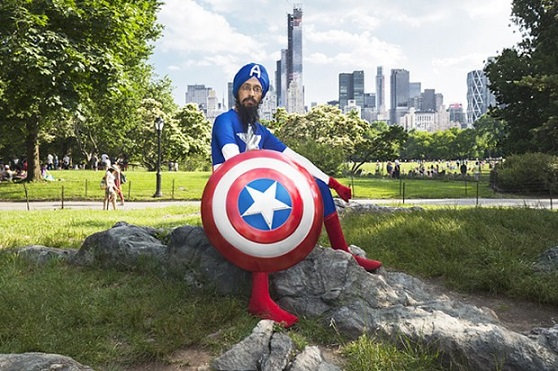
Vishav Jit Singh dressed as Captain America

So I was going to write a post about why I like Captain America, but Steven Attewell has already done it for me:

Because unlike other patriotism-themed characters, Steve Rogers doesn’t represent a genericized America but rather a very specific time and place – 1930’s New York City. We know he was born July 4, 1920 (not kidding about the 4th of July) to a working-class family of Irish Catholic immigrants who lived in New York’s Lower East Side.[1] This biographical detail has political meaning: given the era he was born in and his class and religious/ethnic background, there is no way in hell Steve Rogers didn’t grow up as a Democrat, and a New Deal Democrat at that, complete with a picture of FDR on the wall.

Steve Rogers grew up poor in the Great Depression, the son of a single mother who insisted he stayed in school despite the trend of the time (his father died when he was a child; in some versions, his father is a brave WWI veteran, in others an alcoholic, either or both of which would be appropriate given what happened to WWI veterans in the Great Depression) and then orphaned in his late teens when his mother died of TB.[2] And he came of age in New York City at a time when the New Deal was in full swing, Fiorello LaGuardia was mayor, the American Labor Party was a major force in city politics, labor unions were on the move, the Abraham Lincoln Brigade was organizing to fight fascism in Spain in the name of the Popular Front, and a militant anti-racist movement was growing that equated segregation at home with Nazism abroad that will eventually feed into the “Double V” campaign.

Then he became a fine arts student. To be an artist in New York City in the 1930s was to be surrounded by the “Cultural Front.” We’re talking the WPA Arts and Theater Projects, Diego Rivera painting socialist murals in Rockefeller Center, Orson Welles turning Julius Caesar into an anti-fascist play and running an all-black Macbeth and “The Cradle Will Rock,” Paul Robeson was a major star, and so on. You couldn’t really be an artist and have escaped left-wing politics. And if a poor kid like Steve Rogers was going to college as a fine arts student, odds are very good that he was going to the City College of New York at a time when an 80% Jewish student body is organizing student trade unions, anti-fascist rallies, and the “New York Intellectuals” were busily debating Trotskyism vs. Stalinism vs. Norman Thomas Socialism vs. the New Deal in the dining halls and study carrels.

And this Steve Rogers, who’s been exposed to all of what New York City has to offer, becomes an explicit anti-fascist. In the fall of 1940, over a year before Pearl Harbor, he first volunteers to join the army to fight the Nazis specifically. This isn’t an apolitical patriotism forged out of a sense that the U.S has been attacked; rather, Steve Rogers had come to believe that Nazism posed an existential threat to the America he believed in. New Deal America.

When handled properly, Captain America is a leftwing American icon; it’s no coincidence that he was created by two New York Jewish kids. In fact, he’s all but Jewish himself, even if the official backstory has him as Irish.It’s this background that makes it possible to imagine a Sikh Captain America, something much harder to do with a Superman or Batman.