is comics culture to blame for harassment?

So it turned out there were quite a few incidents of (sexual) harassment at the New York Comic-Con, one part of which was the ad campaign ran by the con’s sponsor, Arizona Ice Tea, with their ” I love Big Cans” hur hur innuendo. Though that sort of pseudo tittilation couldn’t have helped the atmosphere at the con, but Ulises Farinas calls out the much deeper link between comics culture itself and harassment:

There’s arguments about cosplay not being consent, which is such a broken debate because it takes place in a space where half the images being costumed are of characters that’s only existence depends on being a sexual object. SLAVE Leias and Wonder Women who’s only armor is a fucking bracelet. How can i expect any dude to understand some complex shit like white male privilege, when they prefer to spend their whole lives in echo chambers of caveboy spandex. Where every “strong female character” is just another fanboy fantasy with guns strapped on. All the elaborate justifications in the world can’t change the fact that Black Widow was introduced to us tied up, that despite years of slash fiction online and in zines, we’ll see plenty of lesbian witches but never one gay Captain America. That Uhura is an even less important character in Star Trek today, than yesterday. That because we loved pacific rim so much, we had to ignore the fact that it fails the bechdel test like every other movie, and…well..uhhh…lets just call it the Miyako test instead now. Fuck that shit.

I think she’s got a point, in that the immature sexual pandering and sexism in much of mainstream comics feeds into the mindset that thinks cosplayers are there to be groped. But this doesn’t mean it’s pointless for comics conventions to take measures against it. And while “white male privilege” may be “complex shit”, keeping your fucking hands to yourself and showing some minimum of respect to everybody at a con, fan or professional, isn’t above the reach of even the average fanboy.

I also think that the rise of cosplay, as an important, separate thread in comics fandom is a good thing. Cosplay isn’t new of course, but its popularity is and the amount of creativity and sheer craft put in it is amazing. It’s easy to dismiss it all as “slave Leias”, but the fact that this is a part of fandom in which women are in the lead, removes some of that “boy club” feeling lingering in comics fandom.
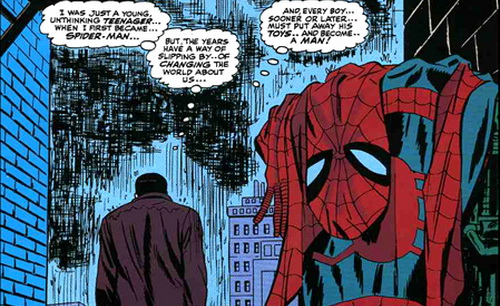

Hate comics. Hate superhero comics. Hate. Hate. Hate.

Peter Parker walking away from Spider-Man from Amazing #50

Alan David Doane is fed up with comics:

The thousands of dollars a year I once spent on comics will now be spent on other things. Rent. Groceries. Maybe the occasional movie. I still crave works that fire my imagination. I am as fascinated by the process of creating art as I am the art itself. Moreso, really. The mysteries of imagination seem like a puzzle too complex for human minds to ever fully decode. I can’t just watch a movie or TV show and lose myself in it, I am constantly pondering the process of its creation. There aren’t any superhero comics anymore that beg that question the way Kirby’s did, or Ditko’s, or whatever genius you think of when you think of the gods of comics creation. I do know that few walk the earth anymore. Fewer still seem to aspire to the heights those gods once reached.

I know the feeling. For me I reached it one sunny day in 2000 at the Haarlem comics con when I suddenly and utterly became fed up with comics: reading them, collecting them, byuying them, thinking about them. I just stopped going to my local comic shop and stopped cold turkey. This didn’t last too long, but for a couple of years I paid no attention whatsoever to comics and felt the better for it. If you have an obsessive personality, the fanboy mentality, comics can leave you feel as bloated and nauseous as gorging yourself on junk food does. Especially during those times, like now, when comics don’t seem worthy of such an obsession.

Of course much of that problem is being obsessed with superhero comics, which even at their best are apt to be unworthy of such devotion, disposable mass culture filler that they are. Having that week in, week out involvement with Marvel or DC superhero fandom, with the constant bombardment of low level manipulation and betrayal, all those cynical event comics that never change anything or are remembered a year after, the rape as plot device, all those deaths of minor characters to show how evil the villian du jour is, all that relentless negativity that being a fan of mainstream superhero comics entails, that wears a body down.

Best thing anybody can ever do is stop doing that weekly grind and just follow comics from a distance. That’s what helped me get back to comics: no more buying floppies, just getting those collections or trades that looked interesting to me as I came across them, and bugger trying to keep up.

Plus … tubular bells

So I haven’t been blogging or been much online this week, mostly because my brain turned to snot early in the week due to a heavy cold and I haven’t been able to concentrate on much ever since. I’m now finally getting somewhat better but it has been horrendous. But never mind all that, let’s look at a prog rock classic that turned forty this year, Mike Oldfield’s Tubular Bells, which he created almost singlehandedly, playing every instrument on the record. For the BBC performance of side A, which online sources say was broadcast in 1973, the BBC says was done in 1974 and IMDB gives as 1975, for Mervyn Bragg’s 2nd House artshow, he assembled a group of friends to help him with doing it live:


Apart from himself (bass and acoustic guitar) and his brother Jerry (flute), that group of friends turned out to consist of about half the people involved with the Canterbury Scene, a loose grouping of prog rock/jazz fusion/avant garde/downright weird bands from around there.


So for example Fred Frith (guitar), John Greaves (Keyboards & bass), Tim Hodgkinson (keyboards) and Geoff Leigh (flute) were all members of Henry Cow, one of the more hardcore avantgarde bands (loosely) connected to the Canterbury scene, who’d later temporarily fused with German-English avant-pop band Slapp Happy for some even more abstract albums.


Then there’s Steve Hillage (guitar), who started off in Uriel, moved on to Khan, but is best known for being part of the classic lineup of Gong, one of the key Canterbury bands and was present for the recordings of the Radio Gnome trilogy of albums (Flying Teapot, Angel’s Egg and You). After Gong he went solo, moving from prog rock into more ambient music, providing an inspiration to e.g The Orb, which in turn inspired Hillage to form his own electronic dance act, System 7, in the early 1990s.


Another Gongster, Pierre Moerlen (percussion), was their drummer and after the classic lineup had imploded in 74-75, became its leader. That incarnation of the band was also known as Pierre Moerlen’s Gong, which released several albums of jazz fusion inspired music. Sadly Moerlen died in 2005.


Then there’s Mike Ratledge (keyboards), a founding member of quintessential Canterbury band Soft Machine, who left in 1976 dissatisfied with the direction the band had taken, as it moved from prog rock to jazz fusion and beyond.


Karl Jenkins (oboe) meanwhile was partially responsible for that direction Soft Machine undertook, as its driving force after all founding members including Ratledge had left. Jenkins is often blamed for the decline of the Softs, but has perhaps found redemption in a second career as a composer.


Not part of the scene was John Field (flute), who as Jon Field, together with David Duhig released four albums of instrumental prog rock as Jade Warrior for Virgin Records.


Also not part of Canterbury: Mick Taylor (guitar), who you of course already know as the guitarist in the last incarnation of tthe Rolling Stones worth paying attention to. He was also in John Mayall’s Bluesbreakers and has had a long solo career ever since he left the Stones in 1974.

Detroit: urban renewal or hipster experiment?

If there’s one city that should be the poster child for post-industrial collapse, it’s Detroit, the decline of the car industry there followed by a corresponding decline in population which in turn meant that huge parts of the city haven fallen into disuse, its suburbs returning to wilderness. Pictures of the city shows an urban core that looks like a set from Mad Max, combined with suburbs that are slowly returning to prairie. Things have gotten so bad you can get houses for $100 or less even, but even then rarely find buyers. The city is broke, industry has moved away and new employers are wary to move in. It’s not an unique story, plenty of industrial cities in Europe and America both suffered the same fate from the sixties onward, as their industries lost the competition with emerging industrialising nations in Asia, but Detroit was hit much harder than any other city, had further to fall. The current recession hasn’t helped either.

But as Aaron M. Renn shows in an excellent overview post on New Geography, this collapse offers opportunities as well:

But as with Youngstown, one thing this massive failure has made possible is ability to come up with radical ideas for the city, and potentially to even implement some of them. Places like Flint and Youngstown might be attracting new ideas and moving forward, but it is big cities that inspire the big, audacious dreams. And that is Detroit. Its size, scale, and powerful brand image are attracting not just the region’s but the world’s attention. It may just be that some of the most important urban innovations in 21st century America end up coming not from Portland or New York, but places like Youngstown and, yes, Detroit.

Disasters, whether slow moving ones like Detroit or much faster ones, like in New Orleans, always offer opportunities for radical change, either positive or negative. They provide an empty canvas on which a sufficiently determined government or visionaire could imprint their vision. In his post Renn contrasts two conflicting ideas for the redevelopment of this empty space. One is a topdown vision still largely vapourware because neither government nor business is strong enough and interested enough to contemplate implementing it:

One natural response is the “shrinking cities” movement. While this has gotten traction in Youngstown and Flint, as well as in places like Germany, it is Detroit that provides the most large scale canvas on which to see this play out, as well as the place where some of the most comprehensive and radical thinking is taking place. For example, the American Institute of Architects produced a study that called for Detroit to shrink back to its urban core and a selection of urban villages, surrounded by greenbelts and banked land.

The other is an already existing, bottom-up movement as people, both local and newcomers, adapt to the possibilities of all the empty spaces and realise that the city government can’t stop them. It’s a typically American vision, individualistic and libertarian:

In most cities, municipal government can’t stop drug dealing and violence, but it can keep people with creative ideas out. Not in Detroit. In Detroit, if you want to do something, you just go do it. Maybe someone will eventually get around to shutting you down, or maybe not. It’s a sort of anarchy in a good way as well as a bad one. Perhaps that overstates the case. You can’t do anything, but it is certainly easier to make things happen there than in most places because the hand of government weighs less heavily.

[…]

As the focus on agriculture and even hunting show, in Detroit people are almost literally hearkening back to the formative days of the Midwest frontier, when pioneer settlers faced horrible conditions, tough odds, and often severe deprivation, but nevertheless built the foundation of the Midwest we know, and the culture that powered the industrial age.

Neither vision really appeals to me, I must say. Both deny Detroit its identity as an industrial city, as a Black city, both ignore the actual inhabitants of the city in favour of utopian dreaming. Detroit deserves better than to be a hipster experiment or some sort of centrally planned monstrosity. True renewal needs to come from the people who actually live in the city, with their input and consideration for their wishes.

There is of course a certain libertarian appeal to d.i.y. urban renewal, but the question how much the people involved help create a true community and how much it’s just trustafarians dicking around.

Female brewers in early modern Holland

Gravure of female beer brewer

Here’s an interesting history paper by Marjolein van Dekken about female beer brewers in Holland during the fifteenth-seventeenth centuries:

As an important part of daily nourishment, women had always produced beer at home and for their own household. However, in Holland from the beginning of the thirteenth century beer production for the general market commenced. In the developing cities more and more labour was divided among specialised craftsmen. Professional breweries were established and the beer industry became a serious trade. In several cities of Holland like Haarlem, Delft and Gouda, the brewing industry played a major economic role during the fifteenth, sixteenth and seventeenth centuries. Even after the industry’s decline from the second half of the seventeenth century, breweries remained important for the local economy in those cities.

The full article is available as a Word document. It’s part of a project that looks at women’s work in the early modern period:

Foreign travellers who visited the Dutch Republic in the early modern period were impressed by the remarkable prominence of Dutch women in public places. Dutch women were reportedly independent and capable entrepreneurs, conducting business either in their own name, or that of their absent spouses. To what extent these frequently repeated observations reflect historical reality is still not clear. There is evidence that the economic success of the Dutch Republic is reflected in the position of women on the labour market. Two opposite hypotheses can be formulated. According to some historians female labour market participation in the Dutch Republic was lower than in neighboring countries. The economic prosperity and the high standard of living enabled the practical realization of the ideal of domesticity. Many women could afford not to work, and withdrew from the labour market as early as in the seventeenth century. According to the second, opposite hypothesis female labour market participation in the Dutch Republic was higher than elsewhere. Dutch gender norms were not very strict, women performed paid work on a large scale, and thus contributed to the increase of income and the standard of living and to the economic success of the Dutch Republic.