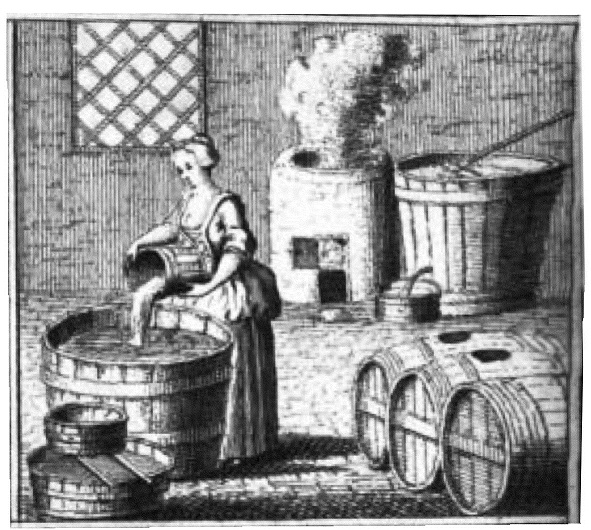
Female brewers in early modern Holland

Gravure of female beer brewer

Here’s an interesting history paper by Marjolein van Dekken about female beer brewers in Holland during the fifteenth-seventeenth centuries:

As an important part of daily nourishment, women had always produced beer at home and for their own household. However, in Holland from the beginning of the thirteenth century beer production for the general market commenced. In the developing cities more and more labour was divided among specialised craftsmen. Professional breweries were established and the beer industry became a serious trade. In several cities of Holland like Haarlem, Delft and Gouda, the brewing industry played a major economic role during the fifteenth, sixteenth and seventeenth centuries. Even after the industry’s decline from the second half of the seventeenth century, breweries remained important for the local economy in those cities.

The full article is available as a Word document. It’s part of a project that looks at women’s work in the early modern period:

Foreign travellers who visited the Dutch Republic in the early modern period were impressed by the remarkable prominence of Dutch women in public places. Dutch women were reportedly independent and capable entrepreneurs, conducting business either in their own name, or that of their absent spouses. To what extent these frequently repeated observations reflect historical reality is still not clear. There is evidence that the economic success of the Dutch Republic is reflected in the position of women on the labour market. Two opposite hypotheses can be formulated. According to some historians female labour market participation in the Dutch Republic was lower than in neighboring countries. The economic prosperity and the high standard of living enabled the practical realization of the ideal of domesticity. Many women could afford not to work, and withdrew from the labour market as early as in the seventeenth century. According to the second, opposite hypothesis female labour market participation in the Dutch Republic was higher than elsewhere. Dutch gender norms were not very strict, women performed paid work on a large scale, and thus contributed to the increase of income and the standard of living and to the economic success of the Dutch Republic.

Books read September

Another month and five more books read. I can’t seem to read much more than a book a week recently.

Swords -Dancer — Jennifer Robson
A northern swordswoman comes to the desert south to search for her brother, taken by slavers. Tiger, one of the greatest swordmen of the south, takes pity on her and accompanies her on her quest.

The Silver Ship and the Sea — Brenda Cooper
On a barely settled colony world, six posthuman teenagers have to win the trust of the small human colony, a decade after the war their parents waged against the colony was lost.

A Bridge too Far — Cornelius Ryan
The classic account of Operation Market Garden, the airborne assault on Arnhem to provide a corridor over the Rhine into Germany and how it failed.

Going Under — Justina Robson
Third in the Quantum Gravity series. Lila Black is still in hell, now married to one of the top demons there and has to deal with becoming increasingly less human as her machine parts slowly take over her body.

Agent of Change — Sharon Lee & Steve Miller
Lee and Miller have just released this as a free ebook, a teaser for their Liaden series. This made it perfect for me to finally try this series, a cult favourite amongst online sf fandom. What it turned out to be was a decent romance/adventure science fiction romp, that unfortunately ended on a cliffhanger. Which means I’ll have to get the rest of the series. Bastards.

The Great American Novel: women need not apply

This is such a great takedown of a certain kind of self important American novel(ist) that it had me giggling at work:

“Often the protagonist of an Important Novel of the Latter Half of The 20th Century is male, and is a thinly veiled version of the author. So thin of a veil. A veil so thin is it possible to discern whether the author was circumcised. Also, he often displays a particular stomach-turning combination. He regards women as, one the one hand a mere necessary evil, not things one would be inclined to befriend or discuss life with, and on the other hand, beings of terrible power that make one very angry indeed.”

Who knew Belle Waring could be so sarky? Timely too, what with the writer David Gilmour (no, not that one) attempting to take a break from a well earned obscurity by saying stupid stuff about not wanting to teach about women writers:

I’m not interested in teaching books by women. Virginia Woolf is the only writer that interests me as a woman writer, so I do teach one of her short stories. But once again, when I was given this job I said I would only teach the people that I truly, truly love. Unfortunately, none of those happen to be Chinese, or women. Except for Virginia Woolf. And when I tried to teach Virginia Woolf, she’s too sophisticated, even for a third-year class. Usually at the beginning of the semester a hand shoots up and someone asks why there aren’t any women writers in the course. I say I don’t love women writers enough to teach them, if you want women writers go down the hall. What I teach is guys. Serious heterosexual guys. F. Scott Fitzgerald, Chekhov, Tolstoy. Real guy-guys. Henry Miller. Philip Roth.

Then saying he was misquoted and that “It was a careless choice of words. I’m not a politician, I’m a writer.” Gee.