Books read August

Yes, I know, I keep forgetting to put these posts up. Here’s what I read last month.

The Time Traders — Andre Norton
A juvenile deliquent gets the chance to redeem himself by voluntering for what turns out to be a time travelling experiment. A very readable, fast paced coming of age story.

The Handmaid’s Tale — Margaret Atwood
Best book of the month, as you might expect. This is the novel that made Margaret Atwood famous, the classic dystopian story of an America taken over by the religious right. Slightly dated in places, but still chilling.

Fever Pitch — Nick Hornby
This is the book that made football cool for the intelligensia in the early nineties. Hornby writes well about his experiences as an Arsenal fan.

Alphabet of Thorn — Patricia A. McKillip
An orphan working in the royal library comes in possession of a book only she can read, the story it tells may be more than just ancient history. A decent novel by a veteran fantasy author.

Up Against It — M. J. Locke
An excellent hardish science fiction story by a new (to me) author.

This Is Why We Video Gaming


So yeah, Grand Theft Auto V came out this week and turned out to be a great game, but somewhat misogynistic as there no playable female roles nor any interesting female characters. Pointing this out activated the usual Internet Women Hating Machine, which prompted Leigh Alexander to write a sarky review as well as put it to song, as shown above in Jonathan Mann’s interpretation.

But what this all really proved is that the Saints Row games are just much better. Yes, the game play is largely the same, but it doesn’t take itself so seriously as “art”. More importantly, in Saints Row you can play as whoever you want to be and it doesn’t matter for how the game treats you. You don’t need to be a gross man who swears a lot and commits crime; you can be a gross woman who swears a lot and commits crime.

Manic Pixel Dream Girl

extract from Manic Pixel Dream Girl by Elizabeth Simins

for some people, it seemed, being a nerd, a geek, a gamer was something they could play at whenever the mood struck. When it didn’t, they got to be normal.

Elizabeth Simins’ Manic Pixel Dream Girl comic touched a nerve, especially the bit quoted above. Simins was talking about growing up as a girl gamer back in the nineties and early naughties and her efforts to fit in and be a “fake normal girl” and how that influenced how she thought about the recent fake geek girl controversy. Gaming in the nineties was very male orientated, with the industry happy to pretend only boys played videogames. Plenty of girls may have played Tombraider too, but you wouldn’t know it from the tits, tits, tits ads. And though there’s still a lot of obnoxious sexism in gaming, it’s much more acceptable and unremarkable these days to like games as a woman.

In general, nerdy things have long become mainstream and now you have the beautiful people, the cool kids arguing that, they too, are geeks. Which can cause unjustified resentment by those who always were outcasts, who grew up when being geeky was strange. It’s a stupid thing to think, to be jealous rather than glad that so many people can embrace their inner geek without being mocked for it, but it’s there and Simins captured it perfectly.

But go read Manic Pixel Dream Girl, as it’s much more than just that.

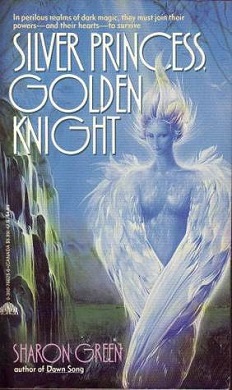
Silver Princess, Golden Knight — Sharon Green

Cover of Silver Princess, Golden Knight


Silver Princess, Golden Knight
Sharon Green
342 pages
published in 1993

When I saw Silver Princess, Golden Knight in a second hand bookshop, it looked like a fun fantasy adventure romp, spiced up with a bit of romance to make it interesting. A quick scan of the first few pages seemed to confirm that impression. I’d never heard of Sharon Green, but it was on the strenght of this that I decided to buy this novel. It was only after I started reading it in earnest that I discovered what a piece of sexist crap it was. I can’t think of any other novel I’ve ever read which spends so much time undermining its own heroine, all but calling her a bitch at times for being so unreasonable as wanting to decide how to live her own life.

Princess Alexia (Alex for friends) has always been a disappointment to her parents. Strongwilled and disdainful of traditional womanly virtues, she instead has spent most of years out on the streets, having been taught how to fight by her father’s royal guard. After one ill thought out attempt to help those less fortunate than her, has landed herself in prison for horse theft, her exasperated father decides enough is enough and decides that she needs a man to keep her on the straight and narrow. What she thinks about this is immaterial, there’s going to be a contest for all unmarried individuals in the kingdom and she is going the prize for the winner. Alex however discovers a loophole in the competition rules and enters herself, to make sure she remains a free womam. Now had Sharon Green chosen to tell the story of how Alex out fought and out smarted her would be suitors that would’ve been awesome. But this isn’t that story.

Read more…

Flook

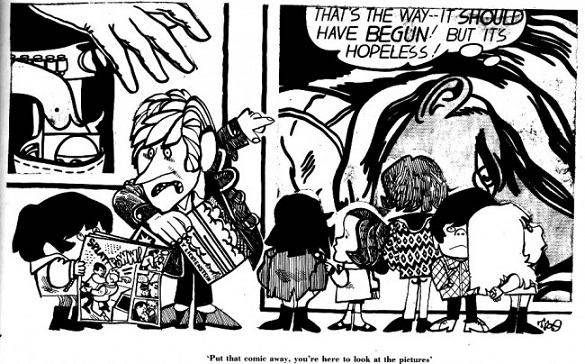
Flook takes on Roy Lichtenstein

You know, you think you’re reasonably well read and knowledgable about comics and comics history, but then you discover something like Flook:

Flook, which appeared in British newspapers for over 40 years, may be the greatest unlauded daily strip of the post war age, and is certainly among the most criminally uncollected. The disarming appearance of its title character, somewhere between a piglet and a mole, conceals a world of keenly observed and hilarious high satire that stands complete comparison with acknowledged greats of the field such as Pogo and L’il Abner. Uniquely the strip offers a mainlined, as-it-happens comic strip almanac of British culture, politics and society during that enduringly fascinating epoch of modern history that takes in Queen Elizabeth’s coronation, The Beatles and the coming of Margaret Thatcher. It achieved this thanks to a succession of savvy script-writers and the brilliant work of its sole artist and caretaker Trog, the penname of Wally Fawkes, one of British cartooning’s best-kept secrets. A complete reprint (or a representative collection at the very least) would be an eye-opening read for anybody with an appreciation for the newspaper strip format in its zenith, or who simply fancies a first class tour around the bustling essence of mid to late twentieth century London.

You know who wrote Flook? George Melly, Barry Took, Barry Norman and Humphrey bloody Lyttleton! This is brilliant stuff and the interviewer is right to compare it to Peanuts or Pogo. Why didn’t I know about this?