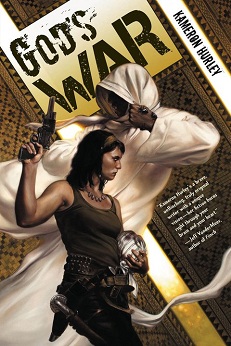
God’s War — Kameron Hurley

Cover of God's War


God’s War
Kameron Hurley
286 pages
published in 2011

The main problem with God’s War is its setting. Kameron Hurley’s debut novel is set in an unspecified far future, on the alien planet of Umayma, featuring an unending, religious war between Nasheen and Chenja, Umayma’s biggest nations. The war has warped both nations’ societies, with each country’s men either dead or at the front, leaving only the very young and very old at home. Despite both societies’ innate conservatism that has left women to take up the slack, having to take on traditional male roles, resulting in what’s best called a violent matriarchy in Nasheen, with women in all positions of power and the men constantly being sacrificed at the front. Nyx, its protagonist, is a brutalised, aggressive, scary woman, a deliberate attempt by Hurley to create the female equivalent of somebody like Conan while the background against which Nyx plays out her story was meant to show how a brutal, violent hierarchical society doesn’t magically become better because women are now in power, how easy it is for women to keep perpetuating the same violence and abuse as the men, just with different people in the victim and oppressor roles.

It’s an interesting concept, but the execution is troubling. Because while it is set on another planet far in the future and the politics and religion that’s being fought about is fictional, the images that Hurley creates are very familiar, because the religion she creates looks a lot like Islam, veiled women, multiple daily prayers, holy book and all, with the war and the societies it has left in its wake familiar from what we’ve seen on the news from Iraq or Lybia or even Chechnya. The landscapes are all desert landscapes, the cities are Middle Eastern, with mosques and minarets, often broken, often bombed out. As Tariqk put it, it’s as if Hurley “took every stereotypical Arab world depiction & TURNED IT TO 11”. It’s this orientalism that fails this novel, this inability to do more than use orientalist stereotypes, that reduces it to just another grim and gritty adventure story when it could’ve been so much more.

Read more…

Wut I did on my holidays

Comics bought on holiday in France

Aaand we’re back. So sorry, my provider went for a hissy fit just as I went on holiday with not enough internet to do anything about it. It’s fixed now, but if anybody has a good, cheap host they can recommend?

This was the first time I’ve been on holiday with my family since (thinks) 1994, back when we we’re last all living together. This time, we instead got my foster brother and his family, my sister and her family, as well as my parents and youngest brother; luckily we weren’t all staying in the same holiday house, but it was still a concentrated blast of family I hadn’t experienced in a long time. Fun was had by all, but two weeks were just long enough for me. It’s interesting to spent so much time together now we’re all in our thirties and see how easily we still somehow slip in our old roles sometimes…

Anyway, going to France meant of course buying some comics; and unlike the last time we went on holiday there, this didn’t mean buying French copies of Marvel titles (I was fourteen). Instead I went to a very nice comics shop in Montpellier, Azimuts, where the woman vbehind the counter was very enthusiastic about Baru, also one of my favourite cartoonists. So here’s what I got:

  • Several volumes of Boulet‘s Notes series
  • The first volume of Trondheim’s Petit Riens.
  • Two Moebius collections
  • The last volume of Adele Blanc-sec
  • Two Baru books recommended to me: Fais péter les basses, Bruno! and Quéquette blues
  • Finally, Le Bleu est une Couleur Chaude by Julie Maroh, which has already been made into a movie.

That last one is the one I’m most excited about, though it’s hard reading what with my fairly limited high school French. Oh well, at the very least I can look at the artwork, which is brilliant.

What I also noticed in France was how manga were everywhere; even the local hypermarket had several shelves full of them, more than of French comics, with all the popular series (One Piece, Naruto, etc) you’d expect.

“I’m an endangered species. I shouldn’t be anymore.”

Samantha Allen, in one of the better posts I’ve seen on the subject, talks about the contineous harassement of trans* people by a certain kind of radfem:

In some bizarre alternate reality, however, I’m seen as a villain who invades “real” women’s spaces and perpetuates harmful gender stereotypes. A small but vocal band of activists known as “Radfems” see transgender women like myself as a blight on the feminist movement, but — because their views are not representative of the feminist movement as a whole — many trans*-inclusive feminists refer to them as TERFs, or Trans*-Exclusionary Radical Feminists.

Carnivale brettanomyces

Frank Boon talks about lambic at In de Wildeman

Some of the best pubs in Amsterdam joined forces this weekend to celebrate wild yeasts, the kind that gives a beer like lambic its particular flavour and characteristics. As part of that, In de Wildeman had Frank Boon give a presentation on the history of the lambic and related beers like gueuze and kriek. Which is fitting, because it was his brewery that was instrumental in saving these beers from extinction.

A short recap. Lambics are beers traditionally brewed in the Senne valley near Brussels, using various wild yeasts of the brettanomyces families (as well as others). It’s a sour beer, not very hoppy and cloudy. Gueuze is a mixture of young (one year old) and old (two-three years) lambics that undergo secondary fermentation in the bottle, slightly sweeter than proper lambiek. Faro is lambic with added sugar, while kriek is lambic with sour cherries added, anything from 350 grammes a litre and upwards. Lambics were originally brewed as a regional beer, as a tax dodge even to escape French taxation on spirits, one of those styles of beer that seemed old fashioned in the twentieth century but which has become hip again as more and more craft brewers are looking to traditional beers like this for inspiration.