Some reasons why science fiction needs more diversity


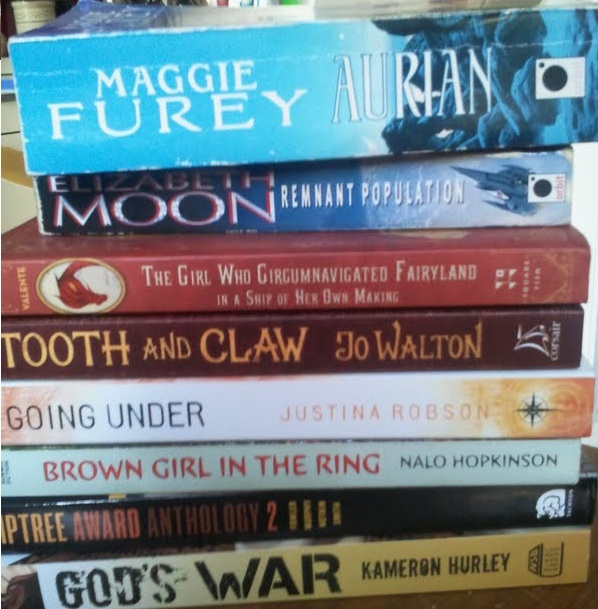
Science fiction and fantasy can be incredibly whitebread at times, though it is slowly getting better. One of the things that having more writers of more diverse backgrounds brings to the genre is new and interesting perspectives, as the two examples below make clear.

First, in a review for the LA Review of Books Nalo Hopkinson made the point that the Caribbean makes a good hjumping off point for a colonional or post-colonial sf setting that would be more interesting than the usual American frontier nonsense:

To my delight, in Lord’s afterword, she claims the Caribbean as the post-colonialist convergence of cultures that it is, pointing out that it is thereby an apt jumping-off place for speculative extrapolation. Sing it, sister. It’s all too common for the rest of the world to assume that the Caribbean is a bucolic vacation playground of villages and beaches, incapable of initiating any real scientific or technological progress.

Then I also found an old post of Aaron Hawkins (RIP), who quoted Mark Dery on why science fiction is so relevant to African Americans:

African Americans, in a very real sense, are the descendants of alien abductees; they inhabit a sci-fi nightmare in which unseen but no less impassable force fields of intolerance frustrate their movements; official histories undo what has been done; and technology is too often brought to bear on black bodies (branding, forced sterilization, the Tuskegee experiment, and tasers come readily to mind).

No real conclusions here, just some things that made me think.
Hammered — Elizabeth Bear

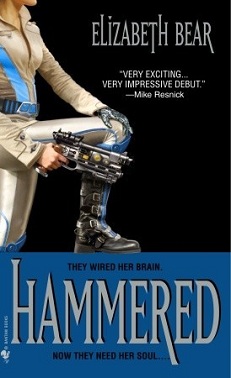
Cover of Hammered


Hammered
Elizabeth Bear
324 pages
published in 2005

Elizabeth Bear is a newish science fiction writer who I’ve been aware off, but hadn’t read anything off until now. Hammered is her first novel, published in 2005 along with its two sequels, Scardown and Worldwired. It was well recieved, with Bear winning both the 2005 John W. Campbell Award for Best New Writer and the 2006 Locus Award for Best First Novel. Both are well deserved, as this is one of the better first novels I’ve ever read. Elizabeth Bear is in complete control throughout and it reads like the work of a much more experienced writer.

Hammered starts out in the most cyberpunk posssible way, with local gangster boss Razorface bringing a kid overdosing on an army combat drug called Hammer to Maker, Jenny Casey, a UN combat veteran of what wasn’t WWII, now left with a cyborg left arm and prosthetic left eye, to see if she can save him. Razorface has mouth full with “a triple row of stainless steel choppers”, hence his nickname, while Jenny has hers because she fixes things. Neither is fond of Hammer, a dangerous drug even when pure and the batch the kid o.d. on is anything but. Some corporation is leaking tainted drugs in their city (Hartford, Connecticut) and together they have to stop them. Meanwhile, an online multiplayer game in which the best players get a chance at piloting a virtual star ship is infiltrated by an AI, who suspects the game is more than just entertainment. It’s 2062, climate change and the wars resulting from it have wrecked the world, China and Canada are locked in a Cold War and somebody’s after Jenny Casey. It might even be her sister.

Read more

Eighteen months

Time flies even when you’re not having fun. This time last year it had been half a year since Sandra died and I’d just come back from Plymouth to scatter her ashes. My youngest nephew was still a couple of days from being born; he’ll be one next Sunday, coincidently being born on the same day as his aunt’s birthday and a week after his daddy’s. It’s a cliche, but the world moves on even when you stand on top of it screaming for it to stop.


Grief lessens over time of course and eighteen months of being alone is starting to feel normal. To be honest, the two years before that, which Sandra mostly spent in hospital, didn’t feel like a normal relationship anymore either, but more as if everything was on hold until she got better, or not. It’s hard to get out from under that holding pattern. Not sure I quite want to yet either.