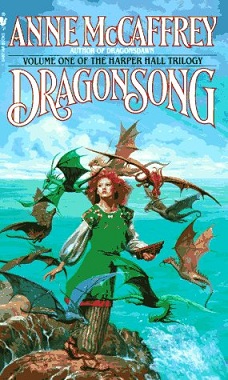
Dragonsong
Anne McCaffrey
192 pages
published in 1976
Dragonsong is the first novel in the Harper Hall trilogy of novels that Ann McCaffrey wrote in 1976-1978 as a continuation of the original Pern novels, Dragonflight and Dragonquest, weaving in and out of the main series. The heroine of the series, Menolly, would also show up in the later Dragonriders books, e.g in The White Dragon as a supporting character, occassionally hinting at her adventures in her own series. I hadn’t actually read this particular subseries before, as I never came across them until recently. All I knew was that the Harper Hall books had been consciously written for a young adult audience, unlike the original Pern books.
And reading Dragonsong that impression turned out to be right. This is as close to the platonic ideal of a certain kind of adolescent power fantasy as I’ve ever read. It’s even better than Harry Potter in this regard. You have the young heroine, on the verge of becoming an adult, with a special talent that’s not only unappreciated by her family, but actively suppressed and forbidden from practising it. She of course runs away from home, only to find people who do appreciate her and to find out she’s capable of more than not just her family, but she herself thought she was capable of. That’s the daydream of almost every misunderstood teenager at one point or another.
Read more…