Iain M. Banks

Fuck. Fuck. Fuck. Fuck. Iain (M.) Banks has cancer and is not expected to live out the year:

“I have cancer. It started in my gall bladder, has infected both lobes of my liver and probably also my pancreas and some lymph nodes, plus one tumour is massed around a group of major blood vessels in the same volume, effectively ruling out any chance of surgery to remove the tumours either in the short or long term.”

He continued: “The bottom line, now, I’m afraid, is that as a late stage gall bladder cancer patient, I’m expected to live for ‘several months’ and it’s extremely unlikely I’ll live beyond a year. So it looks like my latest novel, The Quarry, will be my last.

“As a result, I’ve withdrawn from all planned public engagements and I’ve asked my partner Adele if she will do me the honour of becoming my widow (sorry – but we find ghoulish humour helps). By the time this goes out we’ll be married and on a short honeymoon. We intend to spend however much quality time I have left seeing friends and relations and visiting places that have meant a lot to us. Meanwhile my heroic publishers are doing all they can to bring the publication date of my new novel forward by as much as four months, to give me a better chance of being around when it hits the shelves.”

Damn, this is not good news to hear from one of your favourite novelists. I never met him, but his books had a huge impact on me, discovering them at a time when there were only three Culture books and before anybody I knew had ever heard of him. He has had a huge impact on the shape of UK science fiction in the nineties and noughties and without him, it’s hard to see how writers like Ken MacLeod, Richard Morgan, Neal Asher, Charlie Stross, Liz Williams or Justina Robson would’ve developed.

And of course he also wrote more general fiction, under his Iain Banks pseudonym. That too, is as good as anything I’ve ever read, The Bridge, Complicity and The Crow Road especially.

Good luck to him and his family.
“Avengers Assimilate”

page from Uncanny Avengers

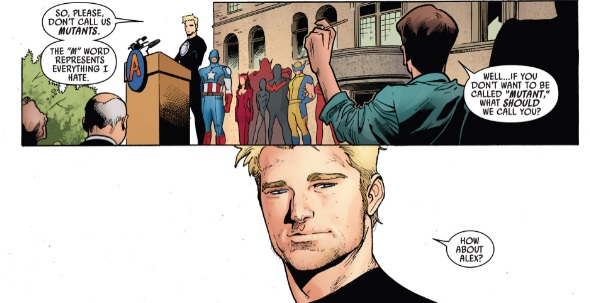
Andrew Wheeler is not happy about Havok’s speech (see above) in Uncanny Avengers #5:

The speech leaves us to believe that Havok doesn’t want there to be any word that describes his minority identity. He’s not saying that he’s not just a mutant, but that “mutant” is not among the things he wants to admit to being.

That’s not a message of inclusion. That’s a message of assimilation. That’s a message of erasure.

While Andrew Wheeler is correct in his analysis and why Havok’s attitude would be problematic in a real world scenario, to see a fictional character, even one that’s portrayed as sympathetic in context, should not necessarily be a problem, should it? Even in actually existing history there have been plenty of people from particular ethnic or cultural groups arguing for assimilation rather than inclusion, as any casual glance at Jewish history in 19th century Europe would show you. To see one particular character in one particular comic arguing the same for mutants, especially when said character is, as Wheeler points out, one who could pass for regular human fairly easily, is therefore no more than realistic, another political position between the extremes of Xavier (cohabitation) and Magneto (subjugation) to throw in the mix of mutant politics, more fodder for the usual angst ridden X-Men storylines.

That is, if you can trust the writer, Rick Remender, who did throw a snit on Twitter when people first started criticising this speech, but who has since apologised.

Unfortunately, experiences over the past few years with how mainstream (sic) superhero comics handle identity politics has taught a lot of people, not necessarily excluding myself, not to trust the writer in cases like this. Too much sexism, women in fridges, fucking around with characters of colour and general bad faith has meant that even mildly subtle plotlines like this are looked at with suspicion rather than interest. For those who are interested in seeing a more diverse approach to superhero comics, there is little trust that writers can handle identity politics like this sensibly and sensitively.

Anne McCaffrey again

Tom Spurgeon links to my review of Dragonquest and expands on it:

I think he’s right, but I actually think he undersells those core trilogies, which I think are pretty great for smart kids and teens. There are a bunch of reasons, including but not limited to: McCaffrey’s prose is ideally suited for younger readers, straight-forward and no-fuss; the plots are reasonably complex without being over-challenging in terms of adult themes, the Harper Hall trilogy is where I first discovered the boarding-school fantasy that the Harry Potter books utilize to even greater effect, and the good-guy/bad-guy elements are interesting in that the biggest threat is environmental rather than all-encompassing, directed evil. I was also fascinated by the fact that the two trilogies kind of wove in and out of each other, and by the concept of a civilization that declined rather than progressed. I’m very grateful to have read those books in my tweens.

All points I’d agree with, save perhaps for the declining civilisation; that’s the case in the first book, but by the second it’s clear there’s a renaissance of sorts going on.

Now I have to confess I’d actually never read the Harper Hall books, but by sheer coincidence I picked them up yesterday, meeting my father at Amsterdam’s Waterlooplein flea market. I just finished the first book, Dragonsong today; at less than 200 pages it’s not a long read. But my goodness, this was even more of a wish fulfilment story than the first Harry Potter book is. A girl on the edge of becoming an adult is denied her talent in making music, put down by her family and Hold, runs away and discovers that not only she’s able to impress more fire lizards than everybody else who ever tried, but has her musical gift recognised by the masterharper itself.

Emotional Mass Effect

I’ve been feeling a bit meh the last couple of weeks, both physically and mentally, for all sorts of not very interesting reasons, so I’ve been fleeing into computer games for a while. Specifically, Mass Effect and Mass Effect 2. Yes, two years after everybody else. I’m not done with the latter, as I don’t want to end it quite yet.

To be honest, as a game it’s not that impressive: an action-rpg with first person shooter sequences, mild puzzles interspersed with lots of cut scenes, the mandatory resource strangled research tree to get your team all the goodies, plus a lot of talking to people. The story meanwhile, at least in it’s broad outline, isn’t that special either: you are the only one standing between Galactic Civilisation and the existential threat of the Reapers and in the second game you have to assemble a crack squad of humans and aliens to deal with their latest scheme.

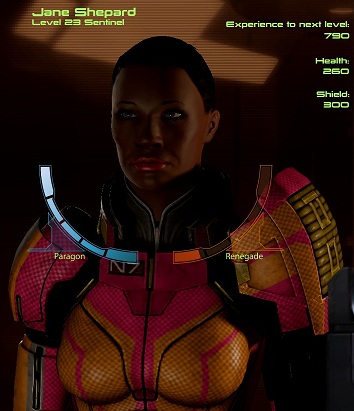
Part of what does make the Mass Effect games special I’ve already talked about a while back: the heroine, Shepard herself (you can also play with the male version of her, but only dullards do so) and her relationships with her crew and allies. BioWare created a great character, but ultimately it’s your own choices in playing the games that make Shepard who she really is. That’s where the depth of the games, especially the second game — which you can start with the full history of what you did in the previous one– lies in. And it all starts with the character creation.

Femshep

In my case Shepard is a Black, lesbian woman who has a thing for pink and yellow armour, who tries to do the right thing in every situation, has a thing for aliens, always tries to persuade rather than force people to help her, but who does sometimes have a temper on her. She’s respected, feared and admired, as well as a bad dancer. The games give you just enough information and guidance for you to make up what your Shepard is really like; the rest is up to you.

But what really impressed me in Mass Effect 2 was the way in which several of the missions and asssignments you can play bring home the effects of the war you are fighting. In one mission you have to find a murderer one of your potential teammates has been pursuing for centuries, where you interview the mother of her latest victim; in another you learn that one particular Asari saleswoman is so hostile because she lost her partner in an earlier war and now distrust all aliens. There’s also the background on Jack who did not have a happy childhood to say the least. Apart from that, there are also more mundane assignments, like reconciling two lovers, or getting somebody’s precious memento of their dead husband back.

The usual games I play tend to be either first person shooters with little plot other than shoot everything that moves, or fairly abstract strategy games of one sort or another, with no story other than the gameplay. The Mass Effect games are the first story driven games I’ve played in a long time, apart from Saints Row the Third (which is much more cartoonish) and the first games to have immersed me as deeply as a good science fiction novel can.

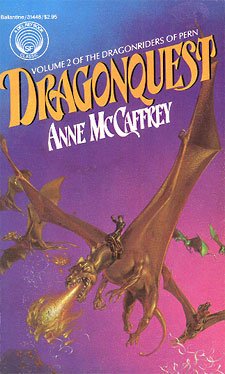
Dragonquest — Anne McCaffrey

Cover of Dragonquest


Dragonquest
Anne McCaffrey
303 pages
published in 1968

Rereading Dragonflight/Dragonquest I realised something: Anne McCaffrey’s influence on modern fantasy is highly underrated. The Dragonriders of Pern after all was a bestselling series long before a Robert Jordan, J. K. Rowling or Stephenie Meyer had even started writing, functioning as a gateway drug into fantasy and science fiction for a lot of young teenagers the way e.g. the Potter books do now. Yet she is rarely mentioned when we’re talking about the evolution of fantasy, with the potted histories of the genre usually starting with Tolkien, lightly touching on an Eddings or Brooks before getting to the fantasy boom of the nineties and beyond with Jordan, Goodkind, Rowling, Martin et all. Is it just because when the Pern books were first published fantasy was still science fiction’s poor cousin and they were therefore sold as sf?

Certainly the streamlining of genre history often has the side effect of erasing all the awkward, not quite fitting parts of it, in favour of a more teleological approach and too often these awkward fits are female pioneers like McCaffrey. More so than Tolkien she helped shape what modern epic fantasy looks like. The loner, young adult hero or heroine, in telepathic contact with his or her dragon, saviour of the world though looking extremely unlikely to be so at first, all taking place in a largely medivaloid world, that’s all McCaffrey. But there are differences with modern fantasy as well: her dragons were made by science, not magic.

Read more…