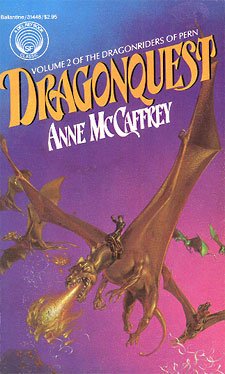
Dragonquest — Anne McCaffrey

Cover of Dragonquest


Dragonquest
Anne McCaffrey
303 pages
published in 1968

Rereading Dragonflight/Dragonquest I realised something: Anne McCaffrey’s influence on modern fantasy is highly underrated. The Dragonriders of Pern after all was a bestselling series long before a Robert Jordan, J. K. Rowling or Stephenie Meyer had even started writing, functioning as a gateway drug into fantasy and science fiction for a lot of young teenagers the way e.g. the Potter books do now. Yet she is rarely mentioned when we’re talking about the evolution of fantasy, with the potted histories of the genre usually starting with Tolkien, lightly touching on an Eddings or Brooks before getting to the fantasy boom of the nineties and beyond with Jordan, Goodkind, Rowling, Martin et all. Is it just because when the Pern books were first published fantasy was still science fiction’s poor cousin and they were therefore sold as sf?

Certainly the streamlining of genre history often has the side effect of erasing all the awkward, not quite fitting parts of it, in favour of a more teleological approach and too often these awkward fits are female pioneers like McCaffrey. More so than Tolkien she helped shape what modern epic fantasy looks like. The loner, young adult hero or heroine, in telepathic contact with his or her dragon, saviour of the world though looking extremely unlikely to be so at first, all taking place in a largely medivaloid world, that’s all McCaffrey. But there are differences with modern fantasy as well: her dragons were made by science, not magic.
Read more…

Foster parents: not freaking saints

This post about being a foster parent resonated with me:

We hate being told we must be saints or angels, because we’re doing something really ordinary and normal – that is, taking care of kids in need. If some children showed up dirty and hungry and needing a safe place on your doorstep, you’d care for them too – we just signed up to be the doorstep they arrive at. The idea of sainthood makes it impossible for ordinary people to do this – and the truth is the world needs more ordinary, human foster parents. This also stinks because if we’re saints and angels, we can’t ever be jerks or human or need help, and that’s bad, because sometimes this is hard.

Back in 1980 my parents, who already had two children and a third on the way, took the decision to make themselves available as foster parents as well, out of a mixture of leftist idealism and Christian sense of charity. At first they were looking for younger children in the same age range of me and my brother, but instead their first placement was sixteen year old, the first teenager they had to learn to deal with. It actually worked out pretty well: he stayed a couple of years, moved out when he got his first job, is still part of the family and that was that. Over the years our family took in a half dozen or so children of different ages and personalities, some staying only a short period as things improved with their biological families, some staying for years, becoming part of the family.

As a kid growing up with at least one or two foster brothers or sisters living with us, all this seemed normal, even though we were aware that it was not common to do. There were problems and conflicts of course, but no more so than with your biological siblings. Certainly we never thought of our parents of saints or angels, nor can I remember other people thinking that way about them; they got praise for what they did, sure, but nothing as absurdly over the top as that.

Being a foster parent, like being any parent is hard work; it’s far from well rewarded monetary and of course there are some special challenges you won’t have to deal with if you stick to just raising your biological children (if only because of the whole necessary bureaucracy surrounding fostering) but it’s not a profession for a saint. Saints don’t raise children.

So how many female writers do you review?

Over at Lady Business, they’ve looked at the coverage of female writers on science fiction and fantasy blogs:

Project thesis: when looking at a sample of bloggers reviewing SF/F, a majority of men will skew toward reviewing more men. A majority of women will skew toward a more equal gender parity, or the opposite in which they review a majority of women. There will be a handful of outliers.

Which meant it was time to check my own reviewing, to see whether or not I’m an outlier or not. A few years ago I re-examined my reading habits, coming to the conclusion I read too few female writers, then set out to correct this. However, though I strive to review each book I read, the reality is that I largely don’t succeed in doing so. Last year I read 91 books, but reviewed only forty.

Luckily I keep track of which books I review each year, so it was easy to do the math. I reviewed forty books, of which twentyfour were written by men, sixteen by women, for a very clean division of sixty to forty percent male vs female writers reviewed. That’s better than how the average male reviewer is doing in the Lady Business study (74 to 25 %), worse than the average female reviewer (42 to 58, slightly more skewed towards female writers) and still not gender balanced.

The numbers are somewhat skewed by my Pratchett rereading project, which accounts for eight of those twentyfour, or a third of my male writers. Without those, the ratio switches to sixteen male to sixteen women, or a perfect fifty/fifty split. All done by accident though.

Why Marvel is more diverse than Fantagraphics

In a CBR interview with Ann Nocenti and Louise Simonson, the anonymous interviewer asked a question that got me thinking:

Right now, fans of mainstream superhero comics seemed to be more engaged than ever in conversations about women in comics, the need for women creators and the need for strong female characters. While that was never a primary consideration for you two, do you think conversations like this one help? Does it actually accomplish anything or are there other things we need to do if we’re serious about involving women in the industry?

Because while mainstream comics, ie. Marvel and DC and perhaps Image are not doing well in being all that diverse in the talent they’re using on their books, at least this lack of diversity is talked about, if not quite acted upon yet. And if we actually did get serious about diversity as a comics community, it would be relatively easy for a Marvel or DC to get more women, more people of colour on their books, just because of the kind of books they publish: assembly line comics with an emphasis on the characters rather than the creators.

Yet what about a publisher like Fantagraphics, the exact opposite of Marvel and DC, a publisher that prides itself on publishing the very best cartoonists publishing in English? If you look at their catalogue and the people they publish it isn’t any more diverse than the socalled Big Two are.

The thing is, it would actually be harder to “fix” Fantagraphics than it would be to fix Marvel justbecause the people being published by Fantagraphics aren’t interchangable cogs. Therefore, if the publishers, Gary Groth and Kim Thompson would want to increase the diversity of their catalogue, they need to do more work: find the sort of cartoonist that would fit in well with Joe Sacco and Daniel Clowes and Chris Ware, but is a woman, or a person of colour. Either that or move away from the Fanta “house style” and find new, interesting areas of “art comics” that unrepresented groups do better at.