The grey realist seventies

agata pyzik talks about living in the seventies:

One of the reasons the punk generation reads dystopias like A Clockwork Orange as if they were their lives, and looks longingly towards the communist East in their aesthetics, is their depoliticisation. The generation of their grandparents was the one who survived the war, believed in socialism, was changing the world, joined political parties. Earlier, to piss off your parents, you’d join a communist party. By the 70s, those who wanted to change the world, were discredited and all that had left was the aesthetics.

[…]

If you look at any footage of West Berlin in 70s, you see a murky, sinister city, whose punctum, trauma, is the Wall. People gravitate around it. Living next to a prison, even if theoretically you’e not the prisoner, you can develop symptoms of suffocation. Seeing people regularly being killed over an illegal crossing of the Wall, not being able to walk through your city, imagining what there can be on the other side.

One of the things that defined the seventies, especially the second half of the decade, was the freezing of the Cold War into stalemate. The excitement of the fifties and the sixties, when war between the capitalist and communist blocs seemed just around the corner had ebbed away, Vietnam was just a memory and all that was left were petty little squabbles in Third World countries of no great interest to people in Europe or America. You can see that period reflected in Jerry Pournelle’s mil-sf stories of the period, with their background of a codominiom of the US and USSR ruling the stars for the next couple of centuries.

The late seventies and early eighties before the feverdreams of Reaganomics and yuppism took hold were a time without great dreams, a grey, dour, chilly time where economic depression and political stagnation looked to be permanent.The generation that grew up in the seventies was perhaps the first to really grow up with the Cold War as a constant, something that had always been there and that short of nuclear war would not go away.

And then at the tail end of the seventies there was the Soviet invasion of Afghanistan, the first major crisis in the Cold War since Vietnam and there was a president in the White House, a southern Baptist, who was a ruthless son of a bitch despite his public image, who deliberately set out to create the USSR’s own Vietnam from this invasion. A few years later he would outflanked on the right by another born again Christian and actor, who was even more determined to suckerpunch the Russsians, fed as he was by Team B propaganda about the overwhelming might of the Soviet War Machine. In the USSR meanwhile, the leaders there were well aware of how vulnerable they really were and several times during the early eighties would creep close to starting the inevitable war themselves out of fear of being surprised otherwise.

The realists were in charge during this time and they all agreed that the Third World War was inevitable and that sense of realism is visible throughout popular culture in the late seventies and early eighties. Nihilism and cynicism ruled as we all expected to die in nuclear holocaust anyway. The idea that a youth revolt could avoid this, that the counterculture could offer an alternative had been shown to be false.

Is it this shared experience that paved the way for the neoliberal revolution of the eighties, as nuclear war receded as a threat? Perhaps.
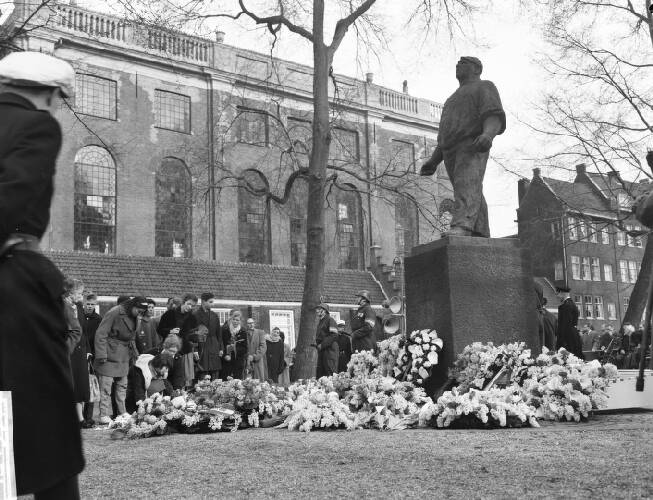

The February strike

Laying of the wreaths at the Remembrance ceremony at the Dokwerker

On 25 February 1941, less than a year into the nazi occupation of the Netherlands, communist union leaders called for a general strike against the increasing persecution of the Jews. The resulting two day strike in Amsterdam and various other cities in North Holland, the February Strike was the first and only massive public protest against the persecution of the Jews in occupied Europe.

Amsterdam had long been a Jewish city, with a large Jewish neighbourhood in the centre and south of the city. Even before the Germans had conquered Holland, there had been clashes between Jewish people and sympathisers against the indigeneous Dutch fascists of the NSB, the National-Socialist Movement. After the occupation the latter became bolder and started systematically harassing Jewish Amsterdammers, who in turn defended themselves, often with the help of their non-Jewish neighbours and friends. This culminated in a street battle at Waterlooplein on 11 February, when a group of NSB thugs attacking Jewish owned businesses were themselves attacked by a communist strike team of Jewish and non-Jewish residents. As the smoke cleared, one NSB man was left mortally wounded, who died on the 14th.

This incident, as well as similar one when the German SD tried to raid a Jewish-owned icecream parlor and got their asses kicked, was the excuse the nazis needed to institute the first razzias, driving together several hundred Jewish men, beating and torturing them, before sending them off to the concentration camps. This razzia took place on February 23-24, with the communist appeal for a general strike following the next morning.

Though the strike in the end was largely futile, it did serve to rip the mask off the nazi occupier. After its brutal repression it was no longer possible to believe things could continue as usual. In Amsterdam the strike is still remembered each year with a march past the Dokwerker, the statue created in remembrance of the strike in 1951, located on the Jonas Daniel Meijerplein, a centre of the old Jewish neighbourhood.

What makes the Februarystrike special is not just that it was such a public act of resistance, but that it was organised by the Dutch communist party and the communist aligned union, at a time when Nazi Germany and the USSR were still nominally allies. It was also one of the few public acts of resistance in the Netherlands, where the majority of the population not unnaturally just tried to keep their head down, while unfortunately the civil administration and bureaucracy went much to far along in their normal patterns of obedience to authority, even when in service to evil. It’s a proud moment for the Dutch left, one of those times when it took a principled stand, even if an ultimately futile stand, where it led the ordinary people of Amsterdam in, even if for just two days, resisting the deportation of their Jewish neighbours.

Comics as their own thing (Campbell was right)

As a kind of bible of pure comedy, the early Mad falls remarkably short of perfection however influential. Where is the personal slander, the rambunctious sex, the mad philandering, the sublime depravity and the political skewering we expect of the richest sources of comedy? Over two millennia ago, Aristophanes was brilliantly mocking the tragedies of Euripides (Women at the Thesmophoria) and risking prosecution with forthright attacks on the leaders of Athens. Contrast this with what we get in Mad. In place of Aristophanes’ unrestrained invective, Shakespeare’s poetic discursions on self-delusion, Wilde’s acute observations of social norms, and Monty Python’s Dada flavored madness we get parodies of superheroes and pulp characters.

It’s somewhat ironic that Ng Suat Tong uses such high-Grothian criticism to put the boot into EC Comics, one of Gary Groth few sacred cows. Groth might have also invoked Aristophanes to skewer some quickly forgotten piece of pseudo art, some DC or Marvel pretense at doing literary superhero comics. There’s something very Pseuds Corner about this litany of unassailable comedic, literary giants being called to the stand in the case against EC Comics, as silly as Stan Lee calling on the shades of Michelangelo and Shakespeare (again) in defence of comics in one old Bullpen Bulletin column.


I like Chris Mautner’s summarisation of Ng Suat Tong’s position better:

In an essay that ran in issue #250 of The Comics Journal – and was recently republished on the Hooded Utilitarian website – the critic Ng Suat Tong took to task one of the comics’ most sacred cows, EC. In the essay, entitled EC Comics and the Chimera of Memory, Suat argues that nostalgia has blinded critics and readers to EC’s many faults; that while the house that Bill Gaines built might have influenced many and laid the groundwork for the underground era, the stories themselves rarely deserve the lofty reputation they have attained.

To which Gary Groth of course had to respond:

In the impoverished cultural context of comics publishing at the time, the EC line was an astonishing achievement; Gaines’s EC came as close as a mainstream comics publisher could to being the comics equivalent of Barney Rossett’s Grove Press. What other comics publisher would even think of adapting stories from the Saturday Evening Post, use stories by Guy de Maupassant, or steal from the best — Ray Bradbury?

Which, compared to Ng Suat Tong’s list comes off decidedly middlebrow. What’s significant though is, that again these are all literary examples, with art not getting a look in. Both miss Eddie Campbell’s point, in his “literaries” essay:

Writing comics is a special skill quite different from writing prose. But before you take it all apart, ask: can you take the pictures out of a sports cartoon, or reduce a clown’s circus performance to its plot? Can everything about a musical performance be conveyed in a stave of notes, or can everything about a film be known from its shooting script? Sometimes, while everybody else was watching the clock, the clown, the actor, the singer, the cartoonist, the writer even, because writers never have as much freedom as we think they have, have slipped their own story in between the tick and the tock.

You can’t judge comics by their writing, their plots alone, you can’t separate the art and writing that easily and judge either in isolation. What makes comics art is not the writing or the art, it’s both as whole. As everybody quoted here does, we’re still judging comics too much in terms of other media, in how well it lives up to our expectations of literay worth, or how well it resembles film, but we rarely look at comics holestically and as their own thing.

It doesn’t really matter whether or not EC Comics was entirely as good and revolutionary as mainstream comics history has it, or whether it was as overrated as Ng Suat Tong would have it: what matters is that it hasn’t been appreciated and critically evaluated in terms of its own thing, but always in terms of other media.