Best song the Guillemots ever did; pretty good for a largely annoying hipster band, as it captured the mood of the UK after 7/7 and the shooting of Jean Charles de Menezes. At the time I was working at a small startup where I could listen to 6usic all day and this came up loads of times in late 2005/early 2006. That was also around the time Sandra and I bought our house and before her health problems had gotten the worst of her. In retrospect one of the happier times of our lives and this fits that so well: uplifting melody, bitter sweet lyrics, a simple recipe deftly executed.
Dutch rightwing politician thinks rape won’t make you pregnant
In a bid to show that Dutch (rightwing) politicians can be just as thick as their American counterparts, the leader of the SGP (the explicitly rightwing Christian party) argued that rape won’t make you pregnant:
‘Women seldom get pregnant as a result of rape and that is a fact,’ orthodox Christian party SGP leader Kees van der Staaij told a tv programme on Tuesday.
He was reacting to a question about the furore in the US around similar remarks made by Republican congressman Todd Akin.
Van der Staaij said rape is dreadful and recognises the huge consequences for the victims, but his party remains against abortion. ‘We are, under all circumstances, for the unborn life,’ he told the RTL programme.
The SGP has long been ignored and tolerated by Dutch politics as a whole, a principled party that stood for a largely neglected part of the Dutch population, the socalled bible belt. Their views may be old fashioned, even reactionary, but who cares, they’ll never get into government anyway. Which meant that for decades they’ve been able to e.g. get away with not giving women voting rights within the party, while recently, due to the minority rightwing government, it has had an undue influence on government policy in return for its support. So far this has luckily been minimal, but the mere fact that van der Staaij felt comfortable to utter these statements on public television shows the growing confidence of the party.
Norman London — William Fitz Stephen
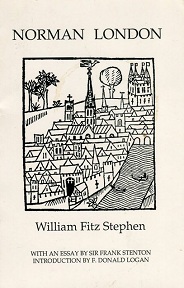
Norman London
William Fitz Stephen
109 pages including index
published in 1990
Now here’s an interesting little booklet. The meat of it consists on a treatise on Norman London, originally written by one William Fitz Stephen for his Life of Thomas Beckett, sometime before 1183. It’s therefore as close an eyewitness account of Norman London as we could ever get. Though interesting, this in itself is not enough to make a book of course. It is therefore partnered by another, more modern essay on the city, written in 1934 by Frank M. Stenton, a renowned historian of Anglo-Saxon England. These two pieces combined from the basis for what’s perhaps the most useful feature of the book, the maps of Norman London at the back of it.
There’s not really much more to say about Norman London. It’s an informative little booklet, but nothing more than that. What’s more, as the Stenton essay is more than seventy years old, it can’t help but be outdated, as new insights, more archaeological research and new theories will have altered our views of the period. I don’t think this would give a good picture of what we thought the Norman city looked like anymore. But this doesn’t make it worthless, if only because it still includes that eyewitness account of London, one of the few if not the only one we have of London at that particular point in time. The Stenton essay on the other hand is more of interest now for its own inherent historical value than for its accuracy.
Comics I bought for the same price as buying the Before Watchmen comics
So because the American Book Center had too many comics for sale I bought too many and spent a little bit too much money on Thursday, which made me feel somewhat greedy until Tom Spurgeon was kind enough to cheer me up by explaining how much it would cost to buy all the Before Watchmen comics (also, what to buy instead of them):
This year’s publication of Before Watchmen has facilitated a significant amount of discussion, both public and private, about the state of creator’s rights and the general direction of the industry. One under-discussed aspect of the project is its price. My own thinking on the topic was triggered this morning by the addition of two comics featuring the character Moloch to the initiative, and the resulting quick math that buying the entire series from a comics retailer might cost the average comics consumer a shade under $145.
I wondered what that meant in comics terms.
What follows is a list of 13 things comics and comics-related you can buy for roughly that same amount of money.
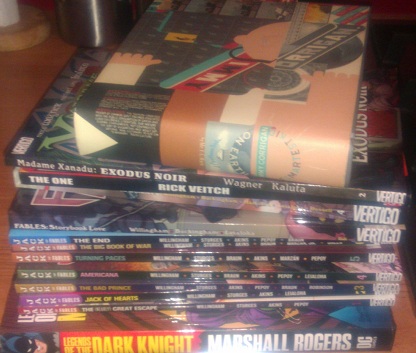
I spent roughly the same amount of money, but in euros and got this:
- The first edition Pantheon hardcover version of Jimmy Corrigan: the Smartest Kid on Earth
- Seven paperback collections of Jack of Fables: #1-6 and 9. (7 and 8 not being in stock) by Bill Willingham, Matthew Sturges and a whole host of other folk
- Two paperback collections of Fables: #3 and 4 (Bill Willingham and co)
- Madame Xanadu #2 (Matt Wagner and Michael wm Kaluta)
- Rick Veitch’s The One
- The big hardcover edition of Marshall Rogers Batman stories
And I still had money left over to buy beer. Fifteen years ago I could’ve totally seen myself buying into Before Watchmen; I bought a lot of crap back then. Knowning I don’t have to pay the full price to buy shit comics right now just to keep up, that the good stuff will be collected for my convenience later is very liberating.