Yeah, I skipped yesterday, but that was a fast day anyway, with only a salad, some raw carrots and the usual amounts of coffee (4 mugs), diet coke (about a litre) and water (same) to show for it. Today was a normal day. Lunch was an omelette and quark with muesli, dinner a small pizza, drinks the same as yesterday, with the exception of the bad boy above.
That’s the Scheldebrouwerij Zeezuiper (“seaquaffer”), a tripel brewed just over the border from my home province. At eight percent ABV it’s fairly heavy, but not as heavy as the Kasteel beer that nice glass was intended to be used for. It’s got a sweet, caramel taste, slightly cloying, that sticks to the roof of your mouth. Not very hoppy, no bitterness whatsoever, something you need to drink slowly but not let stand all evening or it falls flat.
Of course, if I want to lose weight I can’t drink too much beer, so this will have to do me tonight.
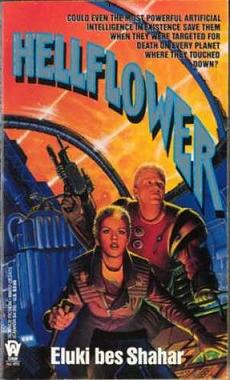
Hellflower
Eluki bes Shahar
252 pages
published in 1991
Eluki bes Shahar is a science fiction and fantasy writer better known as Rosemary Edghill, the form of her name she now prefers. She’s been active since the late eighties, starting her career writing straight romance novels, then moving on to science fiction and fantasy, most recently in collaboration with Mercedes Lackey. I think it’s fair to say she’s only been middling succesfull as a writer, somebody largely forgotten as an science fiction writer. The question is, is she worth rediscovering?
At first glance Hellflower seems to be a bog standard space opera or adventure sf story. Hardbitten female independent trader/starship captain rescues a young nob from a mugging, due to his honour he’s now in her debt, the same honour leads him to be scheduled for execution, she rescues him again, they take off from the planet guns blazing, he turns out to be more than just a young, bored noble and she’s in over her head. What makes Hellflower different from the several dozen other space opera stories with the same plot is the atmosphere of elegiac foredooming it takes place in. This particular caper might have a happy ending after all, but sooner or later the odds will catch up with our protagonist.
So Status Quo has been accused of always playing the same three chords for long enough that they themselves can take the mickey out of it.Meanwhile, over in comics land, Tim O’Neil thought his dismissal of Doonesbury would not be controversial, because really, who still follows Doonesbury:
The best that can be said about Trudeau is that for a brief period of time he was an important cartoonist, and the worst that can be said is that he contributed materially to the development of his generation’s completely unironic self-fixation. Alex Doonesbury alludes to this fact in the 07/30 strip when she refers to the “aging hippie vibe” that permeates the proceedings. It should go without saying that the hippies are no longer “aging,” the hippies are officially “aged,” and the very idea that they get to officially “pass the torch” to succeeding generations is laughable. I would say that Doonesbury exists to cater to the self-regard of its audience, but I don’t really feel comfortable making any kind of pronouncements about the kind of people who follow the strip, if such people actually exist. The only people who pay attention to Doonesbury with any consistency are the newspaper editors who have to read it in order to make sure that this week’s sequence doesn’t offend the 70-year old Tea Partiers who comprise the main audience for all printed media these days.
Quite a lot of people, it turns out. (frex.) Now we could make this all about the difference between the critic and the audience and, depending on writer and their agenda, either scold the latter for their low taste or the former for their elitism and ivory tower eggheadism. But that would be dull. Let’s just take as our assumption that what a critic will look for, needs to look for in any work of art, will always be different from what the general audience will look for.
Certainly Tim wasn’t wrong about the deficiencies of Doonesbury as a comic. The art has never been anything but servicable and over the decades has had any trace of individuality leeched out of it. Storywise there hasn’t been much originality either, with plotting remaining the same mixture of (gentle) satire, soap opera and political commentary that Trudeau had down pat in the early seventies.
And yet…
Doonesbury‘s real qualities never lay with its art and in fact an argument could be made that better art, more personal art, would distract from those qualities. For Trudeau to get his messages through, the art must not be distracting, must be smooth and easily digestible. The same goes, to a lesser extent, for the storytelling.
Because what Doonesbury has done well over the decades is to stay relevant. Far from the baby boomer hippiefest Tim paints it as . it has constantly stayed angry. Only recently there was the abortion storyline, with several newspapers dropping these strips, while in the past decade he has of course spent a lot of time on Iraq, Afghanistan and the treatment of veterans of these wars.
These are not really comix virtues, so if you judge Doonesbury just on its comix merits, especially its art, you’ll miss why it is still such an important strip and why so many people, not just aging boomers are attached to it.
Today I was in Middelburg celebrating my birthday with the family, which meant te traditional late summer barbeque. Dutch barbeque is not very interesting, just cuts of not too expensive meat cooked on a coke fed fire.
So what have I eaten today?
Breakfast: small baguette with cheese
Lunch: sausage rolls
Dinner: lots and lots of meat
Drinks: 4-5 mugs of coffee, 2 beers, various light soft drinks