Food diary (II)

When it’s steam engine time, you get steam engines and when your head is in slimming mode, the whole world suddenly turns out to be obsessed by it too. Not that obesity and dieting and all that are obscure subjects otherwise, of course. Anyway, no sooner had I posted last night or a Horizon episode popped up on BBC2
about the science of fasting to live longer/healthier. We long sort of known that if you restrict your calorie intake you can live longer and that doing so also might help protect against developing diabetes or heart diseases and even cancer, but it turns out there are easier ways to get these benefits than through strict everyday calorie counting. The idea is that instead of this you fast every other day, restricting your intake to one meal of roughly 500-600 calories, than eat normally the next day with no restrictions. People doing that tend to lose weight easier and get all sort of nasty cholesterol levels down too.

An even less stringent variant on that, which the Horizon presenter went on to test it, is the 5/2 regime: eat normally five days a week, fast on two days. It sounded interesting as he got good results on it (cholesterol down, weight down) and as importantly, it sounded doable. The greatest problem with every diet is with sticking to it, which is of course easier if you do it for a limited period than for basically the rest of your life. There’s also the problem that if you do stop with a given diet, you might quickly bounce back into unhealthy eating habits.

This method seems to avoid these two traps, while still delivering roughly the same benefits as the more stringent variants of restricted calorie intake diets. I can acutally see myself doing it and keep on doing it for the rest of my life, which is why I’ve decided to try it out. Hence today I’m skipping lunch in favour of eating a light dinner tonight.

  • Drinks morning: 3 mugs of coffee (0.5 litres), 0.5 litres water, 1 can Coke light.
  • Lunch: skipped today.
  • Drinks afternoon: 1 can Coke Light.
  • Dinner: salad (lettuce, cucumber, olives, a bit of sausage, some feta cheese)
  • Drinks evening: half a litre light orange soda, half a litre Coke light
Food diary (I)

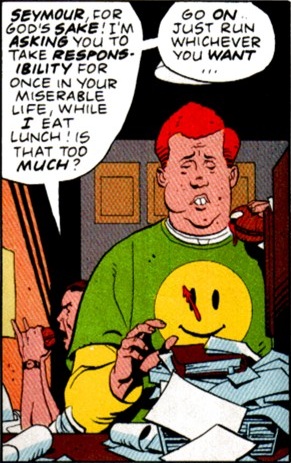
Seymour the fat slob from Watchmen

Is there a more pathetic figure in popular culture than the fat, nerdy slob? The balding comic book guy with his cheetos and toddler dress sense reading Aquaman, the fortysomething D&D player still living in his mother’s basement, that neckbearded guy in stretchy, clingy, clingy latex at the con who has never heard of deodorant. In every intranerd fight these images are lobbied around like grenades on a battlefield; We don’t need bullies to harass us, we can do it ourselves. You can’t really insult somebody’s race, sex, gender or religion without looking like a dickhead, but you can always call somebody a fat nerd, a loser.

And if you’re a fat, sloppy eater in any piece of fiction, you’re best bet is to be the comic relief, because otherwise you’re the disgusting, revolting villain nobody respects and somebody will kill you in a particularly pathetic way at the end of the story. Especially in comics, where the occasional Kingpin is the exception amongst the larger villains, more likely to resemble the Slug.

Nevertheless, it wasn’t comics that made me fat, though they didn’t help; it was puberty. I was a svelte young god until I was about twelve; now if I still resemble a Greek god, it’s Bacchus and not this one. Over the years, slowly, I’ve grown bigger: eighty kilos, ninety, hundred, hundred and ten, hundred and twenty…

Three years ago I had to change, had to lose weight to get slim enough so that we could do that kidney transplant operation for Sandra. So I started dieting and exercising and I managed to lose ten, fifteen kilos. All it took was three-four evenings in the week going to the gym and not eating anything between meals. Oh, and of course, having the threat of Sandra dying of kidney failure hanging over me if I didn’t get slim fast enough.

No wonder perhaps that in the two years since the operation, I’ve ballooned out again, especially the last year, with her gone. Comfort eating and there’s nothing as comforting as stuffing down a Burger King combo meal with added extra hamburger, is there, even if you feel physically ill and depressed afterwards.

But the good times can’t last forever. I was coming up to one hundred and thirty kilogrammes, which was a bit too much even for me. I’ve lost some weight since, but I need to have a new incentive to do so. Hence this post. I need to know how much I’m eating each day, knowing that I’m eating too much when I am, not being able to cheat and what better way than to do so in public?

Starting today therefore I’ll be posting a food diary each day, though they’ll be a lot shorter. I’ll weight myself each week and will keep an exercise diary as well. Hopefully this will help me keep momentum going and not let me backslide into bad habits. So, without further ado:

Weight this morning: 126.7 kilogrammes.

  • Drinks morning: 3 mugs (0.25 litres) of coffee with sugar, 0.5 litres water
  • Drinks afternoon: 1 mug of coffee, 2 cups (0.125 litres) of water
  • Drinks evening: one litre light orange soda.
  • Lunch: 4 slices brown bread, 1 slice of 48+ cheese (Old Amsterdam), 2 slices of Brugse beenham, Pear quark + muesli. One can of Coke Zero
  • Dinner: Stew of lean beef, beans, onion, leeks and mushrooms.
  • Snacks: four small snack sausages, fifty kcal each.

(Inspired by Tom Spurgeon as well as Hairy Bikers.)

EC Comics revisited

Alan David Doane responds to my dismissal of EC comics:

My thought is that yes, the writing in most of the EC horror and SF stories was rote hackwork, but Kurtzman’s Two-Fisted Tales and Frontline Combat, as well as Krigstein’s “Master Race” are without question among the best comics ever created, words and pictures both. Not only are they not, as Wisse asserts, examples of comics where “the story doesn’t matter,” but rather, they represent absolute perfection in their melding of image with text, something Kurtzman and Krigstein (geniuses both) were obsessed with. I don’t care if I never read a Jack Kamen cuckolded husband story again, but the thought of not being able to pull out Master Race or a Kurtzman war comic from time to time, to remind myself how good comics can be, fills me with despair. Krigstein and Kurtzman alone make EC a line worth the respect and awe it generates in informed comics readers.

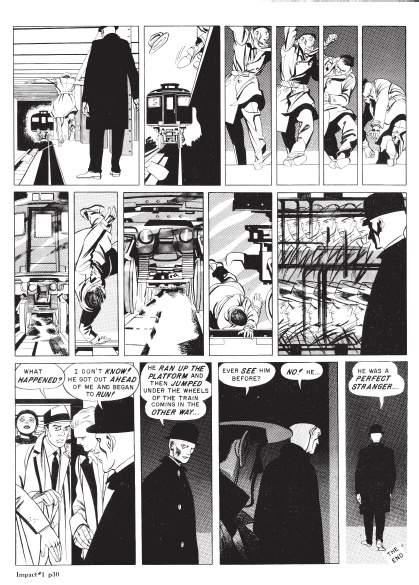
The final page of Master Race

Obviously he’s right to question my blanket dismissal; there was good stuff being done by EC, comics that combined excellent art with good writing. Most of them were written by Kurtzman, who was indeed a genius and a cartoonist, not just a writer, which shows in every script he had his hand in. The same goes for Krigstein and “Master Race” is indeed a great short story.

Yet Master Race‘s genius lies in pictures, not the story itself. Without the artistic choices Krigstein made as a cartoonist, it would only be just another surprise twist ending story. A man goes to take the subway, sees a stranger he recognises from his days in a nazi death camp, he flashes back to his time there and at the end of it it’s revealed he was the camp commander, not a victim (du-duh-duuuh!) and he’s so agitated he flees away from his silent accuser, slips and falls down the platform in front of an oncoming train.

What gives that story its real punch is the art, Krigstein’s figures, his layout. Those narrowing panels at the top right, the cutting between the oncoming train coming closer and the protagonist slipping, the sheer visual overload of the metro moving past the platform contrasted with the static pose of the man in black, the way the man moves back from the light of the platform into the darkness, turning away from the scene, the way it all fits together on the page. It’s brilliantly done and it’s been rarely equalled.

That’s the genius of comics; this is more than a story being gussied up with pretty art, this is where a so-so story is transformed through the choices the cartoonist made to tell the story. Which is different from the vast majority of EC comics, even those drawn by people like Wally Wood or All Williamson or John Severin, where those sort of choices where not made.

I was a bit trollish in my earlier post (no, really? — Ed.) and I never meant all EC stories were bad, just that there is a case to be made that EC as a whole is overrated, partially because we’ve always been more focused on the visual than the textual as comics readers, partially because earlier generations of fans and comics historians have made so much of them, while we’ve missed the context in which they were published, all the other good comics that came out in the fifties from other publishers who didn’t have these sort of cheerleaders.