I’ve been mostly alone at work this week, as most of my cow-orkers are on holiday. To fill up the space I’d normally listen to Radio 4 or 6music, but they’re flakey on my work connection. Youtube to the rescue, as with the removal of the fifteen minute time limit on uploaded videos, it’s now possible to put up entire rock concerts. So’ I’ve been listening to Bruuuce a lot lately, as well as Iron Maiden.
It’s a magical world… Let’s go exploring!
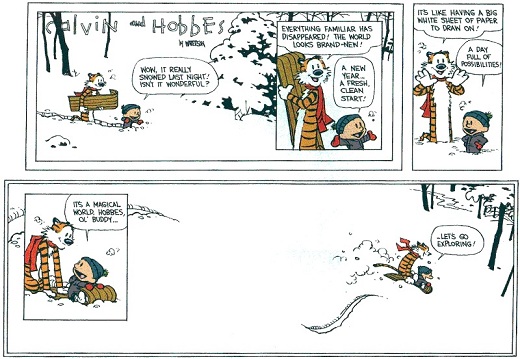
Bill Watterson turns fiftyfour today. Back in uni in 1994-95 our little band of friends read Calvin & Hobbes like previous generations had read Watchmen or Love & rockets. For a while it was the most important comic in the world for us; there were even a couple of occasions of calvinball being played late at night on the streets of Amsterdam…
Hello Mary Sue, goodbye heart
Rhiannon at Feminist Fiction makes an interesting and important point about the idea of the Mary Sue:
And even though I hear the term “Mary Sue” all the time, I don’t think I’ve ever seen or read about a female James Bond, or a female Indiana Jones, or a female Bruce Wayne. At least not in adult fiction. The idea is almost inconceivable, because female characters are already despised and dismissed for far more realistic flaws, like being too well-liked, too successful or too favored by the narrative. So the Doctor in Doctor Who swans around saving the universe and being loved by everyone he meets, but Rose Tyler is a Mary Sue because the Doctor falls in love with her. No medieval knight is called a Marty Stu, but Alanna in Tamora Pierce’s Tortall series is dismissed because she fights gender conventions to become one. Harry Potter is the youngest seeker in 100 years, not to mention the Chosen One, but Ginny Weasley is a Sue because she’s also talented at Quidditch, has a talent for a particular hex and eventually married her childhood crush. Any time a female character becomes important in the narrative, or loved by an idolized male character, or seems to lack humility and sweetness, someone will disparage her as a Mary Sue. And it creates a painful mixed message about the kind of female characters the world wants to see. They can’t be weak and silly and unimportant, but they can’t be too strong, too important, too appealing as role models and heroes to female viewers. They must remain in a safe, unthreatening middle ground.
The Mary Sue is an idea invented in Star Trek fan fiction circles, sometime in the late sixties/early seventies. This was arguably the first media based fandom, the first fandom to be dominated by women and the first in which fan fiction, stories written by fans based on the show, were a huge and important part of that fandom. It’s where slash was invented, the ancestor of all fan fiction fandoms. In that context, the Mary Sue was invented as the name for the new, somewhat too perfect ensign that joins the Enterprise, wins the hearts of both Kirk and Spock, can beat the latter in logic puzzles and the former in bravery, knows more about medicine than Bones, more of engines than Scotty, is loved and adored by everyone, but often dies tragically and above all is a standin for the author.
As with many critical terms divorced from their original context, its meaning has slipped to the point where, as Rhiannon notes, it can be used as a slur against any female character somebody dislikes for being too good, when the same perfection would go unnoticed in a male character.
Male characters can be Mary Sues as well of course; one could argue James Bond was one for Ian Fleming in the same way Harriet Vane was for Dorothy Sayers: an obvious author standin. In Fleming’s case, to live the life of adventure he himself wanted, in Sayers case because she had fallen in love with her own creation, Lord Peter Wimsey. Sometimes these are called Marty Stu rather than Mary Sue, but that is a much rarer term. As seen from both of these examples, a Mary Sue is not necessarily a bad character, but it is the sort of character used more by bad writers…
What Rhiannon sees, that difference in how male and female characters are often judged, where it’s much more acceptable for a male character to be a (male) wish fulfilment fantasy than it is for a woman to be a (female) wish fulfilment fantasy, is important. But perhaps we shouldn’t blame it on the poor old Mary Sue, who really is pretty harmless.
Two PVV members leave because of lack of democracy
There’s a surprise.
But it couldn’t happen to a nicer guy. At the end of the press conference launching his election programme, two members of his parliamentary faction announced their split from the party. According to them Wilders was authoritarian, egocentric and had lost all touch with “Henk and Ingrid”, the common Dutch folk.
Something that could’ve only been news to the PVV faithful.
Wilders’ party isn’t actually a real party after all, with memberships and internal democracy, but a vereniging, a voluntary association, with Geert Wilders as its only member; to be recognised as a political party it has to have at least two founders and one member. In the PVV’s case the member is Wilders and the founders are Wilders and the “Stichting Groep Wilders”, which he of course also owns. You can therefore volunteer for the PVV or support them financially, but nobody but Wilders has any say in the political course of the party, not even its members of parliament. Of course, in practise these will have some say in party policy, but the limits are entirely set by Wilders.
But what would you expect from an authoritarian, xenophobic politician with a flair for right wing populism? Consensus based policies?