A long weekend ahead of us, nice hot weather, so what better way to start it all with some classic eighties summer pop?
Fuck Yeah Comix
Got a new blog, or “Tumblr” as the kids call it these days, for all those throwaway comics links I can’t do much with here. Y’all might be interested. Or not.
Apart from that, it’s too hot to blog or do anything but obsessively play Football Manager.
Scott Kurtz calls the whaambulance
I don’t care about the shitty way Marvel treated Jack Kirby, all I want is to enjoy my Avengers movie and anybody who cares about how the big comic companies treat their creative talent is a cynical meanie.
No, really. Here’s a direct quote if you don’t believe me:
But I am a grown ass man, and I can tell you this: the real world does not operate like the morality plays we see acted out on the silver screen in movies like “The Avengers.” Life can not be summed up by “that’s not fair.” It’s not as simple as “Give Jack’s estate some money, Marvel. You can afford it.” That’s not pragmatic thinking. That’s cynicism. And I’m so tired of the cynicism.
Here we have a manchild deeply offended that he is forced to think about the moral implications of his favourite entertainment. He’s neither the first, nor the last fanboy to feel this way and his arguments, as shown up by the Mighty Mighty Godking are the same tired old excuses fanboys have always been dredging up: it’s all in the past, it’s the way the world works, Kirby wasn’t actually all that important, he signed a contract, etc. etc.
More so perhaps than any other art form commercial comics have always depended on screwing over the people actually creating the stories, with every attempt by these creators to gain a modicum of fair treatment quashed, either by the companies themselves or by fan indifference. Kurtz’s argument fits in neatly with this shameful tradition, another confirmation that for most fans it’s more important whether or a Captain America or Thor are done justice in a movie than whether their creators were.
“It’s just a boy mind in a girl body”
They took Kathryn to a psychologist outside of Philadelphia who specializes in treating the transgendered. Michele Angello confirmed what Jean had long suspected: Kathryn had gender dysphoria. She recommended that Kathryn be allowed to live as a boy, a prospect that filled Stephen with dread but his 4-year-old with elation.
Kathryn wanted to be called “he” right away. And Kathryn wanted to be called Talon, then Isaac, but finally settled on a permanent boy’s name in the fall. (The Post is using Tyler, the name his parents say they would have given him if he’d been born a boy.)
“When we finally let Tyler shop in the boys’ clothing department, it was like the skies opened up,” Jean said.
They switched to saying he/him/his and stopped using the name “Kathryn” at home.
It was a huge upheaval, a change Jean and Stephen had to remind themselves of every day. Then came the next challenge: telling family, friends, teachers and other parents that their daughter had become their son.
Spoiler: their family, friends and wider environment reacted admirably to this change.
Progress is made from stories like this; it wasn’t too long ago that the only newspaper articles you saw about transgendered/genderqueer people were about their horrific murders. In the last decade there seems to have been a decided swing towards acceptance of transgendered and genderqueer people, though of course they’re still some way away from even having the same sort of acceptance as gay people have now. Nevertheless, real progress has been made and one of my pet theories (it could be bunnies) is that the continuing struggle for gay marriage has something to do with this wider acceptance, in that it has kept both queer people and the idea that actually, you know, they’re rather normal people and not horrible horrible freaks leading a deviant lifestyle in front of the public consciousness. Only a committed bigot could’ve seen those pictures of happy gay and lesbian couples getting married and not felt some sympathy.
But while transgendered people are finally getting some acceptance, the idea of transgendered children is still strange for many people. Our gut instincts tell us that four year old children can’t possibly understand gender dysmorphia or being transgender, that “indulging” children in changing their gender is a bad idea, especially when such scary terms as “puberty blockers”, drugs to delay the onset of puberty to make it easier to undergo the full physical transition towards a new gender, are thrown about. That we really feel is wrong; and by we, I mean I and this squirrel in my pocket.
We’re wrong though; in the Metafilter discussion one commenter linked to this scientific study on “clinical management of gender identity disorder in adolescents”. This argues and provides some proof that yes, it is worthwhile to get younger children and adolescents to start transitioning, to put them on puberty suppressing drugs rather than start transitioning when legally and physically adults, as transitioning this way is much more likely to be successful in the short and long term both:
It is conceivable that lowering the age limit increases the incidence of ‘false positives’. However, it most certainly results in high percentages of individuals who more easily pass into the opposite gender role than when treatment commenced well after the development of secondary characteristics. This implies an improvement in the quality of life in these individuals, but may also result in a lower incidence of transsexuals with postoperative regrets or poor postoperative functioning. Clinically, it is known that some patients who were treated in adulthood regret SR because they have never been able to function inconspicuously in the opposite gender role. This holds especially for MFs, because beard growth and voice breaking give so many of them a never disappearing masculine appearance. But, since the number of ‘false positives’ should be kept as small as possible, the diagnostic procedure should be carried out with great care. Until now, no patients who started treatment before 18 years have regretted their choice for SR.
In situations like this we are inclined to treat the probability of a “false positive”, somebody who starts transition when “not really” transgendered as much greater and much more serious than the damages that are done or might be done by not allowing somebody to transition or to transition too late. We worry too much about “man bites dog” to see that “dog bites man” is much more common.
Floppies
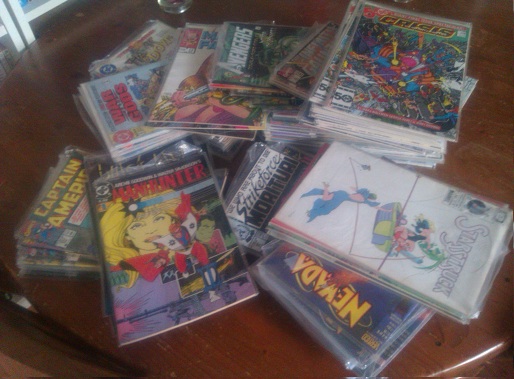
A while back I spent the weekend at my parents and I took the opportunity to pick some of the several thousands individual comics –floppies– I still have stashed away there. It’s been well over a decade since I last bought a new comic in this format, back when I was still a serious collector. Back then I was all about the floppies, buying everything that looked interesting and cheap, but not having been a comics collector for the better part of the last decade has cured me off that. The big disadvantage of the classic comic being that they’re relatively hard to store and, well, look a bit naff when left out in your living room.
It was Tom Spurgeon’s recent post about which comics you read during the eighties and which you regretted missing out on that got me thinking about floppies again. I started seriously buying comics at the tail end of the eighties, spending much of the nineties combing through back issue boxes looking for interesting series I’d read about. That was really the only way you could get your hands on many classic series back then; the internet was too slow for pirating comics, while the great reprint programmes only got started at the turn of the millennium. Even quite recent Marvel or DC stories and titles were only to be had in back issue form, let alone series done by now defunct publishers.
The end result was that I built up a collection full of holes and odds and sods, a couple of issues here or there of series I saw advertised in Comics Interview, half a run of something praised in Amazing Comics, loads of comics that looked familiar and were cheap enough to take a chance at, but very rarely complete runs. Spelunking through comics boxes at shows or obscure comics shop was fun, but readers never had it so good as now, when so much is available at the click of a mouse at Amazon (other online retailers are also available).
The appeal of buying single issues as opposed to trade paperbacks or collections has long faded, but getting these comics out has gotten me a bit nostalgic nonetheless. With floppies you have so much more of a connection to comics as a wider field, through house ads, letter pages and editorials, not to mention having that weekly Thursday evening ritual of trekking to the local comic shop and picking up the latest issues. You don’t really have that buying a Peanuts collection from a bookstore.
(Pictured above, complete runs of, clockwise from the top: Hawk and Dove, Barbara & Karl Kesel, Greg Guler, War of the Gods, George Perez and Russell Braun, the Perez/Ralph Macchio Black Widow four parter from Marvel Fanfare, Kurt Busiek’s and Perez (notice a pattern?) run on The Avengers, followed by the Perez drawn crossover series Infinity Gauntlet (with Jim Starlin) and Crisis on Infinite Earths (Marv Wolfman), Elaine Lee and Kaluta’s Starstruck, Steve Gerber and Phil Winslade’s Nevada, Strikeforce Morituri, the first 20 issues by Peter B. Gilis and Brent Anderson, the Goodwin/Simonson Manhunter, Howard Chaykin’s Black Kiss and finally perhaps Mark Gruenwald’s finest hour on Captain America, #357 to 370, with Kieron Dwyer and Ron Lim. )