People, not disabilities

Just because somebody’s in a wheelchair and can’t speak is no reason to patronise her, but people do:

I’m not a child. I don’t pinky swear. I don’t do patronizing sing-song voices. I don’t like to be touched by strangers and I don’t like strangers trying to force me to look at their faces, touch them, or promise them anything. And I don’t like being called a shithead for not responding to these things or looking terrified by these things. That goes double if you said shithead in the same light-hearted, patronizing way you would to a cat who just put their teeth on you for petting them too long. So don’t think that “I was just joking” would change my mind.

That this woman might mean well is of course no defense of her actions or her inability to understand that you can’t treat grown ass people like troublesome pets, but I can see how easily genuine concern could slide into patronising or worse. It’s the sort of thing I struggled with during Sandra’s illness, to keep treating her like the adult she was, to not let her illness get in the way of her.

Whither Marvel

Tegan O’Neil ruminates on the Avengers movie and its wider implications for modern America and in passing he mentions the following:

You want to know what I find really depressing these days? The Marvel superheroes used to be figures of the counterculture. I don’t want to press on this point to hard, because it’s easy to lose sight of the fact that Stan Lee pushed the characters as being part of the sixties counterculture when he saw that he could leverage a small but enthusiastic readership of college-aged kids into cultural cache.

Which is something I’ve been thinking about as well. Marvel always used to be, if not a leftist, at least a liberal leaning company. Most of its heroes were always either being distrusted by the proper authorities, or were in active conflict with them in some way or another. In fact, the whole Marvel Universe was founded in an act of rebellion, with the Fantastic Four sneaking off on their ill fated rocket flight against the orders of the military. Then there was the Hulk, in which a scientist working for the military industrial complex gets irradiated by his own weapon and turns into a monster. Not to mention Spider-Man, or the X-Men, both hated and feared by a world they repeatedly saved, etc. etc.

It’s all a far cry from the espionage/black ops/governmental superhero death squads of the modern Marvel Universe, where Captain America is no longer a Roosevelt Democrat turned into the symbol of the American dream, but just another Republican thug. Which is one reason why I no longer read many Marvel comics, as even the good ones are drenched in this fascistoid atmosphere.

Lola


There’s an interesting discussion about “Lola” on Andrew Hickey’s blog, mainly about whether or not it’s problematic in its depiction of trans people:

I’ve dreaded writing about this song, because it’s witty, clever, and one of the catchiest things Ray Davies ever wrote, but it also perpetuates some negative stereotypes about trans people. However, it also shows more respect to trans people than any other pop song I could think of

Which might just be laying too much weight on what’s largely an ironic song gently mocking a young boy having his first encounter with what I always thought was a male transvestite, what with the last line of the song being “But I know what I am I’m glad I’m a man and so is Lola”. It’s the old story of boy meets girl, boy discovers girl is also a boy, boy discovers he couldn’t care less: well, nobody’s perfect.

If you look at it unfavourably, I guess you could say that it enacts that hoary old homo and transphobic fear of straight men being “tricked” into having sex with somebody who’s “really” a man, something that used to be a staple of bad American raunch comedies (or even the Police Academy series).

But I think that’s completely missing the point of “Lola”, which is really about love conquering all, gender not mattering and becoming fluid anyway (“Girls will be boys and boys will be girls, It’s a mixed up, muddled up, shook up world except for Lola”). It’s all done with a wink and a smile, but at its heart it is accepting of trans people more than you could say it is damaging.

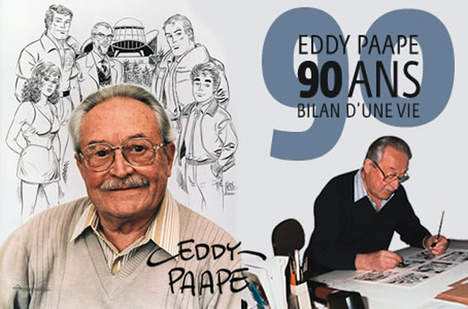
Eddy Paape 1920 – 2012

Eddy Paape

To be honest I wasn’t sure he was still alive, but Tom Spurgeon has just reported his death last Saturday, with a very nice obituary in which he called Paape “one of the last remaining ties to the initial heyday of 20th Century French-language comics publishing”. You might best compare him to somebody like Don Heck, an artist with decades of good, solid work under his belt, never quite in the first rank of cartoonists perhaps, but with his own charm nonetheless.
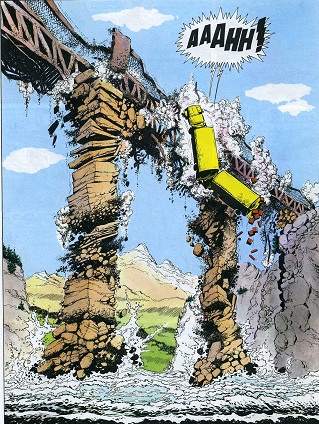
Splash spage from 24 Hours for Planet Earth

Paape had worked on both Spirou and Tintin weekly comics magazines, the Marvel and DC of Belgian-Franco comics, with Tintin being slightly stuffier and a little bit more respectable. While Paape got his start at Spirou, it was Tintin were he left his mark, starting in the mid-sixties when Greg, the Belgian Stan Lee, took over the magazine as editor/writer and revamped it with more adventure stories, modish and stylish, of which his and Paape’s Luc Orient was one.
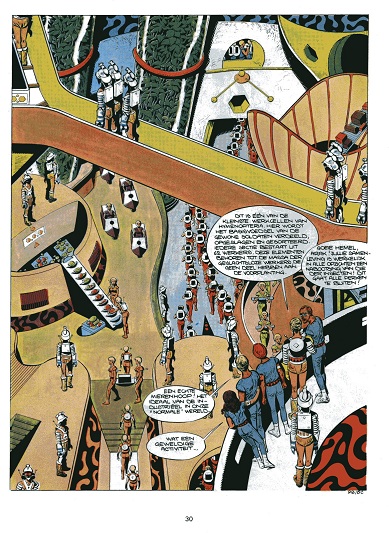
page from the Sixth Continent

Luc Orient has the traditional three man band structure of many European adventure comics, with Luc Orient as the smart, strong, straight but slightly bland leading man, professor Hugo Kala as the brain and occasional comic relief, less physical than Orient but still a man of action and finally Lora, Kala’s secretary and Luc’s friend/love interest, feisty, independent and not nearly as often kidnap bait than e.g. Sue Storm used to be. All three work for Eurocrystal, the leading European science laboratory, in which capacity they go on strange adventures. What sets it apart is that from the start the series was orientated (sorry) towards science fiction, as well as running multiple album storylines at a time when most European series solely dealt with standalone stories.
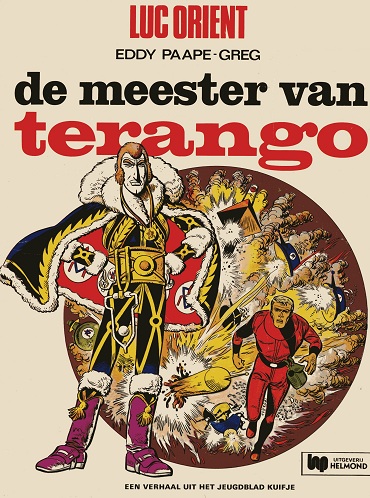
Cover of the Master of Terango

I discovered Luc Orient in the same way I read most comics as a child: through the local library, together with series like Valerian and Les naufragés du temps. Of those three Luc Orient was the easiest to get into, thanks in no small part to Paape’s artwork. At first sight it looks slightly flat, a bit stilted in its composition and with stiff figures, but if you give it a change you’ll find out that this is a deliberate stylistic choices and that it works well in giving an grounding of realism to these science fictional stories. He was great at drawing technology, real or imagined, some of his design sense surely influencing later science fiction series.
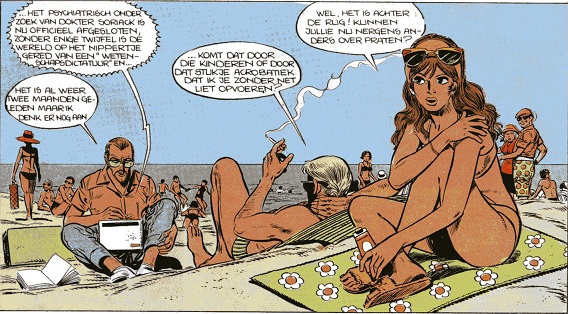
Some rare Paape cheesecake

Luc Orient was and is one of my favourite science fiction comic series and I still love the look of Paape’s artwork. For me, Paape was one of the cartoonists who defined what modern Franco-Belgian comics from the late sixties would look like.