Rich people may be old, but old people are not rich

The Mighty Mighty Godking imagines a commencement address for coffin dodgers, giving old people some of their own medicine in the form of unwanted advice. The key paragraph is the following

Rich people are generally old people; even well-off people are generally old people. And old people look out for old people, and unfortunately over the past twenty or so years the number of old people has been increasing steadily, which means that the interests of old people dominate over the interests of young people, who just have to eventually take care of the old people. I mean – global warming! We all agreed that that was important, right? And then suddenly rich people – who were also old people – all decided it really wasn’t that important any more, and lectured us all about how the economy demanded that we pretend climate change wasn’t happening. (The economy demands a lot of things. Like tax cuts for rich people – who are, once again, mostly old people.) And when the economy gets better, it doesn’t get better for young people. The story of unemployment in every first world country right now is the same: young people are unemployed at vastly greater rates than old people, with rates double or triple the general unemployment rate.

Most rich people might be old, but most old people aren’t rich. While it is true that younger people are affected more by the current economic crisis, for a lot of elder baby boomers it’s not been a happy time either. MGK’s hypothetical sixty year old, who in his version has had everything going for him would’ve also been eligble for the draft when the war in Vietnam was still ongoing, left university just as the mid-seventies economic depressions (stagflation!) hit, had to suffer years of low to non-existing wage raises in the early eighties in order to safeguard his pension later, be suckered into all kinds of 401(k) schemes that paid out more to the fund managers than to his retirement fund, had hoped to have his house as a nest egg but saw the bottom drop out of the housing market just as he lost his job as well, while the only new job he can find is as greeter at Wal-Mart. And to add insult to injury, he now keeps hearing that social security is broken and needs to be privatised to be saved, when he spent most of the eighties moderating his wage demands to save it…

We shouldn’t really be talking about a generational conflict, of a struggle between old and young people, but rather realise that both generations have been suckered by a small elite of rich people. After the Second World War we had roughly thirty years in which all western countries build up an as fair and equal welfare state as was possible in each country, which in the last thiry years has been steadily attacked by those who saw profit in dismantling it. Talking too much about “old” versus “young” just plays in their hands.
F-f-f-frustration


The battlecry of millions of late 20th century/early 21st century suburbanites, Soft Cell’s “Frustration” is one example of how underrated the band is, largely known for its cover of that Northern Soul classic “Tainted Love”. Their other claim of fame of course being one of a whole wave of “gay” (electro)pop bands that broke in eighties Britain: Bronski Beat, Pet Shop Boys, Erasure, Communards, Frankie Goes to Hollywood, Culture Club undsoweiter. It’s strange how that suddenly happened; you can’t really say England was gay friendly at the time, can you?

This song just popped up on my playlist and I thought I’d share it, as it so perfectly sums up some of my feelings at the moment.

The long dark teatime of the soul


Half a year. Six months. Twentysix weeks. It feels like forever; it also feels like yesterday that Sandra died. It’s just not something I can get used to: it still feels like she should be there, she’s just gone out of the room for a bit. Every day I want to call her on my lunch break, every time when I watch a tv show or listen to a radio programme we used to follow together I want to ask her what she thinks about it, every time I read a book that I think she would like, I want to tell her she shouldn’t read it, as she hated having books recommended to her.

The weekends are the worst; during the week work can be busy enough that I don’t really think about her, but in the weekends there’s too much time and space for the memories and grief to come back. It’s not so much that I spent my weekends staring and sighing, more that literally everything in the house and garden reminds me of Sand. Worse, even the local supermarket makes me think of her as I try to remember her advice on cooking and such. Pathetic, I know.

What I also miss is the structure in my life, a goal. Living alone after having spent the better part of a decade living together with somebody you love deeply is so different from just living on your own. When you’re a couple you live for each other as much as for yourself, at least if you it properly, but now what do I have: my job? My hobbies? The cats? All very nice, for sure, but it doesn’t fill my life like Sandra did. And that’s what I miss the most, having somebody there who makes you feel like what Ella sings about and who you can do the same to.

Books read April

Not much read this month, as I spent much of my spare time in playing Football Manager; the trip to Plymouth didn’t help either. I always think I’ll read more travelling than I actually do.

The Making of Europe — Robert Bartlett
This is what I was reading for most of the month, a history of Europe in the High Middle Ages, between 950 and 1350 CE, when Europe became Europe through a process of “conquest, colonisation and cultural change”, as the subtitle makes clear.

Slow River — Nicola Griffith
Nicola Griffith’s second science fiction novel was just as good as her first. A young woman was kidnapped for ransom, then left for dead on the streets of London. Yet instead of going back to her rich family, she starts a new life amongst the outcasts.

Love in Amsterdam — Nicolas Freeling
Bought this in Plymouth because Sandra liked the Van der Valk series, of which this is the first, a murder mystery told from the point of view of the man suspected of the murder.

The Power of Darkness: Tales of Terror — Edith Nesbit
Supernatural mystery stories by an Edwardian writer better known for her fantasy children’s novels. I read this because Sandra loved it, one of the books she read while in hospital. Decent enough stories, but not intended to be read in quick succession.

Pim Fortuyn: ten years after

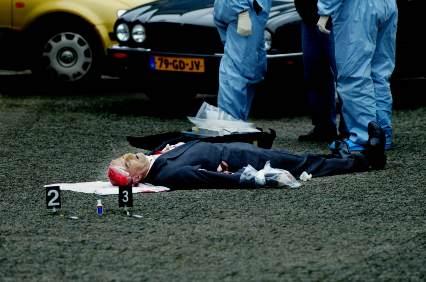
the body of Fortuyn after he was murdered

Ten years ago Pim Fortuyn was killed by an animal rights activist who wanted to save Dutch Muslims from prosecution at his hands. Ironically a study earlier this week showed that six in ten high school students actually think that he was murdered by a Muslim…

Which was actually my greatest fear when I heard the news of his murder back then, before we knew the murderer had been arrested and turned out to be a white Dutch man. Had the murderer be a Muslim, the anger and fear many people felt in the wake of the murder might have been transformed into something very nasty; already there had been people setting fire to the parking lot inside the parliamentary grounds. Who knows what could’ve happened.

Reality was bad enough anyway. Dutch politics were already shifting rightward anyway, of which Fortuyn’s rise was one symptom, but with his death the dam burst. We got a media climate in which Islamophobia was no longer a taboo and and a long line of politicians exploiting this, with Geert Wilders as the end result. We’ve become much more open about our racism, with opinions that would’ve been anathema fifteen years ago now openly discussed in the media. What Fortuyn and Wilders have been saying about Islam and “non-western immigrants” this decade was also said by Hans Janmaat in the eighties, but he was treated as a pariah for them, not feted.

Fortuyn’s murder was therefore counterproductive to what his murderer tried to achieve: instead of abating Islamphobia, it encouraged it. Had Fortuyn lived it might’ve never become as prevelant as it has been this last decade.