Books read March

I read a lot this month, but a huge part of that reading was pure pulp, as I read no less than seven of David Weber’s Honor Harrington novels in five days or so, pure as escapism.

The Honor of the Queen, The Short Victorious War, Field of Dishonor, Flag in Exile, Honor Among Enemies, In Enemy Hands, Echoes of Honor — David Weber
I swear, David Weber has found a way to embed crack in his Napoleonic Wars in Space series because after finishing Osama last month on my Android phone, I read all the books above in about five days or so. These are not good books, but they read so fast and Weber does always make me want to read on.

Dawkins vs Gould — Kim Sterelny
A short but interesting book about the scientific feud between the two best known evolutionary theorists of their generation.

Charlemagne — Rosamond McKitterick
A fairly recent re-evaluation of Charlemagne and the Carolingian empire, based on a re-examination of contemporary sources. Heavy going but interesting.

Keeping it Real — Justina Robson
Urban fantasy meets cyberpunk. Nicely written, entertaining fantasy novel by an author I’ve long wanted to read something of.

The Empress Theodora — James Allan Evans
A short biography/history of one of the most important empresses in Byzantine history.

At the Edge of the Solar System — Alain Doressoundiram & Emmanuel Lellouch
A lot has changed in the past ten-fifteen years in our understanding of the outer Solar System. This is an historical overview of how Pluto stopped being a planet, the other “dwarf planets” that have been discovered, as well as how the Kuiper Belt went from a theoretical construct to observed reality.

Laurels Are Poison — Gladys Mitchell
One of Sandra’s favourite novels from one of her favourite detective writers, which is why I read this.

Genius, Isolated — Dean Mullaney & Bruce Canwell
The first of a trilogy of books dedicated to the art, life and career of one of American comics’ greatest geniuses: Alex Toth.

Star Hunter — Andre Norton
Another book read on my phone, one of her classic young adult science fiction stories.

Hellflower — Eluki bes Shahar
Currently better known as Rosemary Edghill, this was her debut science fiction novel, the first in a trilogy of adventure science fiction stories that reminded me a bit of Elizabeth Moon’s similar novels, only much darker.
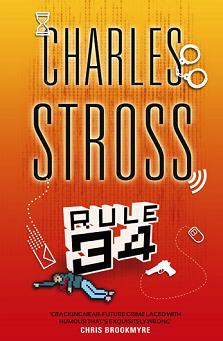
Rule 34 — Charlie Stross

Cover of Rule 34


Rule 34
Charlie Stross
358 pages
published in 2011

It’s only thanks to Christopher Priest’s tirade about this year’s Clarke Award shortlist that you remember that you haven’t reviewed Charlie Stross latest novel, Rule 34 yet. You know that, like Halting State, which it is a sequel to, it’s written in the second person and you briefly toy with the idea to write your review the same way. But then you come to your senses and decide to write the rest of the review in a less irritating way.

Not that I minded the second person point of view in Rule 34, as Charlie Stross made it work and it fit the central metaphor of these books, reality as a massive multiplayer immersive game. At the same time I can see where Christopher Priest is coming from when he writes:

Stross writes like an internet puppy: energetically, egotistically, sometimes amusingly, sometimes affectingly, but always irritatingly, and goes on being energetic and egotistical and amusing for far too long. You wait nervously for the unattractive exhaustion which will lead to a piss-soaked carpet.

Read more…

Let’s leave out the cod psychology shall we?

Let’s talk about Damien G. Walter’s poorly thought out attempt to understand Christopher Priest for a moment. I mentioned it in passing in my last post, but it’s wrong enough for me to want to point this out at greater length. Walter’s core argument is as follows:

Christopher Priest has spent his entire career being close enough to the top table to smell the gravy, but has never quite been invited to sit down. His writing is extremely clever, but even in the ‘literature of ideas’ that is SF, “extremely clever” is really a way of saying rather unemotional, dry, and hard to love. It has all the qualities of someone who has spent decades studying, learning, dedicating every fraction of a considerable intellect to learning the rules and structures of fiction, but never quite managed to get his own soul on the page. Which, in the end, is the only thing we really demand of a novelist.

Walter also characterises Christopher Priest as having spent “most of his professional career not being J G Ballard”, as in driven by jealousy of his contemporaries and envy at their supposedly greater success, sublimated into this magnificent rant against the current generation of sf writers.

In other words, “he’s just jealous”, the most single predictable thing you can say about any critic ever. It’s something you learn on the playground and should stay there. We’re grownups now and we should be able to argue against criticism without subjecting our critics to amateur psychoanalysis.

The other idea, that Christopher Priest never quite made it as a science fiction writer is ridiculous as well. Walter’s portrayal of Priest as somebody who “has spent decades studying, learning, dedicating every fraction of a considerable intellect to learning the rules and structures of fiction, but never quite managed to get his own soul on the page” is a great invention, but not true of the real Priest. Let’s leave out the strange notion that what we all want from a writer is them “getting their own soul on the page” which is a) a meaningless cliche and b) no, not what we want at all; that’s the sort of thing somebody forced to study literature in middle school would think writing was all about, not at all what real writers universally do. Some writers may feast on their own neurosises and personality, others don’t.

If you look at Christopher Priest’s career, he has always existed at the literary end of the sf spectrum and has largely followed his own path. His early 1970ties works were inspired by the New Wave but not of it, he slowly meandered from science fiction into magic realism in the eighties and nineties, returning to more mainstream sfnal themes in the last decade. He’s never really been driven by commercial considerations or any burning desire to be the top dog in science fiction, as far as I can see.

So I don’t see where Walter gets the idea from that this is what drove Priest to write his rant, when he has form for sticking his oar in. Remember the Last Deadloss Visions? Why not just take him at his word rather than invent needless psychobabble theories as to why he was driven to write this?

Priest!

Whether you’re annoyed or amused by Christopher Priest’s broadside against the Clarke Award shortlist depends on how you rate the writers he attacked. For me, it was a mixed bag. On the one hand I loved his description of Sheri “genocide is too a proper tool for solving ecological problem” Tepper’s The Waters Rising:

how can one describe it? For fuck’s sake, it is a quest saga and it has a talking horse. There are puns on the word ‘neigh’.

Which is nicely hateful to a deserving target. But how to take his judgement of Charlie Stross:

Stross writes like an internet puppy: energetically, egotistically, sometimes amusingly, sometimes affectingly, but always irritatingly, and goes on being energetic and egotistical and amusing for far too long. You wait nervously for the unattractive exhaustion which will lead to a piss-soaked carpet.

Charlie decided to take it as a joke and brought out a line of t-shirts to celebrate. Which is probably the best attitude to take as writer. Now you may know that I’m a bit of a Stross fan myself, but I can still see where Priest is coming from. Charlie can be quite enthusiastic about some very geeky things and if you don’t share those interests this might just be a bit wearing at novel length. But this is a question of taste more than of worth. Nobody can like every science fiction novel ever written and unless you want to argue that nobody should write novels like Rule 34, this isn’t a legitimate complaint.

His complaints about “PC Plod characters” and “och-aye dialogue” are more factual, but I find both of them unjustified. If you write a police procedural you’re bound to have coppers while Charlie has lived north of the border long enough to have a good ear for proper Scottish accents; he’s certainly no worse than a true Scotsman like Ian Rankin.

Meanwhile what Charlie Stross has tried to do with Rule 34 and in which for me at least he succeeded for the most part is to write a believable, proper near future science fiction thriller, in a future that we could actually be living in a few years from now. So for example there’s the subplot of exactly what a small time crook is creating with his illegal three-d printer/matter fab: creating highly realistic sex doll facsimiles of five year old girls for pedophiles. That is something you wouldn’t really imagine as an element of your standard near future setting, but you wouldn’t be surprised to be reading about in the newspaper in a decade or so.

So whether or not Rule 34 was the best sf novel published in Britain last year, it is a credible candidate and Priest’s irritation with Charlie’s writing style blinds him to this. Remains to argue why Priest wrote this attack in the first place, which is probably not, as Damien G. Walter wants to argue a belated jealousy of J. G. Ballard. More likely it’s just general irritation with a shortlist that ignores several worthy candidates for far weaker ones, expressed more strongly than other people might’ve done.