Bearing false witness

cartoon about Sandra Fluke

It’s just a coincidence that on international women’s day Tom Spurgeon linked to two of the most horrible cartoons that have been published about Sandra Fluke. The cartoon above, by Gary McCoy, is one of them, while the second one puts some racist icing on the sexist shitcake by putting in a Huggy Bear style pimp.

Sandra Fluke was the woman who testified before Congress about having anticonception as part of health care insurance and how when it isn’t covered by such insurance it can be quite expensive to pay for, especially for oral contraceptives like the pill, which have to be taken regularly and which can vary widely in cost and effectiveness. Frustrating enough that such hearings need to be held in what calls itself a civilised country, but for the dimbulbs on the American right who oppose any sort of measure that can give women any sort of control over their own bodies and sex lives, this made Sandra Fluke a whore and a slut, as Rush Limbaugh called her.

It’s no surprise therefore to see some cartoonists pushing the same stupid, hateful lie, but is depressing. Unlike Tom Spurgeon, I don’t think anybody actually believes this bullshit, unless they’re very sheltered and ignorant about how the pill works, which is impossible but unlikely and in any case no excuse. It isn’t viagra, you don’t swallow it just before sex but actually need to take it on a fairly rigid schedule to get its benefits and apart from being an anticonceptive, it’s also used to help women with a host of medical problems. To believe it’s a sex pill and a woman taking it is a slut is so incredibly stupid that it cannot be done other than in malice.

The secondary features of these cartoons confirm this malice. Gary McCoy turns Fluke into a bloated monstrosity scribbling on the doors of a men’s lavatory, while Mike Lester silences here completely, while a stereotypical pimp figure tells the reader she’s a whore. These are nasty, vile cartoons and the people who made them should lose their jobs over them, just as Limbaugh in a just universe should lose his radio show.

Because what Limbaugh and these cartoonists, as well as all those good Christians chuckling over their jokes” are doing is bearing false witness, lying about and attempting to destroy one ordinary woman just because they see some transient political gain in it.
Not quite a happy birthday

So this time last year I realised that in 2012, this blog would turn ten years old and today is the big day, as my first post was published on 7 March 2002. Of course, that was two blog versions ago, both of which are still running though not being updated and links to which still work. In fact, I still need to upgrade quite a few entries on those to the “new” Wis[s]e Words, even three years after switching…

Today would be a happy occasion, if not for the depressing fact that today is also exactly four months since Sandra died and of course my thoughs are more with her than with the blog, as they always are. I can sometimes stop thinking about her, especially at work when I keep myself busy, but barely an hour can go by without me being reminded of her. Sometimes this is more difficult than at other times. For example, last Sunday I was listening to the Archers omnibus on Radio 4, a fixed part of my Sunday morning routine: get up during the morning service, get showered and dressed, then make coffee and breakfast while listening to broadcasting house, finally read the newspapers and blogs and all about how Aston Villa once again snatched defeat from the jaws of victory while listening with half an ear to The Archers. I can’t help it, you’re obliged to as a Radio 4 listener and besides Sandra got my addicted to it.

But this week’s omnibus hit me hard, because it included Tony Archer’s heart attack, which made me think of Sandra immediately. Not the heart attack itself, which fortunately she never had, but the circumstances surrounding it. His son Tom had had a bit of a row with him and went back to talk it out again, finding him on the floor and confused and not knowing what was happening, just that he was in pain, breathing rapidly. There have been a number of times that I had to find Sandra like that, having to wait for the ambulance, having to ride with the ambulance to the hospital, knowing that things had gotten bad again.

Which isn’t meant as a plea for sympathy, it’s just one of those things I have to deal with, “flashbacks” like that. At the time when you had to deal with a situation like that, you have no choice but to keep it together, not to think too much about it. And since most of the last two years have been either emergencies or attempts to recover from setbacks, I haven’t had much time to think it all over, which is now coming back to bite me. Now I’ve got too much time to think and wonder about what to do with the rest of my life, other than going to work, blog, read and watch tv…

On a lighter note, Sandra would’ve screamed and screamed reading this story, as she was not fond of spiders. I really shouldn’t have teased her with it as much as I did.

Hullo John got a new ‘puter?


Well, yes, I do, as my old one died two weeks back. That was Sandra’s old computer, Id bought for her from a co-worker in 2008 or so and the hard disks just gave up the ghost. Its been through the wars before and she had already lost the data that had been on it a long time ago, so no great loss. Might buy a cheap new harddrive and get it fixed anyway, just for kicks. The new computer is great and I’m well in the honeymoon phase of owning a new computer, except for having to reinstall all my old favourite programmes and settings, which is always a chore. Not of great interest to anyone but me, I know, so have some Alexei Sayle.

Of more interest, this casual suggestion that the US might have experienced its Suez moment:

Humphrey is increasingly of the opinion that we are witnessing the USA’s ‘east of Suez moment’ at which the US is faced with the same strategic challenges that all empires are faced with. The legions will be recalled from Europe soon, and this is going to leave a major series of security and other challenges that need to be filled.

Which would make the War on Iraq something like what the Suez Crisis was for the UK: a point at which America’s military capabilities outreach its political power. It was capable of invading and winning battles, but its military might did not help America reach its wider goals. The War on Iraq was the quintessential late imperial war, one not waged for a concrete, achievable goal, but more to show that the aggressor is still an empire, still top dog. It didn’t quite work out that way, which means the empire is still looking for another enemy to defeat to make everything right again, hence the confrontational stance with Iran.

Doomed Wikipedia still doomed

The latest Wikipedia media controversy is a bit of a storm in a teacup, is the conclusion of the commenters at MetaFilter, but there is a kernel of truth in Timothy Messer-Kruse’s story:

One of the people who had assumed the role of keeper of this bit of history for Wikipedia quoted the Web site’s “undue weight” policy, which states that “articles should not give minority views as much or as detailed a description as more popular views.” He then scolded me. “You should not delete information supported by the majority of sources to replace it with a minority view.”

The “undue weight” policy posed a problem. Scholars have been publishing the same ideas about the Haymarket case for more than a century. The last published bibliography of titles on the subject has 1,530 entries.

“Explain to me, then, how a ‘minority’ source with facts on its side would ever appear against a wrong ‘majority’ one?” I asked the Wiki-gatekeeper. He responded, “You’re more than welcome to discuss reliable sources here, that’s what the talk page is for. However, you might want to have a quick look at Wikipedia’s civility policy.”

Timothy Messer-Kruse wasn’t quite as innocent as he made himself out to be in this story, but he does have a point here, that Wikipedia’s policy of verification over truth privileges wrong but easily traceable facts over the correct facts. It’s somewhat similar to the journalistic doctrine of objective reporting, where a reporter is not allowed to judge the truth of a situation themself, but has to provide a he said/she said sort of balanced coverage. With Wikipedia, there’s an allergy against anything that cannot be traced to an external source, preferably a secondary source at that. There’s some sound reasons for that policy: makes it more difficult for cranks to put their own pet theories in, makes it easier to judge articles on reliability, but it does mean that Wikipedia needs to sacrifice some truthfullness to achieve this. Hence situations like this, where the verifiable facts lag behind the state of the art.

This story also illustrates another large Wikipedia problem, something that’s perhaps even more worrying. It has become easier and more rewarding to be a rule lawyer at Wikipedia than be an actual editor. It’s easier than to just slap up a warning on a page that something is wrong (case in point) than it is to actually fix it. If you do attempt to fix something or even start something new, the odds are likely that somebody else will overrule you, as with the huge amount of rules and policies now guiding Wikipedia, it’s difficult not to do something wrong.

Which is why I stopped bothering a long time ago, save for obvious tyops and errors that I come across when reading Wikipedia. I still use it, but I don’t do much editing there as it’s just not fun anymore and hasn’t been for years.

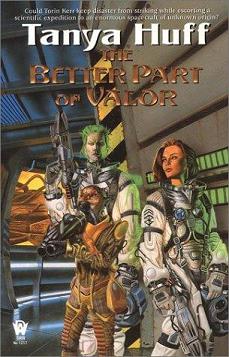
The Better Part of Valor — Tanya Huff

Cover of The Better Part of Valor


The Better Part of Valor
Tanya Huff
411 pages
published in 2002

Once I had finished Valor’s Choice, I knew I was going to have to go back to the bookstore I’d found it in and get the other two Tanya Huff books I’d saw there too. To be honest, I hadn’t even taken me as long as finishing the first two chapters to decide this. I’m always on the lookout for good, intelligent military science fiction and Valor’s Choice was just that, which meant I had to get the sequels too. What I especially liked was the absence of the sort of nasty rightwing politics souring me on so many other mil-sf writers.

The Better Part of Valor starts with staff sergeant Torin Kerr just back from her mission in Valor’s Choice. Having had words with general Morris, who was responsible for said mission, she is immediately sent out on another one by him, without her own platoon even. Whether this is punishment or reward she isn’t sure, but it turns out she will join a new marine platoon put together from scratch to protect a scientific expedition to an “unidentified alien vessel drifting dead in space”. She hopes it will be an uneventful recon mission, but after the last one she was sent on by general Morris, she isn’t hopeful.

Read more…