It’s Charlie’s world, we just live in it

Back when he was writing Halting State Charlie Stross already complained that reality was overtaking his imagined futures and with the sequel, Rule 34 this process only accelerated.

Today The Pirate Bay announced it was going into fab distribution, setting the first steps to making another of Charlie’s predictions come true:

We believe that the next step in copying will be made from digital form into physical form. It will be physical objects. Or as we decided to call them: Physibles. Data objects that are able (and feasible) to become physical. We believe that things like three dimensional printers, scanners and such are just the first step. We believe that in the nearby future you will print your spare sparts for your vehicles. You will download your sneakers within 20 years.

The benefit to society is huge. No more shipping huge amount of products around the world. No more shipping the broken products back. No more child labour. We’ll be able to print food for hungry people. We’ll be able to share not only a recipe, but the full meal. We’ll be able to actually copy that floppy, if we needed one.

Incidently, one of the things Charlie predicted widespread use of 3-d printers/matter fabbers would be used for is the distribution of particularly nasty, highly illegal sex dolls. Hope this doesn’t come true too…
Get it out of your cis-tem

It’s been somewhat depressing to see how fast a Metafilter post on the obstacles put in the way of (young) transgendered people wanting to start transition can dissolve into a food fight about the use of “cisgendered” as the opposite of “transgendered” and how unreasonably angry it makes some people. I expected different from MeFi, which is both fairly liberal and hip and open to all kinds of people.

It all started with a post paying attention to a problem many young transgendered people face: continuous societal pressure not to start transition, to start living life as a member of the gender they feel themselves to be. As one commenter put it, “the entire foundation of transsexual health care is to protect cis people from making a terrible mistake, rather than to help trans people transition with as little added pain as possible”. It is a huge problem, because it means many more trans people are stuck with the wrong gender for longer than necessary, all to avoid the much rare false positives, those cases where somebody believes they are trans, but are wrong, before they’ve made an “irrevocable mistake”. It’s not necessarily done out of malice, more out of a sort of twisted interpretation of the Hippocratic oath of first do no harm.

A nice meaty and important subject for Metafilter, but within a few posts it was disrupted by people annoyed at the use of the terms “cisgendered” and “cis” to mean non-transgendered people. Some just objected because it was supposedly bad English, or because they disliked neologisms, others because they disliked having politicalised language forced on them, or because it “othered” them or they didn’t recognise themselves in the label. It really was derailing 101 in action.

Truth of the matter is that yes, while but “cis” and “trans” are imperfect labels (for starters, they imply a binary opposition between themselves, rather than a spectrum of possibilities between being fully trans or fully cis gendered), they are the closest we have to non judgmental, neutral terms for these conditions. Anything else is either a slur, or unwieldy to use, or both. And of course we’re all special little snowflakes unable to be caught by any label, but it can be very handy in political debates to have these kinds of easy to understand, easy to use, non-insulting terms to use to groups of people that have something in common important in the context of the debate. Nobody should feel insulted by being called cis.

I certainly don’t.

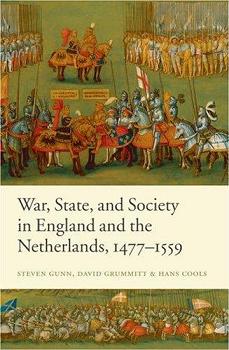
War, State and Society in England and the Netherlands, 1477-1559 — Steven Gunn, David Grummitt & Hans Cools

Cover of War, State and Society in England and the Netherlands, 1477-1559


War, State and Society in England and the Netherlands, 1477-1559
Steven Gunn, David Grummitt & Hans Cools
395 pages including index
published in 2007

Everything the authors tried to achieve with this book is in the title, but whether they succeeded is another question. Based on a massive research project that was carried out between 1999 and 2002, what the book was intended to be was a comparative study of two roughly similar countries in a period critical to Early Modern European history, to determine the impact of war both on society and the (semi-modern) state. As the authors argue, both England and the Netherlands (meaning what we would now call the Low Countries) were sort of outliers in Europe, neither quite fitting in “conventional narratives of the growth of state power”, not as centralised as other countries and with a greater level of democracy. For English historians, an added advantage of this comparison is that it puts England back into an European context by showing the simularities and differences between the two countries’ experiences.

War, State and Society in England and the Netherlands, 1477-1559 is impressive and interesting but what it lacks is that comparative aspect that the title and introduction promises. It’s more a parallel than a comparative history, with developments in the two countries looked at side by side. So you’d have a section on the defence of towns looking first at how English towns dealt with fortifications, then at how Dutch towns did the same, but nothing much on how they differed or why they did. This lack of analysis wasn’t that big a problem for me personally because I found the subject interesting enough already.

Read more…

Moar books

Cannot stop buying books

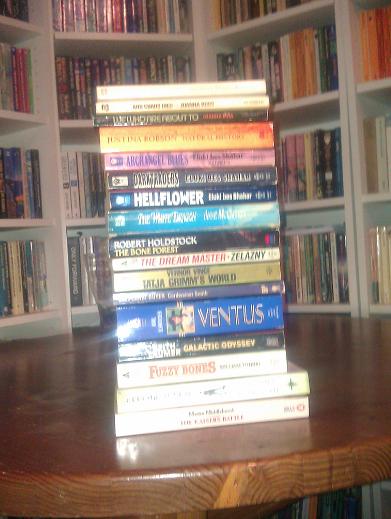
Not the best of pictures, but good enough to show off the books I bought yesterday. And yes, I know I have too many books already, not to mention a fair few library books that need to go back soon. But I can’t help it; every now and then I get the urge and need to get more. What’s nice is when that urge is satisfied, like it was this time. Sometimes you have to let a bookstore lie fallow for a while, not visit for a couple of weeks or months to give it time to surprise you. The secondhand English bookstore near Nieuwmarkt I got all this from certainly did.

From the bottom up: The Kaiser Battle, about the first day of the last German offensive in World War I by Martin Middlebrook, Justina Robson’s Keeping it Real, the William Tuning sequel to H. Beam Piper’s Little Fuzzy novels, a pre stroke Keith Laumer novel I haven’t read yet (Galactic Oddyssey), Karl Schroeder’s debut novel Ventus, Cordwainer Smith’s The Planet Buyers, Tatja Grimm’s World, an early Vernor Vinge novel, a Zelazny novel I didn’t know yet (The Dream Master), Robert Holdstock’s The Bone Forest…

Moving on to the female writers: there’s Ann McCaffrey’s The White Dragon which I foolishly had gotten rid off a few years ago, the first three Eluki Bes Shahar Hellflower space adventure stories and Justina Robson’s debut novel, Natural History which had been on my wishlist for ages.

But the books I’m most happy to have found are at the very top: three Joanna Russ novels: We Who Are About to, And Chaos Died, and The Two of Them. Reading The Female Man last year was a revelation; I hadn’t realised how good Russ was as a writer, rather than as “just” a feminist science fiction writer. Annoyingly, that reputation of being a firebreathing feminist had kept me far too long from trying her novels and then when I did want to read them, I couldn’t find them anywhere. Not anymore.