The King’s Peace — Jo Walton

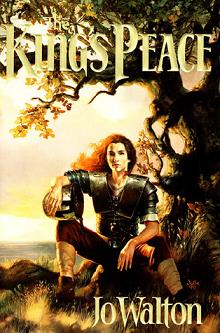
Cover of The King's Peace


The King’s Peace
Jo Walton
416 pages
published in 2000

When I put together the list of science fiction and fantasy books I’d planned to read for my Year of Reading Women project last year, I’d knew I’d want something familiar and enjoyable to close out the year, as a reward. Looking over my bookshelves the choice was easily made: I hadn’t read The King’s Peace since it had first come out in 2000 so it was high time I reread it. Back then I had come to it cold, without any preconceptions other than Jo Walton’s reputation as one of the best posters on the rec.arts.sf newsgroups. Rereading it now, having read more of her novels and also knowing somewhat more about the setting she used or at least the historical inspirations for it, have changed The King’s Peace for me, in a positive sense.

To start with the setting, you could call The King’s Peace an Arthurian romance set in a fantasy Britain, but that’s not quite right. I prefer to call it a histoire à clef, where Walton has taken post-Roman Britain at the time of the Saxon invasions and changed it. So the Roman Empire here is called the Vincan Empire, the Saxony raiders are Jarns, Britain is called Tir Tanagiri and instead of a King Arthur there’s king Urdo whose Lancelot, Sulien ap Gwien is the first person narrator of the story. When I first got to grips with the story more than a decade ago this all seemed needlessly complicated and I wondered why she hadn’t just written a straight Arthurian story. But I think it makes sense.
Read more…

Onwards into 2012


So yesterday I got back from my parents where I’d been for the holidays; a bit of a bother dragging the kittens there and back again on the train, but managed succesfully with a little help from my mum. The kittens behaved quite well on the whole, but Sophie did gave me an heart attack a few days ago when she slipped out of the window in my second storey bedroom into the gutters. That wasn’t too bad, but then she tried to clatter up the rooftiles and I could just grab her before she plummeted back…

Apart from that little incident the holidays were quite relaxing, with endless games of Colonists of Catan and some light reading, but coming back to my empty flat did bring home the reality of life without Sandra again. I lived with her for the better part of a decade and the last three years especially were lived for her; getting ready for the kidney transplant first, then trying to get her out of hospital and back home and finally her dying and funeral.

I’m not sure what to do now. Suddenly there’s this big hole in my life where Sandra used to be and I’m not sure yet what can fill that hole, if anything can. The last two months I’ve gone through on autopilot, but now I’ve had time to think and reflect on what to do with the rest of my life and just don’t know what to do with myself…

Singled Out — Virginia Nicholson

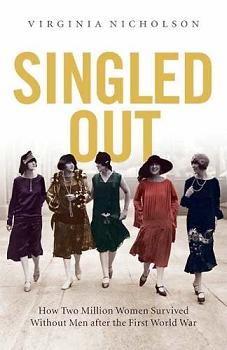
Singled Out


Singled Out
Virginia Nicholson
312 pages including index
published in 2007

I found Singled Out in the Middelburg library and picked it up because it looked like the sort of book Sandra would’ve enjoyed reading. She had always been interested in social history, especially of Britain between the wars and of the role women played in these years. Sandra had actually been the one who first pointed out to me why there were so many spinsters in twenties and thirties detective stories, all those women living alone in bedsit rooms or sharing a cottage together. That was something I had noticed but assumed just to have been some sort of convention of the genre, rather than something real reflected in fiction.

But that was exactly what it was, as the interwar period was the period of the “Surplus Women”, two million women for whom there was no and would be no husbands, with the “flower of British manhood” cut down in the mud of Flanders. The First World War had left hundreds of thousands British men dead and many more crippled for life and a whole generation of women without enough husbands to go around. Granted, as the raw statistics prove this was not a new situation, as in Victorian times too this had been the case, but this was the first time this gender imbalance was both large and out in the open. This time it had hit the middle and upper classes disproportionally and therefore was widely commented on in the media and felt by those women themselves. What’s more, it came at a time of huge societal changes and anxiety and, as Nicholson shows, these socalled “surplus women” played a huge role in making British society more equal to women in general.

Read more…

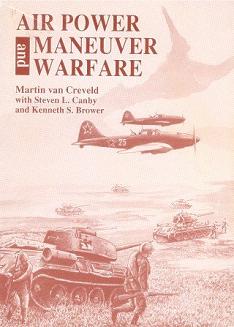
Air Power and Maneuver Warfare — Martin van Creveld et all

Air Power and Maneuver Warfare


Air Power and Maneuver Warfare
Martin van Creveld, Steve Canby & Ken Brower
268 pages including index
published in 1994

Air Power and Maneuver Warfare is a strange book. At first it seems to be just a theoretical and historical overview of how air power and maneuver warfare fit together, but something seemed off from the start. This book was commissioned by the US Airforce’s Air War College just after the Cold War had ended and more importantly, the US military establishment finally started to be convinced of this. It’s a political document as much as a theoretical one, written for an audience that’s supposed to be familiar with the theory of “maneuver warfare” (sic) but who do needed to be convinced of the argument Creveld and his co-authors are putting forward.

Said argument seems to be that the US Army needs to move away from its historical attrition warfare, linear orientation towards a more flexible maneuver orientated attitude, to be better able to deal with the challenges a post-Cold War world will throw at it. Meanwhile the airforces also need to shift towards a more tactical support role for the army rather than being obsessed with strategic air warfae and air defence suppression. This latter is not a new criticism of course, as ever since the USAF became a seperate arm of the armed forces it has been accused of neglecting tactical air support. The irony of it all is that while van Creveld and his co-authors (politely) argue that the then current strategic orientation of the US Armed Forces is outdated and inadequate to deal with the complexities of a post-Cold War world, their own recommendations are just as much a product of Cold War thinking, assuming that potential opponents will need to be and can be defeated by conventional military operations.

Read more…