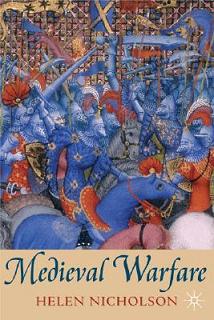
Medieval Warfare — Helen Nicholson

Cover of Medieval Warfare


Medieval Warfare
Helen Nicholson
232 pages including index
published in 2004

Helen Nicholson’s Medieval Warfare is, as she puts it in her introduction, “intended to provide a point of entry tpo the subject of medieval warfare for students and others with an interest in the subject who are perplexed by the rapidly expanding body of scholarship in this area”. Which is just what I needed, as this is indeed a subject I’ve become interested in following on from my earlier readings in Late Antiquity and the Early Middle Ages. Medieval Warfare is an ambitious book for trying to cover this whole period (300 to 1500 CE) even in overview in just 166 pages, excluding index. But Nicholson is a reader in history at Cardiff University who has written extensively on Medieval military matters and therefore is well suited to the task.

As any good historian should, she sets out how she will go about it in her preface. What she attempts to do is to look at the development of the main aspects of medieval warfare from just after the end of the (western) Roman Empire to the end of the Middle Ages, using concrete examples to illustrate these developments. She chose the period 300 to 1500 CE to emphasise the continuity between the military practises of the Late Roman Empire and the Middle Ages, with the latter date providing a convenient cutting off point between them and the Renaissance. The fourth century was chosen as a starting point because it was in the late fourth century that the Roman bureaucrat Vegetius wrote his manual on military strategy, a book that was hugely influential in European warfare until at least the sixteenth century. Geographically, Nicholson limits herself mostly to Europe, particularly France, Italy, England and Germany for her examples, though she does look to Eastern/Byzantine examples as well when appropriate.
Read more.

Da Vinci Code not completely worthless shocker

Adam Roberts has set himself the task to review the world’s top ten best selling books for some reason best known to himself. At number nine is Dan Brown’s The Da Vinci Code and Adam manages to find some positive in the book:

No, I’m talking about two broader ideas. And here’s the first: that the world is not as it seems, and that — particularly where high culture, established religion, wealth and power are concerned — you need to dig down beneath the surface appearance of things to get at the truth. Now this is an idea both powerful and dangerous, for applied with too much force to a receptive consciousness it can easily lead to conspiracy-theorising, batshittery and all manner of ‘lizards secretly rule the world’, ‘the moon landings never happened’ and ‘9-11 was an inside job’ idiocy. But it is an important idea nonetheless; and insofar as a large constituency of people on the planet are in the habit of taking things, particularly Established Things like church and government, precisely at face value, it is a progressive one. Of course, this idea is shrouded around in the book with a great deal of chaff and bollocks; but that matters less, I think, than people think it does.

What the second idea is you’ll have to read the rest of his post.

First Christmas without her

Have some Robert Fripp Christmas cheer:


And so ends my first Christmas without Sandra. To be honest, I haven’t thought much about her, unless this was playing. Which is what I was hoping for spending the holidays at my parents, away from everything that would’ve reminded me of her and celebrating Christmas with her. Instead I fell back in the old family patterns, which is just what I needed right now even if I dreaded it a bit beforehand. It’s been relaxed, with a nice proper dinner yesterday, turkey and all and not too many obligations other than playing Settlers of Catan.

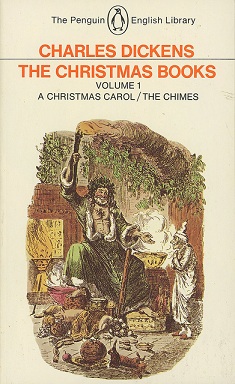
A Christmas Carol — Charles Dickens

Cover of A Christmas Carol


A Christmas Carol
Charles Dickens
100 pages
published in 1843

Sandra always loved Dickens more than any other Victorean novelist and she always tried to convince me to try him but never succeeded. So I thought that it would be nice to try a couple of his novels next year in her honour and to warm up I thought I’d start with A Christmas Carol. It’s short, it’s the season and the story is so familiar to me from various adaptations that I could almost read it on autopilot. I actually read it in its entirety on the train journey to my parents when I was going home for Christmas.

Stories like A Christmas Carol, which are so popular and have been adapted so often that they’ve become part of the background cultural noise, are always interesting to go back to. With some of these stories the original is so different from what you expect that it’s actually a disappointment to read them, as you run into all the awkward bits that had been filed off through various retellings. This wasn’t the case with A Christmas Carol: it’s exactly as you’d expect it to be.

Read more…