Comics might be dangerous to your mental health

Tom Spurgeon interviews Tucker Stone:

It is a bit harder to read as many of them now than when I started. I find myself less enthusiastic about new material as time has gone on, and while that makes the high points that much better, there’s a wide expanse of tiresome comics that has to be plowed to get to the good stuff. I know I would not have inhaled a lot of the crap that I have over the last year if it wasn’t for the store and the relationships that have sprung up out of that.

[…]

So much of comics — and I’m thinking the whole industry, not just Marvel/DC — is dedicated to hyper-consumers, you know? It’s all about buying this stuff immediately upon release, amassing these tomes and libraries and archives alongside the weekly installments of whatever genre stuff there is. Nobody can keep anything in print, there’s so few people qualified to cleave the wheat from the chaff. It’s just buy-buy-buy, X-9 hardcovers and 26 volumes of Peanuts and another re-release of Prince Valiant and 16 newly-translated softcovers from wherever [D+Q Publisher Chris] Oliveros went on vacation. I get sick of trying to play the democratic catch-all who gives everything a chance, sick of that feeling where I’m constantly staring off into the next few months, waiting to see what comes next. And it doesn’t do service to the work, either. It just becomes an ingestion process, this thing where you’re constantly shoveling comics into your head like an old school meat grinder. Reading years of work in days, binging on the stuff, and just checking it off and moving onto the next thing… it’s gross.

I’ve been there. When I was in my twenties and got my first fulltime, proper job and “earned” a huge salary while still living in a student flat with almost no bills to pay; gas, water and electricity being included in the not very onerous rent. It left me with a lot of disposable income which meant that I could buy a lot of comics and months in which I dropped over a thousand guilders on in retrospect often not very good comics. At the same time I had discovered comics fandom online, both in the rec.arts.comics.* Usenet groups as with mailing lists like the late, lamented @Comix run by iirc Charles Hatfield. This was long before blogs, but the effect was the same: you had a community of likeminded, dedicated comics readers, all of whom were very heavy consumers/readers of comics, always looking for the next big thing. This was both a good thing, as there were finally knowledgable people I could jaw about my hobby with, but it also meant that I was constantly pressured to buy more and more comics, if only to “keep up” with the ongoing discussions. Living in the Netherlands already put me at a disadvantage as most US comics only were available at least a week later than in America, so I had to buy the comics as soon as they appeared.

For years I was more than happy with it, but one Sunny day at the Haarlem stripfestival in 2000 I was just fed up. I went home early, didn’t come back the next day and didn’t stop at my local comic shop that week. Or the next. Or the week after. Or ever. I had gorged myself on comics until I was thoroughly fed up by them, stopped cold turkey and didn’t buy any for years, even going so far as dropping most of them off at my parents. (A few months later I met and fell in love with Sandra, but that’s another story.)

Since then I’ve gone back to comics, but I learned to be wary of going back into Club Comics, of making them my entire waking life, of thinking of them as a cause rather than a form of entertainment or an artform. The dirty little not so secret of American comics is that it thrives on persuading a relatively small group of readers to be hyperconsumers, going on weekly pilgrimages to the comic shop and making this into something like a duty rather than a commercial transaction — viz all those people who keep buying the same old shitty Superman comics they always did even though they don’t enjoy them. This is not something you see in many other entertainment fields… It’s not a healthy relationship and the best thing I ever did was to get out of that, to stop obsessing about comics and learn to enjoy them again.
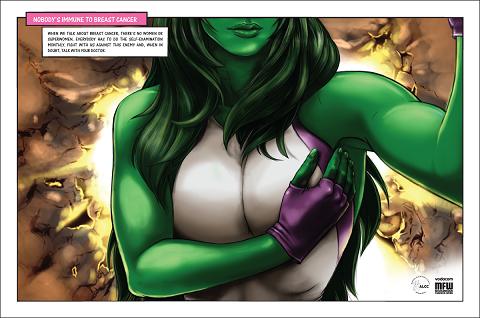
Not even She-hulk is immune to breast cancer

She-Hulk promoting breast cancer awareness

None of the obvious jokes please. She-Hulk and several other Marvel & DC superheroines have been enlisted to fight breast cancer in Mozambique according to Africa is a Country:

Nobody’s immune to breast cancer. When we talk about breast cancer, there’s no women or superwomen. Everybody has to do the self-examination monthly. Fight with us against the enemy and, when in doubt, talk with your doctor.

It makes a certain amount of sense to use these comic book icons for this campaign, but I don’t think you’ll see a similar one in America soon. Titillation yes, self examination for breast cancer? Not so much…

Not quite looking forward to Christmas

I may not look it on the outside, but I’m actually quite sentimental if I let myself, which is why Christmas and especially New Year’s Eve are always a bittersweet time of the year for me even in normal circumstances. Everything surrounding Christmas is drenched in sentimentality about the family and love for the family of course, which is nice if you have a family, not so much otherwise. And then there’s New Year’s Eve and the runup to that, as we all get to reflect on the year past and what went right and what we’d like a do-over on. I always hated that anyway — “another year of not achieving much” — but this is the year Sandra died.

And it’s only been slightly more than a month since she died and it’s been hard, but as long as I can keep up my routines I can cope: go to work, obsess about blogging or cataloging books and comics, don’t try to think too much. But I will be off work from Friday and going to see the family (taking the cats on the train too, which will be fun) and I’ll have two weeks without much distraction but everything reminding me. Not that I won’t have fun at Christmas or not look forward to be away from home for a while, but I think the wee small hours will be a little bit less comfortable…

To be honest, the freaky sex toys are less scary


And here I thought the most disgusting thing I’d on the internet all day would be the Rule 34 confirming Scary Sextoy Friday blog (very NSFW sample) but the New York Times proves me wrong with a much more mainstream piece of filth:

Beyond any of that, though, the wedding was probably the first in the city to be held as a kind of TED conference. After the ceremony, in which chants were chanted and vows, written by the couple’s friends, were exchanged, guests sat down to a series of talks, with PowerPoint presentations, on subjects of interest to the couple — ecological efficiency, neuroscience, holistic healing. Those who did not care to listen wandered about eating dumplings and popcorn, which made up the entire nuptial meal.

The evening’s keynote speaker, more or less, was Graham Hill, a TED alumnus — Technology, Entertainment, Design, that is — the founder of the Web site Treehugger, and Mr. Friedlander’s employer at LifeEdited, where the groom works in marketing and communications. LifeEdited is a commercial enterprise and a movement, one that aims to get people to rid themselves of many of the excesses that industrial living has caused. Mr. Hill gave a talk about the importance of personal downsizing, which was largely a talk about his life.

[…]

When he moved to New York he settled into a small apartment. Soon he will move into 420 square feet of sleek, economically designed space in SoHo with a Murphy bed and movable walls. The purpose of LifeEdited is to develop more apartments and buildings like his and to get people to live with fewer things of higher quality. The motto of the movement is “the luxury of less.” (Mr. Hill did not seem aware of how unnerving it can be to hear rich people talk about the pleasures of not spending money.)

The rich are different from you and I — more obnoxious for a start.

The origin of fan consciousness in the breakdown of bicameral culture

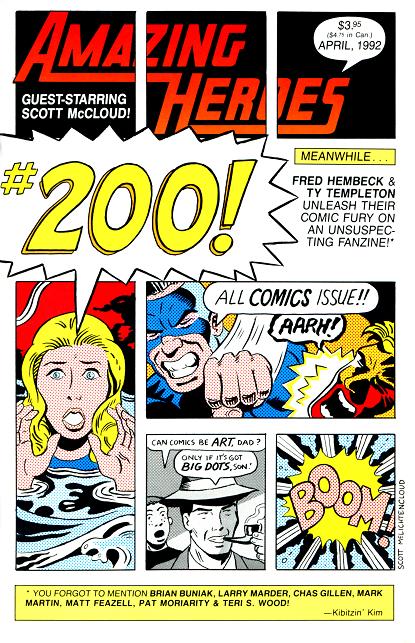
Amazing Heroes 200 cover by Scott McCloud

“Can comics be ART, dad? Only if it’s got BIG DOTS, son!”

That joke Scott McCloud put on the cover of Amazing Heroes #200 neatly shows the attitude of most comics fans to the occasional plundering of comics by the high art world: slightly amused, somewhat defensive but mostly irritated. To see Roy Lichtenstein get the credit, fame and fortune for swiping the work of other, largely anonymous artists is annoying, though I do think we can get a bit too defensive about it as comics fans, not an artform adverse to a bit of creative stealing itself. Nevertheless I can understand Scott Edelman’s annoyance at encountering a modern Lichtenstein repainting comic book pages panel by panel allegedly without crediting the original artists and passing it off as high art:

The intended market of buyers for these works of art would probably assume that the comics depicted in them sprang whole from the mind of the artist, and are a commentary on pop culture in general, rather than being line for line reproductions so close to the original comics that the artist might have been better served taking a photograph of the original comic book pages and framing that. Roy Lichtenstein, who I felt was profiteering on the work of great comics artists, at least altered them to suit his own style, as can be seen by this comparison plucked from David Barsalou’s site Desconstructing Roy Lichtenstein, which shows a Russ Heath panel side by side with Lichtenstein’s recreation.

I never looked at a Lichtenstein without feeling angry on behalf of the unnamed comics artists, because I always felt that a fraud was being perpetrated upon an ignorant audience, one that might assume he was making a commentary on the culture though the tropes of comics in general, as opposed to plundering specific artwork. (I believe any curator of an exhibit of Lichtenstein’s work who fails to include reproductions of the original panels falls down on his or her job.) But again, at least he made alterations to the original works, rather than passing along the unfiltered imagery of Joe Kubert, John Romita, and others as his own.

I’ve always shared Edelman’s feelings about Lichtenstein to some extent, though I do think that his artwork does have an intrisinct worth nonetheless that Shary Moody’s modern equivalent doesn’t have. The difference is one of cultural context.

Roy Lichtenstein’s paintings of blown-up comics panels were mostly made in the early sixties, before 1965. This was a time when comics still was largely anonymously made, mass produced junk culture which even the people making them for the most part didn’t consider art. This was when high and low culture were still taken seriously, before the rise and rise and rise of pop culture. Comics fandom was still in its infancy and there was nobody to champion comic books: Alter Ego started in 1961, the Batman tv series only happened in 1966, it was still a proud and lonely thing to be a comics fan. Comic books for all intents and purposes therefore were mass produced industrial artifacts of the throwaway consumer society, just like Warhol’s soup cans were. There was no way for Lichtenstein to credit the artists he was inspired by because nobody knew who they were. Even somebody like Kingsley Amis, openminded enough to champion science fiction, could only do so by offering it as a superior form of popular culture, rather than as part of literature in its own right.

But since then, with the rise of pop culture, the democratisation of the arts that brought along and the almost complete disappearance of the distinction between “high” and “low” forms of art, comics have become an artform in its own right. What’s more, thanks to the pionering work of those weirdos who always saw something more than disposable entertainment in them, its practitioners, like their counterparts in newspaper strips, magazine and even advertising illustration, have been de-anonymised, been identified and credited for their art. Which means that while Lichtenstein in 1963 could turn a Russ Heath panel from All-American Men of War into a painting and look genuinely innovative and progressive by repropositioning “low art” in a “high art” context, just looks lazy and downright insulting at best when done by Sharon Moody in 2011. It offers nothing new, it’s just passing off somebody else’s creative decisions as your own work by copying it. This is neither low nor high art; it’s bad art.