Ask a simple question


James Nicoll wants to know when cyberpunk died, a question that isn’t that easy to answer. Cyberpunk was an eighties movement, but there are still cyberpunk novels being written and cyberpunk inspired movies being made. In one sense then it hasn’t died yet, but in another it’s clear that somewhere when the eighties turned into the nineties cyberpunk was mugged by reality.


As I said in my review of Trouble and Her Friends, that book came out just when the real internet broke into the mass consciousness, which is as good a place as any to mark cyberpunk’s passing, when its visions of what online life would be like were definatively proven wrong. Cyberspace moved from fiction to non-fiction, there was a small boom of silicon snake oil and that was it for the genre.


But that might be too late. Cyberpunk actually might have died early, at the end of the eighties, between 1989 and 1991 as the Soviet Union collapsed, the Gulf War made spectacle out of consensus reality and the political systems cyberpunk thrived on and took for granted collapsed. Let’s not forget that one of the casualties of the end of the Cold War was the Reaganite return to a manned space programme. Remember, the Shuttle and the ISS would’ve only been the beginning as America would go to Mars, while the Soviets were methologically working on extending their space programme as well, with Mir and all that. Cyberpunk always had in its background this idea that manned space exploration was not only important, but the inevitable future.


And then it turned out not to be…


Leaving books like Neuromancer (climax set on a space station big enough to have tourism), Frontera (set partially on Mars) and The Schismatrix (set in a Solar System ruled by O’Neil colonies) instantly outdated.
See also.

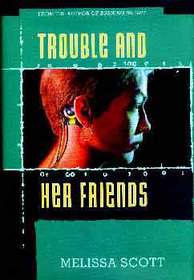
Trouble and Her Friends — Melissa Scott

Cover of Trouble and Her Friends


Trouble and Her Friends
Melissa Scott
379 pages
published in 1994

Trouble and Her Friends is the tenth book I’ve read in my Year of Reading Women project and the first and only cyberpunk novel in the bunch. It’s a book I’ve long wanted to read, having heard nothing but praise for it over the years and seeing it compared to e.g. Pat Cadigan’s cyberpunk novels. As I started reading it, there were two minor things that disappointed me: the first was the publication date, 1994, much later than I though, the second was the tendency of the covers to flake, something it has in common with other Tor books of that period. I’d always assumed Trouble and Her Friends had been published in the mid-eighties; certainly the setting is very eighties.

This matters because it means that not only is its future dated now, but it was already obsolete when it was first published. Trouble and Her Friends‘s vision of cyberspace is essentially an eighties one, where it’s important but largely unused by regular people, divided into discrete blocks owned by huge multinationals and hidden behind ICE (Intrusion Countermeasures (Electronic)) to ward off hackers, who seem to be the only people behind corporate drones to use cyberspace. It’s obviously inspired by the BBS scenes of the eighties and indeed the main hacker hangout is called the BBS. Yet 1994 was the year the internet fully broke into the public consciousness, when it should’ve become clear that it’s the openness of the internet and interaction with other people on it that are its greatest strengths, far removed from the lonely adventures of isolated hackers battling in virtual reality with faceless corporate ICE software that most cyberpunk, including Trouble and Her Friends, offers — it’s probably no coincidence that it largely died as a subgenre in the mid nineties. What saves Trouble and Her Friends from complete obsolescence can be summed up in one word: politics.

Read more…

Sandra: two weeks on.


Neither Sandra nor I believe in an afterlife, but if her ghost is floating nearby somewhere right now she would be so pissed. Because if there’s one song guaranteed to drive her nuts it was the Wu Tang’s Gravel Pit. Just mentioning it would give her an earworm. So if ectoplasm starts to drip from the walls tonight I’ll know ghosts are real…

Meanwhile it’s been almost two weeks since she died — it’ll be exactly two weeks at 2:30 tonight. Last week was mostly a blur, this week I went back to work and “normal” life but it has been strange. Strange to not live a life revolving around hospital visits. One of the things that helped, but last week and this week has been to immerse myself in a bit of archive binging, first reading through the entire Something Positive archive while I was sitting next to Sandra’s body, then continuing with Sluggy Freelance when Something Positive had run out of archive…

I don’t want to dwell on her death; rather I would like to use my Sundays to remember Sandra with a new blog feature. So for the next few Sundays or more I’ll be writing about her and her interests.

Because I don’t want to wake up one morning and realise I’ve forgotten her.

If the Twilight series is your idea of a feminist text…

So somebody at The Hairpin thinks she’s at Slate and writes a contrarian article that praises the Twilight series for its supposed insight into what teenage girls are “really like”. In the process she let’s out the following sneer towards the Stieg Larsson Girl Who… novels:

Lisbeth Salander, the heroine of the popular The Girl With a Dragon Tattoo series, is emotionally stunted but, damn it, she actualizes herself! She punishes the people who hurt her, she sleeps with whomever she wishes, she zips around on a motorcycle, and she’s a master computer hacker. In other words, our actualized female heroine might as well be a tiny man.

It’s a weird sort of feminist critique that sees revenge, an active sex life, computer hacking and riding a bike (!) as inherently male and a woman engaging in them as “a tiny man”. Wasn’t the whole idea of feminism that women should be able to do the same things as men, should be able to seek revenge, have sex, play with computers and even feel a throbbing engine between their legs if they want to? Sure, there has been a backlash agains the idea that this is all feminism should be, that women should turn themselves into surrogate men to be taken seriously (something Joanna Russ already addressed back in 1975), that traditionally female-coded activities are unimportant and engaging in them is unfeminist. There’s even a point to make about how male-written action girls/heroines can sometimes become men with breasts.

But.

This article isn’t the way to do that, considering it’s written to praise the Twilight series for its supposedly true to life portrayal of what it feels like to be a teenage girl, when for all intents and purposes this series actually offers a reactionary view of what womanhood should be about, viz that a girl is only fulfilled if she’s married and preggers weeks after finishing high school. No need for motorcycles, computers or revenge, though some room for properly married but somewhat creepy sex.

In short: before you can argue about the relative worth of “feminine” and “masculine” pursuits, you have to have people who agree that these are not inherent to your gender.

is this commercial racist?


I saw this commercial for the first time on tv tonight and I thought, hang on, is this, if not quite racist, at least a bit dodgy? Beheaded male and female Black bodies and stereotypical African imagery, all very sensual to sell a brand of chocolate called Afrodisiac? When the reality of chocolate production even in 2011 still depends for a frighteningly large extent on slave labour, including child labour in cocoa production in West Africa? To be fair Kraft foods, the owner of Cote d’Or, has signed the socalled Cocoa protocol which aims to child labour in cocoa production altogether, but as the Wikipedia article says, “ten years after implementation, it is unclear if the protocol had any effect in reducing child labor”.

So yeah, it makes me a bit uncomfortable watching this.