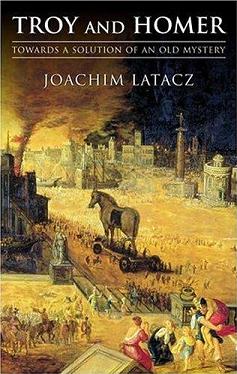
Troy and Homer — Joachim Latacz

Cover of Troy and Homer


Troy and Homer
Joachim Latacz
Kevin Windle (translator)
342 pages including index
published in 2004

My first encounters with Troy, Homer and The Illiad came through one of those ubiquitous Time-Life books on Classical Greece and more memorably, through the serialisation of an adaptation of both the Illiad and the Odyssey in the Dutch Donald Duck weekly comic that ran in the early eighties. The story of how that Teutonic romantic Schliemann had found the remains of Troy and the city of Agamennon, Mycene where everybody had always thought these were just pleasant myths, was of course part of the mythology. The recieved wisdom at the time I first got to learn about all this was that though Schliemann had indeed found something where nobody had expected there to be anything, but that it would be wrong to think that this was indeed the Troy of Homer. The experts supposedly all agreed that at best, Homer had been inspired by half remembered stories of a golden age, that any attempt to answer the question of whether the Trojan War had “really happened” was pointless. That at least was the impression I got reading pop history books.

As Joachim Latacz makes clear in Troy and Homer: Towards a Solution of an Old Mystery that impression was wrong. It is not only possible to answer the question of whether Troy really had existed, whether the city Schliemann had discovered was the Troy of the Illiad and therefore whether this meant it too was based on historical fact, but these questions have been answered, and answered in the affirmative. The Troy Schliemann dug up was the Troy of legend, the Illiad is based on historical fact and there was in all likelyhood a Trojan War similar to the war Homer uses as the background to his epic poem.
Read more…

It has begun


Sandra has had a final talk with her doctors this morning, they’ve taken out her central line and therefore stopped the antibiotics and extra fluids she was getting through it. We don’t know how long it will take for her to …. cross over to the western lands, but the end game has begun.

I’m not happy about it, but I do understand it. And anyway, at least we got to celebrate her birthday yesterday: a proper Sunday roast with all the trimmings.

EDIT: speaking of that Sunday roast, a big shoutout to Hoopman Irish Pub on Leidseplein. We had no luck in finding a pub or restaurant which could cater something like this until my brother’s girlfriend rang them up and they immediately said they would be more than happy to do so. They quoted a price of some 170 euros to provide a meal for twelve, but when it was actually time to pay they said it was on them. There was no reason for them to do that, I would’ve been more than happy to pay for what was an excellent meal, but they went through all that trouble just because they wanted to show some kindness to strangers. So erm, if you’re ever in Amsterdam, look me up and we’ll have a pint there.

Least I could do.

(As somebody whose sentimental side mostly comes out through music, Fairport Convention’s “Meet on the Ledge” always had the chills running down my spine, but this last year it never fails to choke me up.)

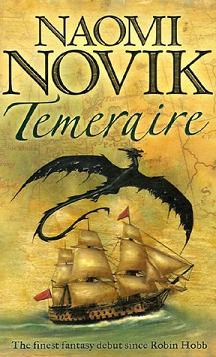
Naomi Novik — Temeraire

Cover of Temeraire


Temeraire
Naomi Novik
327 pages
published in 2006

So that’s why the Temeraire series is so popular. I had heard of it of course, the first novel in the series (called Her Majesty’s Dragon in the original American edition) having been the subject of much hype and enthusiastic reviews when it first came out, but I had been skeptical. It had all sounded too high concept to me: Horatio Hornblower with dragons? Interesting, but it all seemed a bit too slight to hang a novel on. As I quickly found out when I flipped through Temeraire in the library, I was wrong. Naomi Novik knows how to tell a story, to keep you turing the page until it’s finished and leave you wanting more.

Frigate captain William Laurence manages to capture a French blockade runner but is puzzled why it resisted so fiercly when it was clear it could not win the fight. His puzzlement ends when he discovers it’s transporting a dragon, one near to hatching to boot. Dragons are rare and valuable, both as status symbol and instrument of war. Because it’s clear that the egg will hatch before his ship will be back at base, Laurence knows it’s his duty to get the dragon to imprint on one of his men, to get it into service for England, notoriously weak on dragons. Imagine his surprise — if not the reader’s — when it turns out the dragon imprints on him. It means the end of his career in the navy and the start of a life in the country’s most despicable arm of service, the Aerial Corps.

Read more…

Shary Flenniken talks about Trots and Bonnie

I came across Trots and Bonnie again a few weeks back through the interview with Shary Flenniken The Comics Journal did years ago. What struck me was the artwork, which looked as if it should’ve been published alongside Windsor McKay’s and George Herriman’s in some early twentieth century newspaper’s Sunday edition. Even in this golden age of comics reprints there are strips that have fallen through the cracks: no commercial interest, difficulties getting the rights together, too obscure, too difficult to get the original sources for the art together etc, or there just isn’t anybody interested and dedicated enough to overcome these things. Trots and Bonnie is one such comic, for which these problems should be relatively easy to overcome. It’s the last great uncollected underground comic.

Earlier this month Shary Flenniken did an interview for Jeff Kay, who’d emailed her a list of questions expecting to at most get a mail back; instead he got a four part Youtube video:

Part one: general introduction:


Part two: Trots and Bonnie


Part three: about the possibility of a reprint collection of Trots and Bonnie and all the technical difficulties into getting it together.


Part four: what Shary is doing now.


Come on Fantagraphics, Drawn and Quarterly, Top Shelf: get us the complete Trots and Bonnie, you know you want to.