It has begun


Sandra has had a final talk with her doctors this morning, they’ve taken out her central line and therefore stopped the antibiotics and extra fluids she was getting through it. We don’t know how long it will take for her to …. cross over to the western lands, but the end game has begun.

I’m not happy about it, but I do understand it. And anyway, at least we got to celebrate her birthday yesterday: a proper Sunday roast with all the trimmings.

EDIT: speaking of that Sunday roast, a big shoutout to Hoopman Irish Pub on Leidseplein. We had no luck in finding a pub or restaurant which could cater something like this until my brother’s girlfriend rang them up and they immediately said they would be more than happy to do so. They quoted a price of some 170 euros to provide a meal for twelve, but when it was actually time to pay they said it was on them. There was no reason for them to do that, I would’ve been more than happy to pay for what was an excellent meal, but they went through all that trouble just because they wanted to show some kindness to strangers. So erm, if you’re ever in Amsterdam, look me up and we’ll have a pint there.

Least I could do.

(As somebody whose sentimental side mostly comes out through music, Fairport Convention’s “Meet on the Ledge” always had the chills running down my spine, but this last year it never fails to choke me up.)
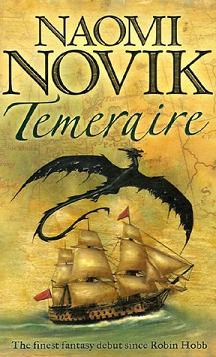
Naomi Novik — Temeraire

Cover of Temeraire


Temeraire
Naomi Novik
327 pages
published in 2006

So that’s why the Temeraire series is so popular. I had heard of it of course, the first novel in the series (called Her Majesty’s Dragon in the original American edition) having been the subject of much hype and enthusiastic reviews when it first came out, but I had been skeptical. It had all sounded too high concept to me: Horatio Hornblower with dragons? Interesting, but it all seemed a bit too slight to hang a novel on. As I quickly found out when I flipped through Temeraire in the library, I was wrong. Naomi Novik knows how to tell a story, to keep you turing the page until it’s finished and leave you wanting more.

Frigate captain William Laurence manages to capture a French blockade runner but is puzzled why it resisted so fiercly when it was clear it could not win the fight. His puzzlement ends when he discovers it’s transporting a dragon, one near to hatching to boot. Dragons are rare and valuable, both as status symbol and instrument of war. Because it’s clear that the egg will hatch before his ship will be back at base, Laurence knows it’s his duty to get the dragon to imprint on one of his men, to get it into service for England, notoriously weak on dragons. Imagine his surprise — if not the reader’s — when it turns out the dragon imprints on him. It means the end of his career in the navy and the start of a life in the country’s most despicable arm of service, the Aerial Corps.

Read more…

Shary Flenniken talks about Trots and Bonnie

I came across Trots and Bonnie again a few weeks back through the interview with Shary Flenniken The Comics Journal did years ago. What struck me was the artwork, which looked as if it should’ve been published alongside Windsor McKay’s and George Herriman’s in some early twentieth century newspaper’s Sunday edition. Even in this golden age of comics reprints there are strips that have fallen through the cracks: no commercial interest, difficulties getting the rights together, too obscure, too difficult to get the original sources for the art together etc, or there just isn’t anybody interested and dedicated enough to overcome these things. Trots and Bonnie is one such comic, for which these problems should be relatively easy to overcome. It’s the last great uncollected underground comic.

Earlier this month Shary Flenniken did an interview for Jeff Kay, who’d emailed her a list of questions expecting to at most get a mail back; instead he got a four part Youtube video:

Part one: general introduction:


Part two: Trots and Bonnie


Part three: about the possibility of a reprint collection of Trots and Bonnie and all the technical difficulties into getting it together.


Part four: what Shary is doing now.


Come on Fantagraphics, Drawn and Quarterly, Top Shelf: get us the complete Trots and Bonnie, you know you want to.

Evaluating Gollancz’s science fiction gateway

So Gollancz finally launched their SF Gateway site after having teased us for months. When they first announced it, I was cautiously optimistic about it. As long as it got the pricing and ease of purchase right and avoided relics from the pre-digital age like territorial restrictions, I could see myself spending a lot of money there. I’m a fairly recent convert to the e-book, liking the ease with which I can carry a small library on my phone, but I still rate physical books higher than their digital counterparts. There are only a few authors I buy in hardcover (Banks, MacLeod, Martin, Miéville, Pratchett, Stross and Walton), more I buy in paperback, but most I buy secondhand. E-books have to compete mainly with the last. They’re certainly not worth buying at hardcover prices and even standard mass market paperback prices is pushing it. Especially for backlisted books.

In short, the books available through the SF Gateway have to be as cheap as buying them secondhand would be. Most of which cost me in the region of two to four euros, being lucky enough to live in a city with loads of cheap, well stocked secondhand bookstores. I’m more than willing to pay roughly the same price or a little bit more for those books I can’t find there, but not much more.

Gollancz got one thing right, from the start offering a wide range of authors and books, but they got it wrong on the other aspects. The first is that you can’t buy the books directly from their site, but are directed to a selection of online booksellers like Amazon. Worse, there’s no pricing information there either. So if I want to buy Pat Cadigan’s Fools, I’m redirected to Amazon, where it costs $8.25. I’m also invited to buy it at Kobo (never heard of it), but that site doesn’t know this book at all!

I could just as well do a search on Amazon UK directly and find the books there, which brings me to the second flaw: the pricing. Here they got it almost right: many of these books are available for three pounds, but there are also quite a few more expensive than that, five pounds and up. Three quid is reasonable; five quid not so much. Annoyingly, most of the books I would like to get are on the expensive side.

Finally, as James Nicoll noted, there are territorial restrictions on these books, while the gender ratio of the authors is a bit skewed…

In conclusion: Gollancz’s experiment is a mixed success. It hasn’t really made it easier or cheaper for me to get these books, but I think I will get at least some of these books at some point. Unless I find them secondhand first of course.