Ineluctably masculine

No matter how long Tim O’Neil will continue his series on Dave Sim and Cerebus, the following is the most insightful comment he has made during it:

But for the longest time the dialogue inside the industry was completely dominated by competing views of masculinity, with only so much room for women as was provided by the stupendously large breasts of female superheroes. Some of the most formally adventurous and aesthetically rewarding work produced in the late eighties and the nineties was the product of artists who grew up in the hothouse of men’s adventure stories rebelling against the conventions of the dominant power fantasy by producing successive waves of anti-power fantasy – impotence fantasies such as I Never Liked You, It’s A Good Life, If You Don’t Weaken, the aforementioned Jimmy Corrigan, American Splendor (which, to be fair, began in the seventies when the undergrounds were not yet entirely dead), almost everything by Clowes with (of course!) the exception of Ghost World. Which is not to say that this was the only ideological current stirring the tide in comics, but with so many of the medium’s foremost talents dedicated to untangling questions of masculine identity, it’s hard not to see that male identity exerted a powerful force on the evolution of the medium in our lifetimes.

Which is the sort of comment that’s incredibly obvious once somebody else thought of it. It wasn’t a secret that the socalled alternative American comics scene in the eighties and nineties was reacting vehemently against the decades long supremacy of superhero comics, setting itself in opposition to this supposed mainstream, but to look at it through the prism of masculinity? Genius.
Dr Feelgood


On Friday nights BBC4 usually has some sort of musical theme running through its programming, last night it was all about the Old Grey Whistle Test, the old BBC flagship for all sorts of rock music not commercially enough for Top of the Pops. There was one and a half hours of the best appearances from the seventies, very nice it was too, followed by a look at the histoy of the programme, which I turned off halfway through. Whereas the music shown was fairly diverse, including people like Curtis Mayfield and Gladys Knight, the history was all about how prog rock ruled supreme until punk came along and liberated the world from aging hippies and half hour guitar solos. There was more than that going on in the seventies, neither prog rock nor punk were ever as dominant as the music press retroactively made them out to be and it is actually possible to enjoy both.

This overwhelming narrative, kept alive by the same caste of rock critics who established it in the first place means odd ducks like Dr Feelgood are lost in the noise, judged only as precursors to punk. Which is a shame, because Roxette, shown above, has more menace in it than everything the Sex Pistols ever did. The short, sharp guitar and understated drums and bass, the harsh, biting way in which Lee Brilleaux speaks the lyrics, not to mention his aura of barely restrained menace, makes this the creepiest stalking song I’ve ever heard. You can believe the song’s character would do something nasty to Roxette if she’s not careful.

To do away a band which could come up with gems like that as “pub rock” or proto-punk is to do them wrong.

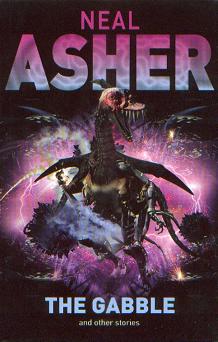
The Gabble and Other Stories — Neal Asher

Cover of The Gabble and Other Stories


The Gabble and Other Stories
Neal Asher
372 pages
published in 2008

I’m always a bit wary when I start reading a short story collection by a modern science fiction author like Neal Asher, who has made his name writing novels. It’s been decades since the short story was the dominant form of science fiction, so for most modern authors writing them is like doing finger exercises for pianists. Something you do inbetween serious projects. Which can be very unsatisfying for the reader, who sometimes just gets a slab of novel instead of a proper story, or just something slight and inconsequential with no real point to it.

With that in mind I got The Gabble and Other Stories from the library, Neal Asher’s collection of short stories set in his Polity series universe, all written between 2001-2008. Anybody familiar with that series will find more of the same here. Asher’s universe is one of violence, strange alien biotech and body horror, squelchy organics and baroque artificial intelligences, all of which are on display here as in his novels. The main difference between Asher the novel writer and Asher the short story writer is that in the latter he keeps his plots much simpler.A few do suffer from reading as extracts from novels, especially the longest story in the book, Alien Archaeology

Read more…

Things can get better

Even in the context of the military-industrial complex. Only hours after the repeal of the Don’t Ask, Don’t Tell, keep yourself in the closet and we won’t fire you from the army policy, one gay soldier prepares for the scariest moment in his life: telling his dad that he’s gay: