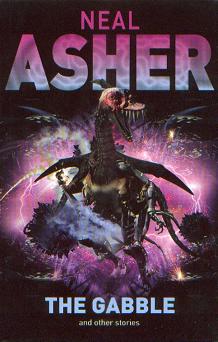
The Gabble and Other Stories — Neal Asher

Cover of The Gabble and Other Stories


The Gabble and Other Stories
Neal Asher
372 pages
published in 2008

I’m always a bit wary when I start reading a short story collection by a modern science fiction author like Neal Asher, who has made his name writing novels. It’s been decades since the short story was the dominant form of science fiction, so for most modern authors writing them is like doing finger exercises for pianists. Something you do inbetween serious projects. Which can be very unsatisfying for the reader, who sometimes just gets a slab of novel instead of a proper story, or just something slight and inconsequential with no real point to it.

With that in mind I got The Gabble and Other Stories from the library, Neal Asher’s collection of short stories set in his Polity series universe, all written between 2001-2008. Anybody familiar with that series will find more of the same here. Asher’s universe is one of violence, strange alien biotech and body horror, squelchy organics and baroque artificial intelligences, all of which are on display here as in his novels. The main difference between Asher the novel writer and Asher the short story writer is that in the latter he keeps his plots much simpler.A few do suffer from reading as extracts from novels, especially the longest story in the book, Alien Archaeology

Read more…

Things can get better

Even in the context of the military-industrial complex. Only hours after the repeal of the Don’t Ask, Don’t Tell, keep yourself in the closet and we won’t fire you from the army policy, one gay soldier prepares for the scariest moment in his life: telling his dad that he’s gay:


French burqa ban leads to more racism

Is this what the current Dutch government wants for our country too?

In April, France introduced a law against covering your face in public. Muslim women in full-face veils, or niqab, are now banned from any public activity including walking down the street, taking a bus, going to the shops or collecting their children from school. French politicians in favour of the ban said they were acting to protect the “gender equality” and “dignity” of women. But five months after the law was introduced, the result is a mixture of confusion and apathy. Muslim groups report a worrying increase in discrimination and verbal and physical violence against women in veils. There have been instances of people in the street taking the law into their hands and trying to rip off full-face veils, of bus drivers refusing to carry women in niqab or of shop-owners trying to bar entry. A few women have taken to wearing bird-flu-style medical masks to keep their face covered; some describe a climate of divisiveness, mistrust and fear. One politician who backed the law said that women still going out in niqab were simply being “provocative”.

Ahmas, 32, French, a divorced single mother of a three-year-old daughter, puts her handbag on the table and takes out a pepper spray and attack alarm. She doesn’t live on the high-rise estates but on a quiet street of semi-detached houses. The last time she was attacked in the street a man and woman punched her in front of her daughter, called her a whore and told her to go back to Afghanistan. “My quality of life has seriously deteriorated since the ban. In my head, I have to prepare for war every time I step outside, prepare to come up against people who want to put a bullet in my head. The politicians claimed they were liberating us; what they’ve done is to exclude us from the social sphere. Before this law, I never asked myself whether I’d be able to make it to a cafe or collect documents from a town hall. One politician in favour of the ban said niqabs were ‘walking prisons’. Well, that’s exactly where we’ve been stuck by this law.”

Very roughly estimated, there are probably some 100 to 200 women in the whole of the Netherlands who wear the full on face covering veil. In my own Amsterdam neighbourhood, which does have a high percentage of people with a Muslim background, with a mosque only a few blocks away, there are one or two, perhaps three women I’ve seen wearing this. Even if we accept the prejudices of those arguing for a ban, this is not a real problem. But then of course it’s meant as a distraction from the very real problems our country is facing,what with the economy and having a rightwing government with no ideas how to handle these problems other than by keep on cutting spending even when it’s clear this is counterproductive.

For the politicians pushing this, not just Geert Wilders, but supposedly respectable politicians like our prime minister Mark Rutte, this may not be an issue they take seriously other than to pull the whool over the electorate eyes, but for the women who’ll be caught in the backlash this will only make worse the racism and bigotry they’re already facing. After all, once the law has singled out a certain group of people as beyond the pale for how they look or act, it does encourage people to take justice in their own hands, as the French example shows, but we also know from closer to home. We have seen an increase in accepted casual racism and islamophobia once the politicians and opinion makers decided it was alright to break these taboos — and it’s not all stuff that has been bubbling under the surface before that. Having these sorts of negative examples and stereotypes of a certain population group fired at you day in day out matter. Having the law say that certain religious attributes are wrong matters even more.

Dutch cartoonist Minck Oosterveer has died

Minck Oosterveer

Via Michael Minneboo comes the news that Dutch cartoonist Minck Oosterveer has died in a motorcycle accident at age fifty. A sad enough death for anybody, but even sadder as it came just at a point in Oosterveer’s career when he had recieved the critical acclaim of his peers in the Netherlands, if not the commercial succes he wanted. At the same time however, after several years of effort it seemed that he had finally broken through in America, getting assignments from Boom! Studios as well as Marvel Comics. He had recently done the artwork on Mark Waid’s Victorian detective series Ruse as well as an issue of Spider Island: Deadliest Foes.

That latter was something of a dream come true for Oosterveer, one of whose earliest professional pieces had been a newspaper style Spider-Man strip for a dayplanner published by the then Dutch license holder for Marvel Comics, way back in 1989. Oosterveer had been trying to break into the American comics market for a couple of years now, as possibilities for the kind of comics he drew were drying up fast in the Dutch markets. As he had put it earlier this year:

Spider-Man and the Black Cat drawn by Minck Oosterveer

Marvel pays royalties and the money you start with there is more than you could earn here. The only ones still paying a page rate is Eppo strip magazine. But there you get half of what I’m going to earn at Marvel per page. In the Netherlands I really can’t ake a living from comics anymore. You can’t blame Dutch publishers for it, because album sales here are just too low.

The lack of commercial succes in the last few years in the Netherlands, which also included the loss of his daily adventure newspaper strips in De Telegraaf did not mean Oosterveer wasn’t appreciated by his colleagues and readers. Only this year he won the Stripschapsprijs’ lifetime achievement award, the highest award his peers could give him. He was praised for the very qualities that made his work uncommercial in the current market place, his focus on doing realistic strips in a country that was always more into the cartoonesque and funny side of comics.

Artwise, Minck Oosterveer had always been influenced by the classic American adventure strip cartoonists, people like Milton Caniff, Alex Raymond and Will Eisner. His style was loose and fluid, with a strong feel for black and white contrasts, just as you’d expect from somebody with those influences. He managed to be recognisable and interesting even in the severly limited space of the daily newspaper strip, where he’d be lucky to have three small, cramped and badly reproduced panels. His work may have been taken for granted and not always been appreciated by the general audience, but his peers knew his worth.

I didn’t know him personally and it’s only been recently that I realised how good he actually was. I regret not getting the chance to tell him in person.