Howard Jacobson’s pathological need to be persecuted

There’s a disease that strikes English novelists of a certain age and fame, that makes them think whatever small talent they have at creating Times reviewed stories means they have an unique insight into human nature and the political realities of 21st century Britain. This usually manifest in rightwing babble about the problems of the day, as exclusively revealed to whichever newspaper with spare column inches to fill, as well as through novels that suddenly tackle big political issues in the way literary writers normally reserve for dabbling in science fiction: naively and ploddingly reinventing cliches better writers had long since abandoned and being proud of it. Martin Amis and Ian McEwan are the best examples of this disease, but Howard Jacobson seems determined to join them.

Jacobson is “best known for writing comic novels that often revolve around the dilemmas of British Jewish characters” as Wikipedia puts it. Not one to hide his Jewishness under a bushell and keen to let you know how his background makes him uniquely able to provide insights into the Israel/Palestinian conflict, he has been making a nuisance of himself for years in opinion pieces. As with Amis and McEwan, his politics also infected his fiction, metastasising in The Finkler Question, made unreadable by his politics.

So it comes as no surprise that when he saw the images of Asian shopkeepers defending their communities against the riots in London two weeks ago he saw something quite different from the rest of us:

The good thing that came out of the riots was a renewed sense of community. “How does one put this without sounding gross … it was terrific to see the Asian communities on telly and not to have to think about terrorism, and not to have to think about the thing I’m always thinking about… do they want to kill Jews?”

A remark on par with Amis’ similar ones on wanting to make Muslims suffer for 9/11. But there seems to be more going on with Jacobson, he seems convinced that pogroms could break out in London any minute and that like any good Jew he needs to be prepared. It’s not a mindset that’s not unique to him; I’ve stopped being surprised at the number of middleclass Jewish people living in England or America, never having suffered any discrimination in their lifetimes, convinced that it’s only a matter of time before the killings start again. If the most important event in your history is the Holocaust, it’s not surprising some people get a bit paranoid.

With Jacobson however it almost seems as if he would welcome persecution, that he feels agrieved that there are no pogroms in England and the number of real anti-semitic incidents (as opposed to people being accused of anti-semitism because they disagree with Israeli policies) is low and has remained low for decades. Hence remarks like the above, as to him it’s inconcievable that Asian people would not want to oppress him. Call it victim envy.

Real names and other dangers

On the subject of Google’s childish insistence on “real names” for its new Google+ service, jwz is scathing, but it’s this comment that gets it right on what mature online communities need to remain civil:

In 20+ years of online communication (much of it with people I either have never met, or only later met) I’d have to say the only reliable predictor of civil discussion is stability of identity, which allows reputation to work. You want people to use the same identity by which they are regularly known, so you can recognise it’s the same person again. As you note this worked just fine for most of USENET’s existence, through most of LJ’s existence, and across a wide range of BBSes prior to that. It even works across a diverse, but loosely related by theme, set of blogs, and their comments, providing there’s a general understanding that people will continue to use the same identity on all of them.

It’s not the only thing you need for a decent online community — you also need a good system to block the numpties, either through active but fair moderation or on the user side ala Usenet’s kill lists — but what you really don’t need and what’s in fact counterproductive is to insist on “real names”. Insisting on that is just another unnecessary hoop for people to jump through to start participating and only an idiot won’t realise that for very many people for very good reasons this is one hoop too far.

But of course Google and Facebook and all the other socalled social media sites are not interested in creating a proper online community, but rather an exploitable resource to sell to advertisers, for which purpose “real names” are much more valuable….

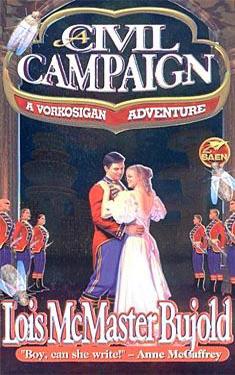
A Civil Campaign – Lois Mc Master Bujold

Cover of A Civil Campaign


A Civil Campaign
Lois McMaster Bujold
534 pages
published in 1999

A Civil Campaign should have been the last novel in the Vorkosigan series. Starting with Brothers in Arms and continuing through Mirror Dance, Memory and Komarr Lois McMaster Bujold had constantly upped the ante for Miles, not just by giving him bigger challenges to overcome, but by forcing him to grow up and become mature, putting him in situations where his character strengths are useless or even counterproductive. A Civil Campaign is the culmination of that process, as Miles crashes hard against the realisation that his usual crisis management tactics are not suitable for trying to win the hand of the woman he fell in love with the first time he saw her. At the same time Bujold also ties up all the loose ends from the earlier novels, providing a proper ending for the series. It’s not a book for people new to the series.

In the previous book, Komarr, Miles had met Ekaterin, a duty bound Vor woman trapped in a loveless marriage, and fallen hard for her from the first moment. With Ekaterin now a widow, Miles sets out to court her, but with the best of intentions decides to do so without her knowning or telling her that this is what he’s doing. Surely the same tactics of deception that worked so well in his career as a galactic man of mystery will be good enough to win him a wife? Of course there’s also the small matter of the imperial wedding to prepare for, the return of his clone brother Mark with his Escobarian business partner and their somewhat too biological startup they’ve set up in Vorkosigan House, the blossoming relationship of Mark with Kareen, the daughter of one of Miles’ father’s — count Vorkosigan — oldest friends and various other minor complications and side issues Miless will have to deal with, but how hard can it all be?

Read more…

Trading in Danger — Elizabeth Moon

cover of Trading in Danger


Trading in Danger
Elizabeth Moon
506 pages
published in 2003

Reading Sheepfarmer’s Daughter gave me a taste for more Elizabeth Moon. Trading in Danger, the first book in the Vatta’s War series was what the local library had available. It’s science fiction rather than fantasy, but it’ll do. It’s still the same sort of adventure story even if the genre has changed. The other thing they have in common is familiarity, both are coming of age stories with few surprises, but sometimes familiarity is just what you want in a story.

Ky Vatta is a cadet at the naval Academy, an unusual career choice for a child of one of the great trading families. She’s an examplary cadet, but this doesn’t save her when an impulse to help a fellow cadet lands her in the shit. Expelled from the academy, she now has to face her family. Worse, because it’s a highly politicised mess she found herself in, she also has to leave Slotter Key, her home planet. Worst of all, the reputation she has in her family as a sucker for anybody with a sob story is once again confirmed, in the worst possible way. The solution to all her problems lies in an old Vatta family tradition, that sends any child wanting to join the family trade on a shakedown cruise first. She will captain the Glennys Jones, an old trading ship on its last voyage which will be sold as salvage at the end of it, as it’s too expensive to bring up to modern standards. This trading trip will take a couple of months and at the end of it Ky will be able to come home, having proven herself as a captain. As importantly, it will also get her away from her own humiliation.

Read more…

Striptember in Amsterdam

Striptember

The current Dutch government may have decided to slash all cultural funding, yet this so far hasn’t stopped the official art world from increasingly embracing comics as an artform worth subsidising and promoting. This is not necessarily a new development — the Joost Swarte spearheaded Haarlem Stripdagen has always had the support of the city council and corporate sponsors — but it has been increasingly prominent in the past few years. Which is a good thing, especially when it leads to initiatives like Striptember, a month long celebration of comics organised in Amsterdam. From the description on IAmsterdam (sic), the official Amsterdam tourist site:

Amsterdam dedicates the entire month of September to the art of cartoons and comic strips. Taking place in various locations across town and encompassing a large variety of exhibitions and events, Striptember is a perfect month for lovers of cartoon art.

And there’s good reason for highlighting the genre in Amsterdam. The city has long been associated with the best of comic illustrators and artists and the art form has a diverse and rich history here – stressed by the fact that Amsterdam boasts the oldest cartoon shop/gallery in the world: Lambiek, open since 1968.

Iconic international comic illustrators such as Peter Pontiac, Peter Kuper (USA), Edmond Baudoin (France) and Daniel Bueno (Brazil) take part in this year’s edition of the festival. Expect the best in comic art strips, fanzines and associated paraphernalia!

(There’s more information at the official Striptember site, but it’s written in not very good English.)

Having an annual, month long festival is a very ambitious project and it’ll be interesting to see how well this works. The events lined up are impressive and the organisors have managed to rope in quite a few institutions you’d not normally see involved in a comics festival. There is e.g. the Maison Descartes (the French cultural embassy comparable to the British Council) holding an Edmond Baudoin exhibition, as well as exhibitions in city hall itself.

A great initiative and I hope it will be succesful.