The Masked Man 08 — #aComicaDay (15)

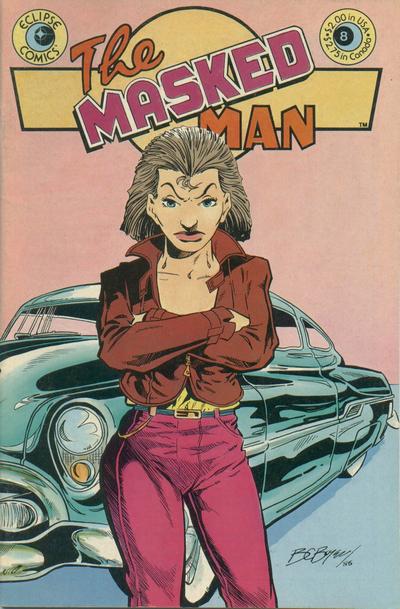
The Masked Man meets his long estranged sister for the first time in years — as she’s busy trying to rob fake antique coins filled with cocaine from the criminal gang that robbed them first! Cover and everything else by B. C. Boyer.

Roxy, the Masked Man's sister is a short haired brunette dressed in pink trousers, a yellow shirt and a brown leather jacket. She stands with her arms folded in front of a car.

The only issue of The Masked Man I ever found. It’s a credit to B. C. Boyer’s storytelling skills that it still made sense despite it being part of a continuous storyline. It sure helps if you can put a proper summary on the first page, something modern comics seems to abhor. The Masked Man, proper name Dick Carstairs, always was a dreamer, wanting to be a champion of justice and now he is. His sister, Roxannne Carstairs was always more realistic and is now a criminal. Why and how they grew up the way they did is shown in this issue and goes all the way back to when they were children.

The Masked Man started off as one of the features in the black and white series Eclipse, the Magazine, published by Eclipse Comics (huh) before continuing in Eclipse Monthly and finally its own series in 1984. This ran until 1988 for a total of twelve issues. The Masked Man was only an ordinary bloke, who one day stopped a robbery and grabbed a mask from a convenient costume store to hide his identity. His adventures are therefore fairly low key, sub-Batman level. I don’t think he ever fought any real supervillains. What set it apart is perhaps its more human view of superheroics, though this seemingly wasn’t enough to make it a success. Publishing only twelve issues in four years cannot have helped either.

The Masked Man is B. C. Boyer’s most significant work, but he would return in the mid-nineties with Hilly Rose from Astro Comics, edited by his old Eclipse editor cat yronwode (who spells her name all lowercase). Apart from that the Grand Comics Database only lists a few scattered credits here and there, with his last work being from 2011. I like his artwork, it has a very Matt Wagner-esque feel to it. The same sort of plasticity to his figures, a similar sort of faces.

As far as I am aware neither The Masked Man nor Hilly Rose has gotten a collection, so the only way to read either is to hunt the back issue bins.

The Horrible Truth About Comics — #aComicaDay (14)

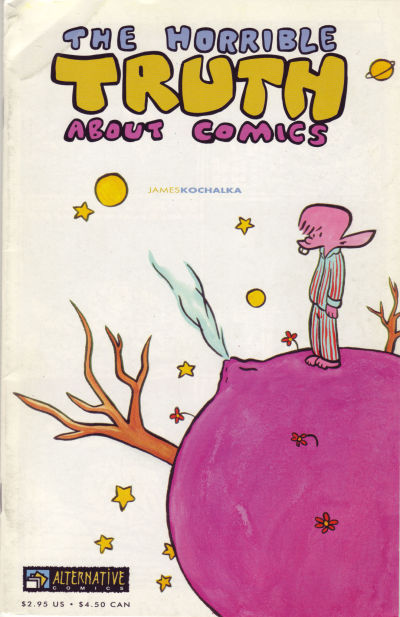
The Horrible Truth About Comics is that comics are good and you can’t stop thinking about them.

A buck toothed elf in pyjamas is standing on a small pink planet

(Fun fact: the first ever mp3s I downloaded were James Kochalka recordings. Some of his songs lived rent free in my head for years.)

I like James Kochalka. An arrogant, abrasive braggart whose grasp exceeds his reach perhaps to some, but goddamn he was right to call craft is the enemy. There’s still no greater advice than what he gave in that original letter to The Comics Journal:


What every creator should do, must do, is use the skills they have right now. A great masterpiece is within reach if only your will power is strong enough (just like Green Lantern). Just look within yourself and say what you have to say.

It’s exactly what he does with his comics and music. He doesn’t worry about whether his singing or art is good enough, he puts pen to paper and puts it out there. A very punk attitude that has worked well for him over the years. But that same attitude also meant that this simple message led to a years long controversy in the pages of The Comics Journal with people like Jeff Devine and Jim Woodring no less coming down on the side of craft being essential. Reading it back, you feel that they completely misread what Kochalka was arguing but also that he was deliberately fanning this misunderstanding in his follow-up messages. It became a flamewar all over alternative comics space, where to be honest the fight was more interesting than the outcome because obviously both sides had good points.

The Horrible Truth About Comics came out in 1999 and is a 32 page monologue about Kochalka’s views on art and comics making, which repeats some of the points made in “craft is the enemy” but more coherent and less obnoxiously. I think it was advertised at the time as being Kochalka’s ultimate statement on these themes, a final rebuttal to his enemies. At heart though it’s a glorious celebration of the possibilities of making comics, something that gives me joy every time I read it.

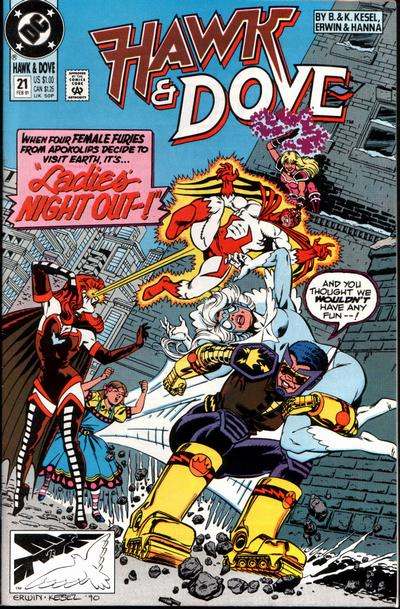
Hawk and Dove 21 — #aComicaDay (13)

Hawk and Dove have to fight off unwelcome visitors from Apokalips — a group of Femal Furies come to DC hunting for trophies and each trophy means a murder.

A Female Fury on rollerskates is taking away Dove on her shoulder while Hawk is blasted by another and two more are poised to attack

The very first issue of Hawk and Dove I bought, way back in 1991. I had real knack for picking winners back then: the series would last for just another seven issues after this. A victim of one of DC more pointless crossover series, Armaggeddon 2001, which ran through all its annuals, where it was an excuse to look into the future. However, the identity of the Big Bad behind it all got spoiled so instead Hawk and Dove got sacrifised to keep the ‘surprise’.

But that was in the future. This issue, like ever, was written by Barbara and Karl Kesel, with art by guest artist Steve Erwin. A done in one story with a couple of new Female Furies causing havoc and our heroic duo barely escaping with their lives. A perfect example of a late Bronze Age comic, with all the ongoing subplots bubbling away in the background.

The entire series was like that. As you may know, Hawk & Dove was originally a Steve Ditko creation, the brothers Hank and Don Hall becoming the living embodiments of arguments about the Vietnam war, with the aggressive, somewhat dickish Hank becoming the Hawk and pacifistic Don becoming the Dove. Having one part of a superhero duo just refusing to use violence makes for an interesting challenge but it never quite worked in practise (and you suspect Ditko wasn’t on Don’s side in the first place, considering.) Some guest appearances here and there, a stint in the Titans and ultimately Don died heroically saving a child during Crisis on Infinite Earts. In 1988 Barbara and Karl Kesel created a new, female Dove (Dawn Granger) and made her and Hawk into representations of Order and Chaos respectivily, as that was a thing with DC Comics in the late eighties. This was done in a five issue miniseries with art by a somewhat obscure artist called Rob Liefeld…

For the ongoing the next year Liefeld was replaced by Greg Guler, who did a great job. The series had a great setting in Washington DC, away from most other superheroes and an excellent supporting cast as well as a good mix of recurring and oneshot villains. Since I got into the series late, most of the earlier issues I got from cheap back issue bins — Tijdschriftenhandel Noord in Rotterdam is where I got most of them. Even though the series ended thanks to a shitty crossover getting spoiled, at least most of the major subplots were wrapped up by the last issue. On the whole, this is the sort of superhero series you don’t see anymore, as self contained as it was, with no pretence to be anything other than a superhero series.

Overstuffed and Indecisive — Na Nare Hana Nare

Six girls from different schools and backgrounds come together to do cheerleading and make videos. It should be relatively simple to make a series about this, but why does Na Nare Hana Nare feel so disappointing? Even when it ended with such a great performance?

Way back in the first episode we met Kanata, who is in her high school’s cheerleading club but sidelined because of some issue and her friend Megumi, who also did cheerleading in middle school but who got ill and had to stop while she recovered and went through rehabilitation. Her other friend is Shion, from a very posh school, famed for her gymnastic ability. Shion is classmates with the fourth girl, Suzuha, a small, silent girl who parkours her way to school every day. Chasing her is how Kanata meets Anna, half Brazilian and aspiring Youtuber and her friend Nodoka, a yoga enthusiast. Anna wants to feature Suzuha in her Youtube channel; Suzuha doesn’t want. Some hijinks and misunderstandings later and by the second episode we got our cheerleading group.

From there on you expect to see the story revolve around these girls with their different backgrounds and abilities to learn to do cheer together, while they’re also looking for opportunities to actually perform, both to cheer up people and to help Anna grow her channel. Interspersed with that there should also be episodes in which each of the girls gets a bit of the spotlight, in typical (school) club anime style. Plenty material in this to fill a series, if that what it wants to do. Unfortunately it’s not the only thing Na Nare Hana Nare wants to do.

The other approach this series could’ve taken, the approach it seems to settle on at first, is to treat it as a serious sports anime. After all, we start off with Kanata and her school cheerleading team at a regional competition, in which an accident happens during their routine. An accident that was so serious that it stopped Kanata from participating anymore. Not because she was hurt herself, or because like Megumi she was physically incabable, but for purely psychological reasons, suffering from something similar to what Simone Biles suffered from in real life. Lacking the confidence to keep doing cheer, Kanata is aimless; her encounter with Suzuha and Anna int hat first episode gives her a bit of her confidence back. Na Nare Hana Nare therefore could be the story of how Kanata regained her confidence and came back to competitive cheerleading. This could be contrasted with how Megumi is struggling with her purely physical rehabilitation and as well with how her cheer club mates will respond to seeing her do cheerleading, but not for them.

Slice of life focused story on how cheerleading can lift up the spirits of your neighbourhood and town, a very P.A. Works sort of thing, or a sports orientated show about coming back from psychological and physical setbacks. Both are interesting and could’ve led to a good series. The problem was that Na Nare Hana Nare didn’t want to choose either approach and therefore half assed both, giving short shift to either.

Honestly, this mixture could have worked, but not in a one cour, twelve episode series. With a main cast of six girls and four or five more supporting characters drawn from the school cheerlead club, there are too many people to give everybody the attention they need. Because of the need to keep both storylines going and little room to stuff them in, plot points from one get dropped when the focus is on the other, most noticably seen in episodes 4-5, which is all about Anna trying to save her beloved local records shop, her second home, from closing through the power of cheerleading and Youtube. Not only cuts that short Kanata’s entire story when it just started, the resolution to it had little to do with what the girls themselves did. It all felt messy and rushed. Had this been a two cour show, with twentyfour episodes, there would have been room for an A and a B-plot in each episodes, swapping focus when necessary but still keeping the other story going. There would’ve been more room to get to know all the characters, when now Nodoka e.g. barely got any attention.

It would have also meant that the whole plot revolving around Kanata, her fears and what exactly happened during that incident, what that incident meant for the confidence of the team as a whole could have been better handled. Because now it was confusing to understand even what happened. Plenty of people thought e.g. that it was this incident that led to Megumi getting hurt to the point of needing a wheelchair, rather than having been ill and requiring surgery for it.

Episode by episode this was a decent show still; the quality of animation and character acting was what you’d expect from P.A. Works, but as a whole this was a failure.
“Omaha” the Cat Dancer 07 — #aComicaDay (12)

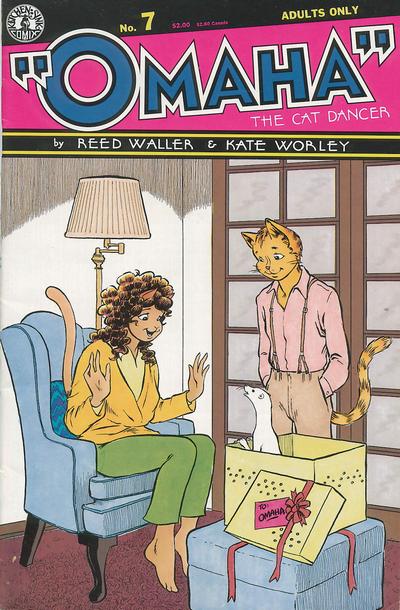
It’s always hilarious when funny animal characters own pets.

An anthropomorphic cat girl is seated opening a present, while her cat boyfriend stands next to it looking on. The present is a ferret.

One of those series I only got through buying back issues when I came across them, which is why issue 7 is the earliest one I have. “Omaha” the Cat Dancer was a long running funny animal, or rather, furry comic that got its start in various underground anthologies zines in the late seventies and then its own series from Kitchen Sink in 1984. Why there were quotation marks around Omaha in the title I still don’t know. Created by Reed Waller, with art and later also writing by Kate Worley it lasted some twenty issues there, plus a few more at Fantagraphics. By 1995, after Worley had been in a car accident and Waller had gotten bowel cancer, they split acrimoniously and the story would not be completed until 2006, at which time Worley had sadly passed away from cancer.

A rather unhappy history, which may explain why this series is now relatively obscure when it was critically well received at the time. It may seem a bit strange now, but furry comics were actually a not inconsiderable part of the direct market back in the eighties, featuring some of the most interesting work done — even Fantagraphics had Dalgoda and Usagi Yojimbo after all. And while the cover here is cute, Omaha was far from a kid friendly funny animals series, but one in which sexuality and queerness were an integral part of the story. These animals fucked and fucked uncensored.

Which, in the rather puritan America of the Reagan and Bush years put it right in the firing line at a time when comics had once again come under scrutiny from the usual crusaders for decency and cleanliness. In 1986 the manager of the Friendly Frank’s comics store was arrested and prosecuted for distributing obscene material, which included Omaha. This, as it did in the 1950s put the fear of god into the comics industry and led to a lot of self censhorship and refusal to carry certain titles by distributors and shops, something Omaha also suffered from.

No wonder then that one of the ongoing subplots in the series was about similar attempts to regulate strip clubs in Mipple City, the fictional not in anyway based on Minneapolis twon in which the series is. Omaha, the “Cat Dancer” is herself an erotic dancer; her boyfriend Chuck is heair to a wealthy business tycoon. While the series started mostly focused on the political and the theme of censorship, it quickly became much more interested in the relationships between its characters. Kate Worley called it an “adult funny-animal soap opera” in an interview in Comics Scene 17 which covers it well. It’s not just Omaha and Chuck, but there’s also their gay friend Rob who gets to be sexually active in its pages as well as Omaha’s best friend Shelley, who ended up in a wheelchair after an accident. The topic of her sex life and whether that’s even possible comes up in this very issue.

Having only a few issues of this series, it’s a pity the collected editions seem to be out of print.