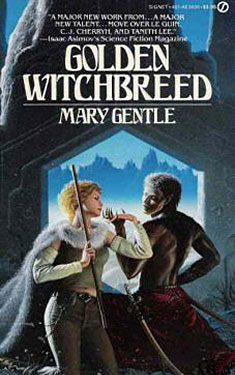
Golden Witchbreed – Mary Gentle

Cover of Golden Witchbreed


Golden Witchbreed
Mary Gentle
460 pages
published in 1983

It was the beautiful Rowena cover that got my attention, a long long time ago when I was browsing the English shelves at my hometown’s library. Showing a blonde woman in jeans and fur cape, armed with a stave and linking fingers with an obviously alien six fingered man, two swords at his side. That intriqued me, it promised both adventure and romance and it got me to pick up the book and that was how I got to know Mary Gentle. I’m not sure how old I was, but I must’ve been no older than sixteen-seventeen and Golden Witchbreed was arguably the best novel of hers I could’ve started with, much more easier to get into than most of her novels would turn out to be. But though I loved it when I read it and remember it fondly, I haven’t read it since. Which was why I put it on the list for my Year of Reading Women project. I wanted to know if the book I remember was still as good as I remember.

Golden Witchbreed I remembered as a planetary romance, emphasis on romance. It starts with the cover with the two lovers holding hands. The woman on the left Lynne de Lisle Christie, envoy from Earth to the primitive, medievaloid world of Orthe, there to represent both Earth to the Ortheans and to judge Orthe on its fitness to trade and partner with. The Orthean she holds hands with therefore should be her alien lover, Falkyr. I remembered their romance as central to the plot, the circumstances in which it took place ultimately forcing Christie to go on the run and having to travel through most of the civilised lands of Orthe. Apart from that recollections were hazy.

Read more…

UFO (Enemy Unknown)


Found at James Nicoll’s, the title sequence of the old Gerry & Sylvia Anderson live action series UFO. Three years ago Brad Hicks called this his favourite retro future, which was when I first heard about it. UFO is one of those series that, if you didn’t catch it when it was first aired, you’ll never know about and I was much too young (or even born) to do that. Since then I have managed to watch some episodes and seeing this title sequence reminded me of how much it resembles a similarly named classic computer game, UFO: Enemy Unknown. So much so the 1971 television series has to have been an inspiration for the 1994 video game; which the Wikipedia entry indeed says it was.

UFO: Enemy Unknown is one of the best games I’ve ever played and one of the few that actually scared me. A combination of strategy/god game and tactical squad combat, the player is the leader of the X-Com organisation defending Earth against UFO attack, having to set up bases and manage funds to equip his squads, improve weapons and ships and do research. Once an UFO is signaled you can try to intercept it and if you do you can send a squad to capture it and capture or kill any aliens it carries. There are also alien infestations you may need to combat etc. It had relatively good graphics and decent, atmospheric sound effects for a mid-nineties game.

It was when you went to actually fight the aliens that the game got scary. You could only see what was directly in your line of sight, especially in night missions you had little visibility and at literally ever corner some alien menace could hide. Add the music and sound effects, which though synthesiser based were quite spooky, then play late at night with the lights off not to wake anybody up and it could make you jump when you turned a corner and some nasty mo-fo was waiting for you…

I remember one time I had loaded my squad on a Shuttle, which had landed on the site of an UFO crash, I had moved my first soldier out, who had been armed with a grenade launcher, moved out the second one, then some alien fscker psionically possessed that first soldier and got her to launch a grenade right into the shuttle. Whoops, that was the squad gone…

Shorter me: I really should dig out my copy of this game again…

Joe Sacco: too controversial for the middlebrow Atlantic

Here’s what The Atlantic gave me as a birthday gift last week, an utterly dull and middlebrow list of “10 Masterpieces of Graphic Nonfiction”. The complete list:

  • The Beats – Harvey Pekar et all: a history/biography of the Beats writers
  • Edible Secrets – Mia Partlow, Michael Hoerger and Nate Powell: food based extracts from the CIA files
  • A.D.: New Orleans after the Deluge – Josh Neufeld: Hurricane Katrina
  • The 14th Dalai Lama – Tetsu Saiwai: the authorised manga biography of the Dalai Lama
  • The Stuff of Life – Mark Schultz, Zander Cannon, Kevin Cannon: a biology textbook
  • Smarter Comics Business Books – no idea: all the same sort of tedious business books now in comics format
  • The Influencing Machine – Brooke Gladstone & Josh Neufeld: why we mistrust news media, written by an NPR commentator
  • The Photographer – Didier Lefèvre & Emmanuel Guibert: a photographer’s journey through war torn Afghanistan, set in 1986
  • Burma Chronicles – Guy Delisle: potted history of Burma and its dictatorship
  • The Elements of Style Illustrated – Strunk and White, adapted by Maira Kalman: that pernicious old style guide illustrated

So these are the finest examples of “comic books as journalism” The Atlantic can think off: adaptations of prose books, some treatments of not too controversial current affairs/political/historical issues, pop science and biographies of people everybody knows. Nothing too outre stylistically speaking either, all these books can be picked up and read easily by people not familiar with comics with no problems. It’s all safely middlebrow in both subject matter and execution, kinda dull.

The worst thing about this list is that this insipidness is a feature, not a bug. As the writer herself acknowledges in a comment, she has deliberately left out certain authors and books for fear of being controversial:

You guys are right–I almost included Footnotes in Gaza but chickened out at the last moment because the topic is so polarizing. I was already expecting heat from rank-and-file fanboys/girls about the overall list and didn’t want to brave the Palestine question as well.

That’s what you call self censorship. It’s not just that Joe Sacco is one of the best and most influential non-fiction cartoonists around, somebody who should not be left off any such top ten list, but as opposed to the majority of people on The Atlantic‘s list, he has actually done comics journalism. He went to the West Bank, Gaza, Bosnia, talked to people there, tried and confirm their stories, then distilled them into a coherent narrative, just as a prose journalist would do. Nobody mentioned above comes close to doing this. He’s not the only high profile creator missing: there’s no trace either of Larry Gonick, who with Jaxon, another missing giant, pioneered the idea of doing long form comics history. Also missing: Ted Rall’s account of his journey to Afghanistan, which happened not when it was the Soviets bombing the shit out of that country, but Uncle Sam. I would like to think its omission on this list was just ignorance, but I suspect it was political…

So yeah, that’s The Atlantic in a nutshell: bland, boring, politically constrained, trying to be “hip” but failing miserably.

I know rules are a bore, You know I’m no stranger


His name is Judge Minty, not Dredd and he took the Long Walk more than thirty years ago, in prog #147. And now there’s a fan film to show what happened once Judge Minty took up retirement in the Cursed Earth, where mutants dwell. Which, no matter how it will look, can’t help but be better than what Sylvester Stallone did to Dredd back in 1995.

It’s also a good example of a) how powerful the fan fiction impulse is and b) how sophisticated it can become. It costs a lot of money/effort/expertise to make a movie and this is not a movie one can make a profit with. The Homeric impulse is universal.

Sausage fest

These are the top ten comics in the Hooded Utilitarian International Best Comics Poll:

1. Peanuts, Charles M. Schulz
2. Krazy Kat, George Herriman
3. Calvin and Hobbes, Bill Watterson
4. Watchmen, Alan Moore & Dave Gibbons
5. Maus: A Survivor’s Tale, Art Spiegelman
6. Little Nemo in Slumberland, Winsor McCay
7. The Locas Stories, Jaime Hernandez
8. Pogo, Walt Kelly
9. MAD #1-28, Harvey Kurtzman & Will Elder, Wallace Wood, Jack Davis, et al.
10.The Fantastic Four, Stan Lee & Jack Kirby, with Joe Sinnott, et al.

Notice anything? Yep, for an international poll it is very much dominated by American comics; even Watchmen, though created by two Brits, is very much in the American comics tradition. Worse, there’s no woman to be seen either, not until number 24, Fun Home, Alison Bechdel. In total there are just eight women on the list for a total of nine entries (Alison Bechdel being the sole woman to be mentioned twice), most of which are clustered in the lower regions of the list, having gotten on with just a handful of votes:

Fun Home, Alison Bechdel
Persepolis, Marjane Satrapi
The Dirty Plotte Stories, including My New York Diary, Julie Doucet
Dykes to Watch Out For, Alison Bechdel
Furûtsu Basaketto [Fruits Basket], Natsuki Takaya
Maison Ikkoku, Rumiko Takahash

Ernie Pook’s Comeek and the RAW Stories, Lynda Barry
A Drunken Dream and Other Stories, Moto Hagio
Moomin, Tove Jansson

I’m not going to blame the poll contributors for their appalling oversights, my own collection not being very gender balanced either and at least the Hooded Utilitarian editorial team are aware of this shortcoming, having asked Shaenon Garrity to redress the balance somewhat in a separate article. The gender skewedness of this list is just a symptom of a much greater problem, that comics as a medium is much too male dominated.

Part of that is mindset, a certain ignorance of readers and critics of female cartoonists, in which only a handful of currently active creators are well known, but the context and history in which they work is lost, each a singleton, the same problem we’ve discussedhere before regarding science fiction. Nobody is consciously suppressing women cartoonists, but there is still a systemic bias working against them, which polls like this bring to light. It’s so much easier to think of ten, hundred, thousand great male cartoonists who could arguably be part of the list than it is to find even half a dozen female cartoonists who could also be. It’s natural to think of sequences of influence like Noel Sickles -> Milton Caniff -> Al Severin -> John Buscema, but where does somebody like Marie Severin fit in?

But as Shaenon touches upon in her article, there are other barriers as well. The past ten years have seen an explosion of classic comics series, both newspaper strip and comic book being rediscovered and republished in nice, prestige editions, but how many of them have been created by women? Where are the classic female underground cartoonists to take their place amongst the Crumb archives? Where is the Daredevil Visionaires: Ann Nocenti? If the best work by women is not available, how can readers ever discover them?

Finally, and this is something that’s especially true for American comics, it might just be that the kind of work that really gets you noticed in comics is the kind of work that — certainly historical — has been the last available to female cartoonists. That’s the long form comic, the multiple decades old newspaper strip, the fifty issue plus comic book run, the one that needs time and dedication and self sacrifice. In Tom Spurgeon’s unrelated, intensly personal rant from earlier this week (which I found both moving and hard to respond to, if response is needed), he mentions at one point the “children of strip artists whose primary memory of their fathers and mothers is that person at a drawing board, desperate to get away for a few moments but deciding with an almost whole-body resignation to continue working while life-moment X, Y and Z unfolds nearby.” Which of course has always been easier for men than women to do, traditional gender roles being what they were and often, in disguise, still are. As Virginia Woolf once argued, before you could have great women writers, they need a room of their own, which goes double for cartoonists.

So, umm, yeah. It is understandable if bad that a list of the best comics a group of dedicated, clever critics can think of is such a sausage fest, but it’s just one symptom of a deeper imbalance, one not easily solvable, so what can you do? Well, perhaps comics needs to take the Russ pledge too:

The single most important thing we (readers, writers, journalists, critics, publishers, editors, etc.) can do is talk about women writers whenever we talk about men. And if we honestly can’t think of women ‘good enough’ to match those men, then we should wonder aloud (or in print) why that is so. If it’s appropriate (it might not be, always) we should point to the historical bias that consistently reduces the stature of women’s literature; we should point to Joanna Russ’s How to Suppress Women’s Writing, which is still the best book I’ve ever read on the subject. We should take the pledge to make a considerable and consistent effort to mention women’s work which, consciously or unconsciously, has been suppressed. Call it the Russ Pledge. I like to think she would have approved.