Comics loot

Bunch of comics

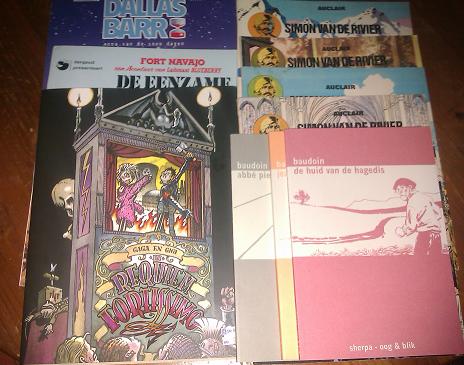
Apart from books, I also bought a bunch of comics yesterday, so me show you them. What you see above is:

  • Dallas Bar 5 — Marvano and Joe Haldeman: comics series loosely based on Haldeman’s The Long Habit of Living done by the same Belgian cartoonist who also adapted The Forever War.
  • A Jean Giraud/Jean Michael Charlier Blueberry album I still needed.
  • The first four albums in the Simon du Fleuve (“Simon of the River”) series by Auclair. Seventies hippy post-apocalypse sci-fi, these is the sort of series I buy as much out of (pseudo) nostalgia as for its intrisic qualities. These are not the comics I grew up with, but they are like the comics I did grew up with.
  • Three Baudoin comics, published by Oog & Blik/Sherpa a few years ago and now in the sales at De Slegte, Holland’s largest remainders/second hand bookstore chain. De Slegte Amsterdam actually has quite a few Oog & Blik comics available, including books by Mattotti, Loustal and Dupuy/Berbarian, all for four to eight euros. Cheap as chips.
  • The piece de resistance, Peter Pontiac’s first long form work, Requiem Fortissimo, a punk rock apocalypse, pure eighties underground comix.

Book loot

Books bought yesterday, top to bottom:

bunch of books

The Dancers of Noyo — Margaret St. Clair
City of Illusions — Ursula Le Guin
The Dolphins of Altair — Margaret St. Clair
A Heroine of the World — Tanith Lee
Needle in a Timestack — Robert Silverberg
Planet Run — Keith Laumer & Gordon Dickson
Courtship Rite — Donald Kingsbury
The Martian Inca — Ian Watson

The last one I got because of Adam Roberts’ reviews of Ian Watson’s books over at Punkadiddle. Watson is one of those writers I read a lot of when younger just because the local library had so many of his books, then sort of lost sight of afterwards. The same goes for Tanith Lee. The Le Guin I had a long long time in Dutch, but never read as far as I know. One of her early works.

Margaret St. Clair is a writer who has been largely forgotten it seems like; what I’ve read of her I liked. I also got these books to review for Ian Sale’s SF Mistressworks site.

Finally I buy anything Silverberg or Laumer has done, though with the latter everything after 1971 or so isn’t very good. Sadly Laumer got a stroke that year, lost most of his writing abilities and never was the same afterwards. he had to keep on writing though to pay the bills, but that doesn’t mean you should buy them…

Guy Halsall has a blog

Bully for him, you might think, and just who is Guy Halsall anyway? Well, he’s an historian specialising in the period I’m most interested in myself at the moment, Late Antiquity/Early Middle Ages, who I first heard of being slagged off gently corrected by Peter Heather in his latest 1,000 page history, Empires and Barbarians for getting the impact of barbarian invasions on the Roman Empire All Wrong. So I had to read this fellow Halsall’s work for himself and found Barbarian Migrations and the Roman West 376-568 one of the better one volume explorations of how the Western Roman Empire came to an end, his differences with Heather being one of degree rather than kind, as far as I could make out. In our always on, 24/7 wireless mobile internet connected world it should not come as a surprise a professional historian like Guy Halsall has a blog, but I still can’t take this for granted, especially not when it leads to posts like this, where Halsall examines why we are so wedded to barbarian invasions as explenation for the “Fall of Rome”:

The barbarian is the classic ‘subject presumed to’. The barbarian can change the world; he can bring down empires; he can create kingdoms. The barbarian dominates history. ‘He’ is not like ‘us’, enmeshed in our laws, our little lives and petty responsibilities. The barbarians in the vision of Peter Heather, are peoples with ‘coherent aims’, which they set out single-mindedly to achieve. No people in the whole of recorded human history have ever had single coherent sets of aims. Well – none other than the barbarians anyway.

And finding Halsall’s blog (through a post from Nicola Griffith I should add) led inevitably to discovering a whole slew of likeminded blogs, now listed under “Science” in my blogroll. There are days when the internet looks small and dreary and all your usual blog friends are silent, not saying anything of interest. And then there are days when you cut around a corner and find whole vistas opening up. This is one of those days. It’s not any day I find four new brilliant blogs: Guy Halsall’s, Blogenspiel, Medieval History Geek and last but certainly not least, A Corner of Tenth Century History, where posts like this one make me very jealous and slightly in awe — why can’t I write like this?

Lee and Kirby didn’t know it was the sixties

Tom Spurgeon worries at one of his artistic preferences:

for all that the Fantastic Four comics worked in the 1960s, I’m somehow not a big fan of placing the characters in the 1960s. That’s a nice picture and everything, I just don’t get a thrill out of seeing those characters “in their time” the way someone could surmise I might from my affection for the original Lee-Kirby run. What can I say? I’m complicated.

Actually, this makes perfect sense. There’s a huge difference between Lee and Kirby working on Fantastic Fourback in the sixties and somebody coming along forty-fifty years later and doing a pastiche or homage, drawing explicitily on our shared cultural conception of “the sixties”, like Alex Ross did with Marvels. In the latter case the pastichist is working in an aesthetic formula that has been retroactively defined as “sixties” and tries to adhere to this as best they can, working with a limited amount of both visual and storytelling cliches, at all times conscious of the desired impact on their readers. You can see that in the end product too: you get either the Leave it to Beaver/JFK Camelot, the Hippies and Summer of Love or the Vietnam/race riots/RFK version of the sixties.

Lee and Kirby had their own constraints of course, both unconscious and conscious ones (the comics code not being the least of them) but they lacked that creative straightjacket their modern day emulators willingly subject themselves to. They could evolve, while of necessity somebody like Alex Ross or Darwyn Cooke trying to place the Fantastic Four or the Silver Age DC characters in their own time has to remain static, consistent, recognisable.

For the reader, it’s the thrill of the familiar rather than the thrill of the new. Hence always disappointing and empty.

Those who forget their past are doomed to bullshit endlessly about it

Stormie Normie Geras is one of the last of the Decent Left deadenders, still a true believer in The War Against Terror. It’s a given that when presented with an article in The Guardian calling for spending cuts in the ministry of defence he’ll won’t be totally honest in his refutation, shall we say? Misrepresenting and misreading it in the worst possible way is all very much to be expected here, but what struck me was how good Normie is at not remembering recent history when it’s inconvenient to his arguments:

Do not do anything like invading Afghanistan again. Or, as he puts it, ‘Are we, pliant planters of the Nato flag anywhere in the world the Pentagon prescribes, going to get involved in another Iraq – or, worse, another Afghanistan? Of course not, says bitter experience.’ So, were Britain ever to be on the receiving end of a 9/11-type of attack, prepared from a country hosting an organization dedicated to carrying out such attacks against it, and resulting in the deaths of thousands of people in London, Birmingham, Manchester, Edinburgh or some other British city, the government of the day should just ‘pass’ on the idea of a military response.

What actually happened was that the UK invaded Afghanistan and Iraq and then the “9/11-type of attack” took place, with the people responsible explicitely stating that it was these invasions that motivated them. Something war supporters like him having been trying to wish away ever since, but the truth remains that invading “a country hosting an organization dedicated to carrying out such attacks” did not make Britain safer but instead made it a target for people who before these invasions had no reason to attack Britain. Note also that the UK never found it necessary to invade the Irish Republic to end IRA terrorism or attack the main source of its funding, a certain terrorist loving country called America…