You sing one song about going on a Jew hunt…
Sheepfarmer’s Daughter — Elizabeth Moon
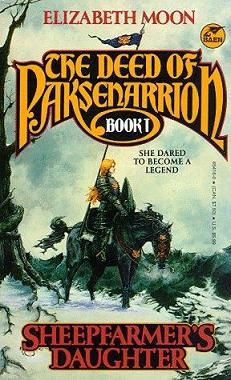
Sheepfarmer’s Daughter
Elizabeth Moon
506 pages
published in 1988
Sheepfarmer’s Daughter was Elizabeth Moon’s first published novel and is now available from the Baen Free Library as a sample to get you to try her other work. I got it to have something to read in those stolen moments where it’s too much hassle to dig a paperback out of my bag, but I can get to my mobile. Sheepfarmer’s Daughter was the ideal book for this: not overtly complicated, easy to read in small chunks without missing much of the plot and engaging enough to keep reading.
I’ve only read one Elizabeth Moon novel before this one, A Sporting Chance, a science fiction adventure story that was decent enough but nothing special. From all I had read about her other novels, they seemed much the same so until now I’d never really sought out her books. But it’s hard to argue with free books and people I trust had been praising Sheepfarmer’s Daughter, so when I needed something new to read the choice was easy.
Sheepfarmer’s Daughter is the first in a trilogy called The Deed of Paksenarrion, which Elizabeth Moon allegedly wrote after she was introduced to Dungeons and Dragons by friends of her and got annoyed by the way it handled paladins, to show what real paladins were like. A paladin is “a holy knight and paragon of virtue and goodness”, as Wikipedia calls it and in D&D it’s one of the character classes you can play. What exactly Moon disagreed with I’m unclear about, but there certainly is some D&D influence visible in the fantasy world she created. The other influence on the series was Moon’s own background as an US Marine, giving her a somewhat more realistic idea of warfare than many other fantasy writers have.
Books read July
Nick can’t be talking about me, because I count how many books I read in a month. Ten this time. More than I thought I would manage this month, but there’s a lot of fluff on this list.
The Early Middle Ages — Rosamond McKitterick (editor)
This is intended as an introduction to and broad overview of (West) European history from 400 CE to 1000 CE, in which it succeeded reasonably well. Having some prior knowledge of this period helps though, especially if you got some grasp on the rough chronology.
The Sacred Art of Stealing — Christopher Brookmyre
Brookmyre’s slightly anarchistic thrillers are pure comfort reading.
An Imperial Possession — David Mattingly
A postcolonial history of Britain under Roman rule. What did the Romans ever do for us? Exploit our natural wealth, make our warriors into slaves and force us to grow cash crops for absentee landlords is the answer. This review at Blood & Treasure is why I bought this.
King of the Rainy Country — Nicolas Freeling
Another inspector van der Valk murder mystery, taking him far from his hometown of Amsterdam all across Europe.
Zoo City — Lauren Beukes
In Beukes’ near future/alternate South Africa (not quite clear which is the case) being a murderer can quite literally land you with a monkey on your back, or in Zinzi December’s case, a sloth. It makes her one of the new underclass, the Animalled, having to make a living exploiting the small magical talent to find anything she got along with her totem. Then she’s asked to find a lost person rather than a lost property.
Whoops! — John Lanchester
Readable if slightly out of date overview of why we were dropped in the shit when the financial crisis hit in 2007. Lanchester is the same guy who has written on this subject for the London Review of Books.
The Good, the Bad, and the Uncanny — Simon R. Green
Green is a cheerful hack writer (and probably the last to deny this) and this is a volume in his urban fantasy series. The whole experience is like reading a mediocre superhero title (Alpha Flight say) long after the talent left. Still enjoyable though.
A Point of Honor — Dorothy J. Heydt
Mary Craven is a world renowned player in the VR game of Chivalry, whose alter ego Sir Mary de Courcy is that game’s current champion of the Winchester Lists. And now she has stumbled on a real world secret hidden in the game, people are trying to kill her and she has to fight both offline and online for her very life. Dated in its technological assumptions, but something of a precursor to novels like Charlie Stross’ Halting State and Walter John Williams’ This Is Not a Game.
Trading in Danger — Elizabeth Moon
Entertaining and competently written adventure science fiction. First in a series, but enjoyable on its own.
Making a Killing — Iain McDowall
Treading some of the same ground as Ian Rankin, this is a slightly disjoint police procedural set in the fictional town of Crowby.
One more reason why I’ll never ever visit America
Don’t watch this video because it will only upset you. It shows the deliberate torture of a homeless man by California police officers for “resisting arrest”. Not content with tasering him a half dozen times, they then beat them up so bad he needed to be put on life support in hospital where he died a few days later. From the Gawker report:
Thomas—who suffered from schizophrenia, and was homeless—caught the attention of the police after someone reported that a burglar was breaking into cars parked near a Fullerton bus station. When officers approached Thomas in the depot parking lot and tried to arrest him, he resisted. What happened after that is a topic the Fullerton Police Department doesn’t seem too enthusiastic to discuss—but the sound of Thomas’s voice certainly speaks on their behalf. And as this gruesome photo shows, the six officers involved in the altercation beat Thomas beyond recognition; after several days on life support, Thomas was taken off the machines and died. (To be fair, two cops suffered broken bones.) Update: According to this report, a police sergeant stated on July 20 that, contrary to several news reports, no officers suffered from broken bones as a result of the Thomas incident—only “soft tissue damage.”
Did Thomas actually resist arrest? Mark Turgeon, who witnessed the beating, says no:
“They kept beating him and Tasering him. I could hear zapping, and he wasn’t even moving,” said Turgeon. “He had one arm in front of him like this, he wasn’t resisting. And they kept telling him, ‘He’s resisting, quit resisting,’ and he wasn’t resisting.”
The picture they refer too is gruesome and like the video should not be viewed because it will only upset you. But perhaps we need upsetting, to see the reality of what “the thin blue line” is up to. What hit me about this story is that the poor guy was beaten up while he cried for his dad, an ex-cop himself, and was only thirtyseven when he died, the same age as I’ll be next week. That could’ve been me, if I had been less lucky.
Dutch cops aren’t always squeeky clean either and I’m smart enough to know they don’t always have to be my friend, but I feel a hell of a lot more comfortable approaching them in public, or have them approach me, then I would be in the United States. Dutch cops aren’t convinced of their own superiority and obsessed by respect and authority the way American coppers are.
The Halfling and other Stories — Leigh Brackett
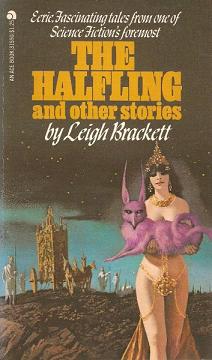
The Halfling and other Stories
Leigh Brackett
351 pages
published in 1973
The Halfling and Other Stories is the sixth book I’ve read in the Year of Reading Women challenge I set myself after I’d noticed last year how few female written science fiction books I read. I had chosen this because it was something I hadn’t read before and I always liked Brackett. Unfortunately it turned out this was one of her lesser collections. The stories don’t fit well together, there’s no real theme to the collection and some are decidedly on the weak side.
It doesn’t help that the first two stories are basically the same. In both there’s the hardbitten protagonist falling for a mysterious beautiful alien girl who he knows is trouble yet can’t help himself but get involved with, who then turns out to be evil. Worse, in both stories this girl is shown to be representative of her race, their evil part of their biology. It’s a bit …uncomfortable… shall we say, but unfortunately these sort of assumptions are build into the kind of planetary romances Leigh Brackett wrote.