The military wing of melanie phillips

The guys at Blood and Treasure are discussing the Norway Attacks and how the ideology behind it sounds so familiar. Ken MacLeod sums up:

Familiar indeed. ‘Cultural Marxism’, the Frankfurt School, feminism and political correctness as the root of the problem, the EU apparat as its enforcer, Muslim immigration and terrorism as its consequence or indeed as its weapon … now where have we heard these ideas before?

An ideology for justifying violence against racial minorities, the Left and the labour movement has been developing in plain sight, rather than in the underworld of NSDAP re-enactors. And it overlaps mainstream right-wing thinking.

There have warnings that this sort of atrocity would happen sooner or later in Europe. It’s not just the rhetoric that came along in the wake of the The War Against Terror, but also a slew of incidents in which rightwing extremists were caught with enough explosives to kill a small town, or massing guns, or with chemical warfare equipment, largely going unreported in the media. Remember the ex-BNP members and their weapons cache that nobody wanted to call terrorists? In the last decade there has been a climate in which Islamophobia and fear of “Eurabia”, the susposed clash of civilisations have become mainstream, in that these are no longer extreme opinions to hold, but arguments that can be seriously debated by serious mainstream commentators. In that climate, when day in day out you have certain politicians (Wilders not being the last example to come to mind and loonies in the media foaming at the mouth about the life and death struggle “Islam” and “the west” are locked into, it should not come as a surprise one of the internet hard men ranting about striking a blow for civilisation actually did.

Heartbreak & Heroines

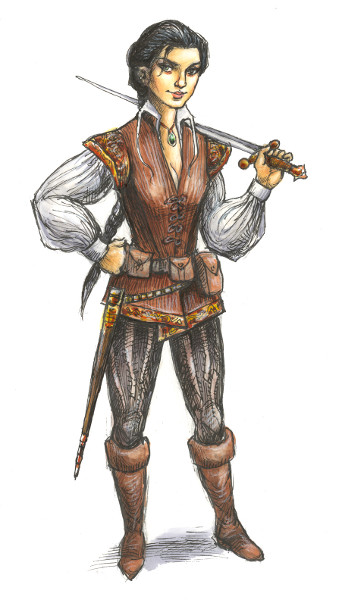
Character from Heartbreak & Heroines. Art by Joanne Renaud

I should’ve done this before, as her project is more than fully founded, but Caoimhe Ora Snow/Kynn Bartlett has a Kickstarter proposal up to fund her new feminist role playing game, Heartbreak & Heroines:

Heartbreak & Heroines is a fantasy roleplaying game about adventurous women who go and have awesome adventures — saving the world, falling in love, building community, defeating evil. It’s a game about relationships and romance, about fairy tales and feminism.

You play a fantasy heroine (or hero, if you prefer) whose heart has been broken. She’s experienced some loss so great that she’s taken up her sword, her tome, her staff, or her wand and walked away from her place in society — by becoming one of its defenders, fighting back the darkness that endangers everyone.

[…]

My friend Dwayne McDuffie passed away earlier this year. He was a comic book and animation writer who loved comics — but also saw they didn’t reflect his life as an African American man. Instead of writing a lot of essays and making blog posts (although he did both at times), he and went founded Milestone Media to create the kind of comics he wanted to enjoy. By doing so, Dwayne changed the comics industry and left a legacy that won’t be forgotten by fans of Static, Icon, Justice League, Ben 10, and other comics and animation properties.

I’m no Dwayne McDuffie, but I do want to change gaming by making it more inclusive — of women, people of color, LGBT people, and basically everyone. Using Dwayne as my model, I don’t want to just talk about inclusive gaming, I want to make and play games that push the window on inclusion.

Caoimhe/Kynn is an old internet friend of mine, dating back to Usenet somewhere in the mid nineties, so I’m biased to want this project to succeed anyway, as seems to have done by having raised over $5,000 from a $3,000 target, but even on its own merits this looks worthwhile. As we’ve seen in the past few years, what with Racefail and the Russ Pledge and all that, fandom in general is in need of having our consciousness raised; what better way to do this than through projects like this, with inclusiveness awareness build in from the start, without being preachy? If you are an RPG player, why not check it out to see if you like it? Only fifteen bucks buys you a copy of the game once it’s done…

Bold as Love — Gwyneth Jones

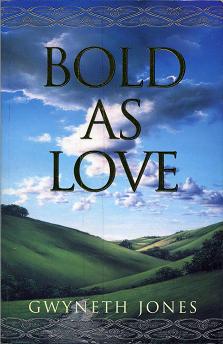
Cover of Bold as Love


Bold as Love
Gwyneth Jones
403 pages
published in 2001

Bold as Love is the second book in my year of reading women sf challenge, chosen partially because Niall Harrison was also going to read it in February, for Torque Control‘s similar project. For a long time I wondered whether I had made a mistake selecting this book, picking it up and putting it down again, not getting to grips with it. Didn’t like the writing, didn’t believe the world building or plot, couldn’t care for the protagonists. Only the fact that I was reading this as part of a self imposed challenge kept me going. That, and the feeling that a novel which had won the Arthur C. Clarke Award and which was commercially succesful enough to span four sequels, must have something in it that I was missing.

Perhaps it was just that this was a novel I needed to immerse myself in fully, not read in bits and chunks here and there during the daily commute. Gwyneth Jones is not a writer who grabs you from the first sentence — at least she isn’t for me. She writes her characters from the outside in, rather coolly and hence it takes more time to get into her characters’ heads than it would with a more “warmer” writer. I had the same sort of problems with the future England Bold as Love predicted, which at first seemed dated and implausible, more sixties New Wave than early 21st century science fiction.

Read more…

Shuttlepunk

It isn’t ironic that the last flight of this:


Happens on the anniversary of this:


But it is the end of an era. I’m too young for the Apollo missions, but old enough to remember when the Space Shuttle was still the promised miracle ship that would get us into space properly, back before Challenger showed us how much of this promise was just wishful thinking. The Space Shuttle was the last gasp of the idea of manned space exploration as something analogous to the discoveyr and settlement of America, something that could be done just as long as we had enough willpower and enginering fortitute to pursue it. The end of the shuttle does not mean the end of space exploration, but with its retirement the science fiction dreams of L5 space colonies with millions of inhabitants, Helium-3 mines on the moon and asteroids being melted in low earth orbit for their metals has finally gone the way of all science dreams made obsolete by reality.

So in honour of steampunk (the faded dreams of Victorian era science fiction), dieselpunk (thirties), atompunk (fifties and sixities), I’d like to propose shuttlepunk as a new genre for all those stories that still think those seventies and eighties ideas about the colonisation of space can be made into reality. First candidate as proto shuttlepunk: Stephen Baxter’s Voyage. Science fiction being what it is, I’m sure we’ll see quite a few shuttlepunk novels coming out in the next few decades looking back towards an old, discarded future in preference to inventing new ones…

Science fiction linkage: Joanna Russ and the Gollancz experiment

Graham Sleight tells us about the book project he has been working on for the last couple of years, the collected short stories of Joanna Russ:

Perhaps I should explain. In, I think, 2006 or 2007, Farah Mendlesohn very kindly asked me to write a chapter on Joanna Russ’s short fiction for a book she was editing; this became On Joanna Russ (Wesleyan, 2009). At the time, Wesleyan were reprinting a number of Russ’s novels. Via Farah, a request came through. Wesleyan were interested in publishing a Collected Stories of Joanna Russ, but the bibliography seemed a bit complicated. Would I be interested in working with Joanna to sort it out? I would, I said, and began corresponding with Joanna. Over the course of several years and a lot of airmail post, we worked out the contents list, the texts to be used, and the scholarly apparatus. In addition to the published collections, the book would contain about another collection’s worth of unpublished material. (About a quarter of this Joanna referred to as “Ghastlies”, meaning early work she wasn’t that keen on; but most of it was astonishing, like the late hilarious story “Invasion”. Most is not from the sf field but rather from small literary/feminist magazines.) I sent the completed MS off to Wesleyan in late 2008 and waited.

This book is currently in limbo, but needs to happen, a fitting tribute to one of science fiction’s best writers. Sadly much of her work seems to be out of print now, while it’s not very easy to find secondhand either, at least not here. I’ve rarely seen her work in the secondhand bookstores I browse in.

This is not an unique position a sf writer can find themselves in of course; apart from the obvious classics, most of science fiction’s history is out of print. Gollancz aims to change this, by launching the Science Fiction Gateway. From their press release:

Gollancz, the SF and Fantasy imprint of the Orion Publishing Group, announces the launch of the world’s largest digital SFF library, the SF Gateway, which will make thousands of out-of-print titles by classic genre authors available as eBooks.

Building on the remarkable success of Gollancz’s Masterworks series, the SF Gateway will launch this Autumn with more than a thousand titles by close to a hundred authors. It will build to 3,000 titles by the end of 2012, and 5,000 or more by 2014. Gollancz’s Digital Publisher Darren Nash, who joined the company in September 2010 to spearhead the project said, “The Masterworks series has been extraordinarily successful in republishing one or two key titles by a wide range of authors, but most of those authors had long careers in which they wrote dozens of novels which had fallen out of print. It seemed to us that eBooks would offer the ideal way to make them available again. This realization was the starting point for the SF Gateway.” Wherever possible, the SF Gateway will offer the complete backlist of the authors included.

Gollancz has always been one of the most important, if not the most important publisher of science fiction and fantasy in the UK, both commercially and for the development of the genres. If any publisher can make this project work it’s them, but will all depend on how this gateway will work in practise. They’re getting at least one thing right, by going for volume from the start, rather than being cautious in what they’re offering and by going for the backlist as well as new titles. Now all they need to do is make sure all those minor little details like pricing, ease of purchase and how to handle territorial copyright, digital rights management, not to mention which formats to publish in and so on.

What I want from the SF Gateway is being able to buy all of Joanna Russ’ backlist, for about the same money that I could get them from a secondhand bookstore from — they should not be more expensive than a new mass market paperback — and do so hassle free, with no DRM or nonsense about not allowed to buy them because I’m not in the UK.