ABC book sale loot

Pile of books I bought in the ABC sale

Above is the pile of books I bought in the ABC book sale: five euros per kilo of books, bring large bags. All of this cost me twentyfive euros, which is not bad for thirteen books. From top to bottom:

  • The Edge of Reason — Melinda Snodgrass. This looked okayish and it’s a writer I haven’t read anything from so I took a punt
  • Wyrdest Link — Pratchett and Langford: Discworld quiz book
  • Africa –John Reader. One volume history of the continent
  • The Extremes — Christopher Priest
  • The Cretan Runner — George Psychoundakis. A classic schlachtbummeler book, about the occupation of Crete in WWII
  • The Vengeance of Rome — Michael Moorcock. Last of the Colonel Pryat Quartet
  • Mythago Wood — Robert Holdstock. Read this in the library decades ago, this is the twentyfifth anniversay edition
  • A Distant Mirror — Barbara Tuchman. Replacement copy as mine had split in half
  • Beat Master’s Planet — Andre Norton. Collection of two classic novels, best known for inspiring the not that bad Marc Singer movie
  • Tiptree Award Anthology Vol. 2
  • Whoops — John Lanchester: I recognised his name from his articles about the economic crisis in the LBR; this is the book treatment of same
  • The Half-Made World — Felix Gilman. A much discussed book in sf&f circles
  • Penny Arcade vol. 2 More reprints of the webcomic

This was on my mind today

In the midst of his vacation, Timothy Burke had to take an unforseen trip to the emergency room. Not a nice experience at the best of times, but this was in America and things are done differently there than in civilised countries:

After waiting two and a half hours, I began to get the picture. The nurse on duty repeatedly called patients who were not present, who had checked in and then left later on. At first I thought it odd that they kept calling and calling for almost thirty minutes for people who were very obviously not there while not calling cases of people who were present. Every once in a while, someone who was there was called and seen, though in a few of those cases, the nurse on duty simply took vitals again and sent them back to the waiting room. At the limits of my endurance, I finally went up to ask how long I might expect to wait. “We’re still seeing cases that checked in between one or two p.m. today,” I was told. Meaning it might be four in the morning before I was seen, I asked, stunned? Yes, that’s very possible, said the nurse. I gave up at that point: infection, disease, whatever it was, if I was going to continue to worsen overnight, I’d damn well go back and do it in my hotel room and hope for better in San Francisco. (Which I found, thanks in part to my Facebook friends.)

And why it’s on my mind is because I read about while I was waiting around an emergency room myself, as once again poor old S. had to be taken back into hospital. In our case though she was seen and helped within minutes and was it just the medicial process itself of getting her stabilised, getting an I.V. hooked up, blood tests, x-rays unsoweiter that took a long time. Bureaucratic nonsense? Much less. So whenever I’m starting to wallow in self puity I remember things could be much worse and we could’ve had all this shit in America and we’d been bankrupt or dead by now.

This is what passes for a joke in Austria

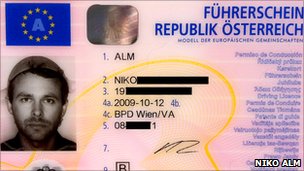
Austrian man strikes a blow for atheism:

Austrian driving licence

An Austrian atheist has won the right to be shown on his driving-licence photo wearing a pasta strainer as “religious headgear”.

Niko Alm first applied for the licence three years ago after reading that headgear was allowed in official pictures only for confessional reasons.

Mr Alm said the sieve was a requirement of his religion, pastafarianism.

Hi-larious. This sort of thing is why I dislike the “new atheism”.

And I thought Richard Herring was the nerdy one

In a story I missed a year ago, Stewart Lee reveals he’s a packrat addicted to collecting comics, cds and books:

And all this stuff, in the digital age, is literally worthless financially, and losing any value it had daily. There’s nothing here a burglar would even bother with. I’m aware I’m a social relic from an age when you walked through the shopping centre with an unbagged album under your arm to show like-minded souls who you were, and when the book as an object was quietly fetishised. Now kids stake out their personal space with knives and guns and gadgets, and working stiffs flip falsified pages of virtual books on Kindles. I’m like a character in a dystopian science-fiction novel, holed up in a cave full of cultural artefacts, waiting for the young Jenny Agutter to arrive in a tinfoil miniskirt, fleeing a poisonous cloud on the surface, to check out my stash and ask me: “Who exactly was the Quicksilver Messenger Service? Who was this Virginia Woolf? What kind of man was Jonah Hex?”

I feel his pain. Below is part of my own library; we’re sort of resigned to having to move on from our cozy two room flat in a couple of years solely because our (well, my…) collections will be too big for the limited space we have.

part of our book collection

Can *you* identify the two books on the table?

The dead hand of Heinleinism

Adam Roberts reviews a dreadful sounding novel, Charles Sheffield’s and Jerry Pournelle’s Higher Education, a “confection of right-wing ideological tendentiousness, bias, strawmannery, tedious earbending and downright banging-your-fist-on-the-edge-of-the-pulpit preaching”. It all sounded very familiar, reinforced by the extracts Roberts provided:

“You stated on your general knowledge quiz that Rome was founded in the year 753A.D. Would you be interested in revising that opinion?”

There was a long silence as Deedee opened her mouth and then closed it. Finally she said, tentatively: “753 B.C.?”

“Correct. A mere difference of fifteen hundred years, but what’s that between friends? Bravo. … Now listen all of you. You may be thinking, what the hell is all the fuss about? Barney French is nit-picking on things that don’t make a damn of difference. Well if you think that you’re wrong.” … She walked along the line of trainees, turning so that they could get a good view of her misshapen face. “See the scars? See the bone grafts? Take a close-up. You’re seeing me after thirty-seven operations and the best plastic surgery that money can buy. My body is in worse shape than my face—I have more metal than bone in my shoulders. And I’m one of the lucky ones. Four people died in the accident that did this. And do you know what caused it?”

It’s Heinlein isn’t it? Ersatz Heinlein, that is, inferior writers aping his style and his certaincies without having his skill to make you share them, at least for the duration of the story. The dead hand of Heinleinism, strangling science fiction from beyond the grave.

Heinlein could sell you a lot of nonsense, really rather stupid opinions and authoritarian bullshit but he could make you believe in all that bullshit. Especially if you are twelve, bookish and slightly smarter than your friends. He was like a kindly if slightly more cynical than your parents thought was appropriate uncle, calmly explaining to you how the world worked, trusting you were smart enough to follow his logic and never upset if you disagreed with him, as long as you could argue why you did so. He stacked the decks outrageously of course, but that didn’t matter when you were in the middle of the story. He made you trust him, if only until the book was finished.

His imitators on the other hand…

All a Pournelle or Sheffield can take away of what Heinlein did so effortlesly is the authoritianism, the big man swagger and opinions stated as facts, but without the skills to make it work. They’re just bullies, Heinlein without Heinlein’s charm. And it’s this dead hand of Heinleinism that helps hold science fiction back, as all these wannabes try to ape the old man and fail and as he remains for so many writers and readers both the standard to measure everything new with, even though it should be obvious he isn’t just that relevant or interesting anymore. Just because we liked him when we were young doesn’t mean kids today should read him or that we should keep trying to imitate him and failing. Let him be.