The dead hand of Heinleinism

Adam Roberts reviews a dreadful sounding novel, Charles Sheffield’s and Jerry Pournelle’s Higher Education, a “confection of right-wing ideological tendentiousness, bias, strawmannery, tedious earbending and downright banging-your-fist-on-the-edge-of-the-pulpit preaching”. It all sounded very familiar, reinforced by the extracts Roberts provided:

“You stated on your general knowledge quiz that Rome was founded in the year 753A.D. Would you be interested in revising that opinion?”

There was a long silence as Deedee opened her mouth and then closed it. Finally she said, tentatively: “753 B.C.?”

“Correct. A mere difference of fifteen hundred years, but what’s that between friends? Bravo. … Now listen all of you. You may be thinking, what the hell is all the fuss about? Barney French is nit-picking on things that don’t make a damn of difference. Well if you think that you’re wrong.” … She walked along the line of trainees, turning so that they could get a good view of her misshapen face. “See the scars? See the bone grafts? Take a close-up. You’re seeing me after thirty-seven operations and the best plastic surgery that money can buy. My body is in worse shape than my face—I have more metal than bone in my shoulders. And I’m one of the lucky ones. Four people died in the accident that did this. And do you know what caused it?”

It’s Heinlein isn’t it? Ersatz Heinlein, that is, inferior writers aping his style and his certaincies without having his skill to make you share them, at least for the duration of the story. The dead hand of Heinleinism, strangling science fiction from beyond the grave.

Heinlein could sell you a lot of nonsense, really rather stupid opinions and authoritarian bullshit but he could make you believe in all that bullshit. Especially if you are twelve, bookish and slightly smarter than your friends. He was like a kindly if slightly more cynical than your parents thought was appropriate uncle, calmly explaining to you how the world worked, trusting you were smart enough to follow his logic and never upset if you disagreed with him, as long as you could argue why you did so. He stacked the decks outrageously of course, but that didn’t matter when you were in the middle of the story. He made you trust him, if only until the book was finished.

His imitators on the other hand…

All a Pournelle or Sheffield can take away of what Heinlein did so effortlesly is the authoritianism, the big man swagger and opinions stated as facts, but without the skills to make it work. They’re just bullies, Heinlein without Heinlein’s charm. And it’s this dead hand of Heinleinism that helps hold science fiction back, as all these wannabes try to ape the old man and fail and as he remains for so many writers and readers both the standard to measure everything new with, even though it should be obvious he isn’t just that relevant or interesting anymore. Just because we liked him when we were young doesn’t mean kids today should read him or that we should keep trying to imitate him and failing. Let him be.
Gen U

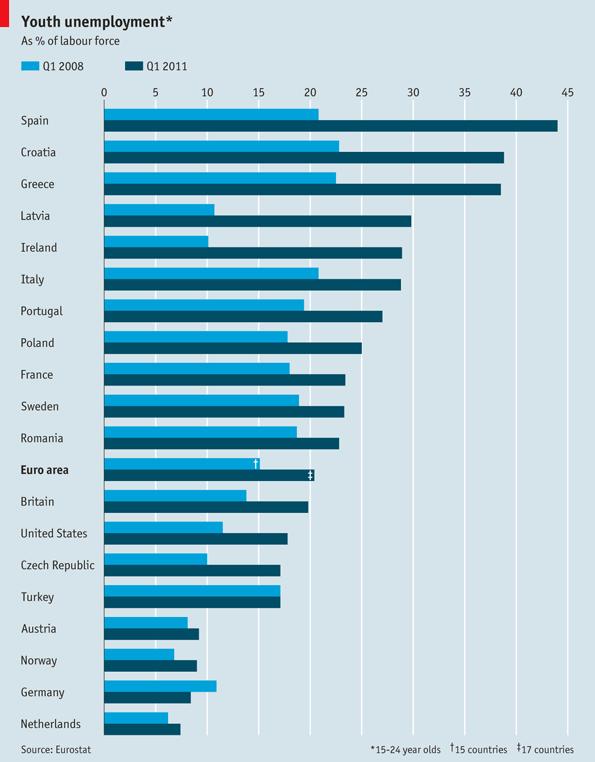
Generation Unemployment, the young bearing the brunt of the crisis

Move over Gen X and Y and go away millennials: gen U is here: generation unemployment. As the stats show, all over the western world it’s young workers who are paying the price for the economic crisis. Things didn’t look too good before 2008, but since then the spiral of economic depression and harsh saving measures by governments desperate to cut their way out of the crisis have hit young people hard. It’s not so bad in the Netherlands at the moment as it is elsewhere, but I do have the feeling that’s that because we’ve been in the eye of the storm and only now are going to feel the full brunt of it. We were lucky that when the crisis first hit, we still had a relatively moderate coalition governing the Netherlands that didn’t quite have the same neoliberal instinct to cut spending as our current minority rightwing government supported by fascists has. Didn’t mean that they did very much to combat the crisis in any recognisable Keynsian fashion, but they did put through several measures to dampen the worse effects of it.

No such luck anymore. We now have the same sort of government as every other European country, either slavering to start cutting everything they’ve disagreed with for decades, the crisis providing the perfect excuse for it, or forced to by the pressures of the financial markets and their fellow EU countries. So everybody’s cutting spending while the depression gets worse and of course it’s the most vulnerable, especially the young, who bear the brunt of it.

(Statistics via Mr Wonkish.)

Steph Swainston: “The internet is poison to authors”; quits writing

Fantasy author Steph Swainston stops being a fulltime writer to pursue her dream of being a chemistry teacher:

But – cautionary tale alert! – the writer’s life isn’t what it could be. For starters, packing in the day job can be a mistake. Swainston says: “Writers have to have something as well as writing, something which feeds back into their work and makes it meaningful.” She references the 19th-century Scottish writer and reformer Samuel Smiles. “He said that if you are going to be an artist, you should have a job as well, so that you’re not relying on your art to pay your bills. If we don’t have external influences …” she pauses, “well, look at Stephen King. All his characters seem to be writers.”

Then there’s the lack of human interaction: “I suffer terribly from isolation while writing. I really need a job where I can be around people and learn to speak again. It’s much, much healthier to be around people. Human beings are social animals.”

[…]

“I don’t have a problem with fandom,” she says. “But I don’t think fans realise the pressure they put on authors. The very vocal ones can change an author’s next book, even an author’s career, by what they say on the internet. And writers are expected to engage and respond.” She pauses. “The internet is poison to authors.”

Swainston is also unhappy with the “book a year” ethos of modern publishing: “Publishers seem to want to compete with faster forms of media, but the fast turnover leads to poorer books, and publishers shoot themselves in the foot. And it’s as if authors have to be celebrities these days. It’s expected that authors do loads of self-publicity – Facebook, Twitter, blogs, forum discussions – but it’s an author’s job to write a book, not do the marketing. Just like celebrities don’t make good authors, authors don’t really make good celebrities.”

You can’t blame her for her decision, but it does point out a worry that in these much more commercially minded times, where writers do have to depend on their own gifts for self promotion, some writers will lose out because they aren’t good at playing this game. It certainly doesn’t help fantasy/science fiction to lose yet another prominent female writer this way…

The women sf writers men don’t see

In the ongoing struggle to get greater recognition for female writers of science fiction, one of the fronts surely has to be that of history. One of the points Joanna Russ made in How to Suppress Women’s Writing is that each female author is seen as something singular, a freak, standing outside a history almost entirely defined by male writers. This goes for science fiction as much as for literary fiction: in both cases it’s much easier to imagine a history written without references to women than it is to imagine the opposite. I saw this happen two years ago with the Racefail debate in online sf fandom circles as well. When pushed upon it, well meaning liberal (white) sf & fantasy readers could mention two-three writers of colour, but these were always the same two-three (Delany, Butler, perhaps Barnes or Hopkinson) everybody knows, rather than any of the hundreds of other candidates, of whom most sf readers were ignorant to a degree they were not of their white counterparts. Most of Racefail was a struggle to teach this insight to people (willfully) blind to this and to find ways to make sure this insight was not lost, through e.g. the Carl Brandon society I linked to above.

Consciously or not, like writers of colour, female also sf writers get written out of science fiction’s collective awareness and sense of history, the vast mass of female writers ignored in favour of always the same outliers, their history lost in a way that means that every new high profile female science fiction writer is a novum, rather than standing in the same sort of tradition granted to male sf writers. instead she’s either evaluated in terms of that explicitely male tradition or seen as somebody who breaks with it. It’s not just that feminist or female themes and concerns get ignored and sidelined, but that the whole history of the genre can be and is defined in terms of the accomplishments of male writers, with only the occasional token female writer.

It’s this background that makes an effort like Pre-1923 Utopias and Science Fiction by Women: A Reading List of Online Editions, hosted by the Online Books Page, so important. Inspired by L.Timmel Duchamp’s list of Science Fiction and Utopias by Women, 1818-1949, it does exactly what it says on the tin, providing a list of science fiction and utopian writing by women written before 1923 and available online. Lists like these provide context to the male dominated mainstream history of the genre, by showing how many more writers other than Mary Shelly were active before Gernsback “invented” science fiction, that the genre is build as much on a now largely submerged field of female writers as it is on their much better known male colleagues.

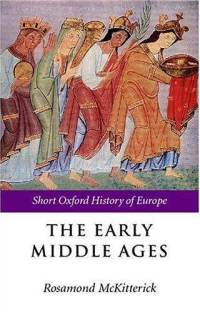
The Early Middle Ages — Rosamond McKitterick

cover of The Early Middle Ages


The Early Middle Ages
Rosamond McKitterick
308 pages including index
published in 2001

I spotted this book at the local library and got it out because it contained a contribution by Chris Wickham, whose Framing the Early Middle Ages and The Inheritance of Rome impressed me quite a lot when I read them earlier this year. The Early Middle Ages is one of the entries in The Short Oxford History of Europe and intended as an introduction to this particular period, what the editor Rosamond McKitterick called “the Boeing 767 view of early medieval Europe”, quite a different sort of book from the two Wickham books. I therefore didn’t expect to learn much news from this, but rather wanted to read it as an introduction to the other historians involved, none of whom I’d read before.

The Early Middle Ages attempts to give a broad overview of the evolution of Medieval Europe between 400 CE and 1000 CE and tries to evaluate this period on its own terms, rather than as a transition period between the Roman Empire and the “real” Middle Ages. Doing this in less than 250 pages, or some 80,000 words is a real challenge and of course means that a lot of history is elided. Ironically, if you are already familiar with the period, it helps a lot to understand some of the developments that are sketched out here, at least to put them into a chronological context. I’m not sure how much I would’ve understood of some the chapters had I come to this book as a complete novice. This feeling was the strongest in Chris Wickham’s chapter, which felt as an extract of his two books mentioned above…

Read more…