The Russ Pledge

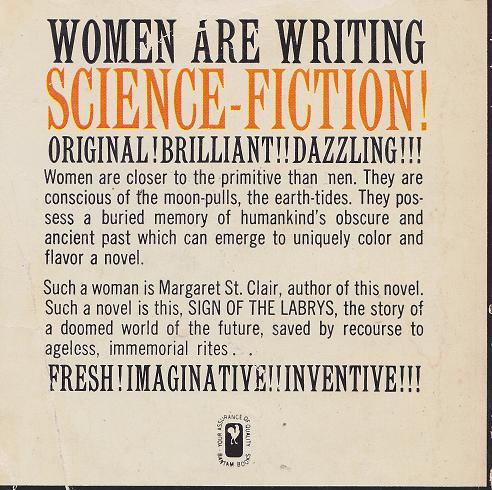
backcover blurb from Sign of the Labrys

That’s from the backcover blurb of Sign of the Labrys, a 1963 sf novel written by Margaret St. Clair. Even then the idea that it was new and different for women to write science fiction was laughably ignorant, but that didn’t stop whatever unnamed marketering genius who came up with that quote.

This blurb is the perfect illustration of why the “Russ Pledge” is important. No male writer would’ve been introduced like Margaret St Clair was here, as both representative of his whole genre and as something new. That’s one part of what Joanna Russ wrote about in How to Surpress Womens’ Writing: the constant emphasis that this female writer is an exception, that female writers are rare and strange. Though things improved since this blurb was written, we’re currently — with allegedly only two female sf writers having a book contract in the UK — in danger of moving back towards a situation in which it once again becomes easy to imagine such blurbs, unless we actively work to prevent this.

As Farah Mendlesohn made clear in her contribution to the SF Mindmeld linked to above, it is especially important for male sf writers, editors, reviewers and readers to take the lead in this. Though women can obviously share the same biases and are caught in the same distortion, it’s been us men who’ve — consciously or unconsciously — been setting this trap. Moreoever, if we don’t change our behaviour the same power dynamics will continue to be in force. Obviously. Hence the Russ pledge and its importance. What I’d therefore like to do, apart from reading and reviewing more books by female sf writers, is to do a series of posts on my favourites and why they’re my favourite female writers: people like Jo Walton, Mary Gentle, C. J. Cherryh, Leigh Brackett, Lois McMaster Bujold…

You don’t prove your feminist credentials with racism

You may know Sugar Ray Leonard as a seventies boxer. He recently released an autobiography in which he admitted he had been sexually assaulted by an unnamed boxing coach, just before the 1976 Olympic Games. Not an easy admission to make, especially not for somebody coming from the macho world of boxing. You therefore expect a leftwing, feminist blog to both take his confession seriously and treat it sensitively. Anthony McCarthy at Echidne of the Snakes is here to prove you wrong:

I have a hard time imagining that a very middle aged gay man would have chosen Sugar Ray Leonard to make a sudden, un-negotiated, physical sexual assault against just as he was about to win a gold medal in BOXING. Boxing, repeatedly and skillfully and forcefully hitting an evenly matched opponent in the face and head in order to inflict damage up to and including knocking him unconscious. Boxing is not track and field, it’s not gymnastics, it’s the training and practice of how to do physical damage to someone. No matter how physically attractive Leonard was, the possibility that he might beat you to a bloody pulp if he didn’t welcome your entirely unannounced, unapproved physical advance would have made him an unlikely man to choose to make one on.

Though he never quite comes out and says it, everything McCarthy says is based on the assumption that Black man = violent thug and especially that a Black boxer is a violent thug. Obviously it’s absurd to assume that just because Sugar Ray Leonard was a career boxer, he would beat up people outside the ring as well, as if boxing and criminal assault are the same thing. To make his case McCarthy has to ignore all other power considerations that could exist between a young, Black boxing hopeful and a well established, white boxing coach, has to ignore what the likely consequences for Sugar Ray had been had he indeed physically attacking this coach, had to ignore the very fact that awareness of sexual assault, especially sexual assault aimed at men, was pretty low in 1976. Instead he has to rely on unspoken but understood stereotypes of young Black men, dogwhistled through emphasising Sugar Ray Leonard’s boxing career.

Without this racism he only has own incredulity as an argument, but just because Anthony McCarthy finds something hard to believe doesn’t mean it didn’t happen — I found it hard to believe any self declared feminist could engage in victim blaming this blatant, yet Anthony made it happen anyway.

The Mammoth e-Book of Mindblowing Mars SF

Need something cool to read this weekend? Here you go:

The Mammoth e-Book of Mindblowing Mars SF (2009) presents 20 of the finest examples of mind-expanding, awe-inspiring, 21st-century Martian science fiction that are free and ready-to-read on the Internet. The storylines range from a spunky young bride-to-be truding across Red Planet sands, to a classical concert on Earth interrupted by unannounced guests, to a brutish psychic that roams the twisting urban alleys of the north face of Mars. These are works that take you across time and space -– from today’s top-name contributors, including Camille Alexa, Kage Baker, Terrie Leigh Relf, Patricia Stewart, Mary A. Turzillo, and Liz Williams. So sit back, adjust your glasses, and prepare to have your mind blown!

Bonus question: what’s different about this anthology?

Living life in the bike lane


Suddenly the petty concerns of my bike commute in lovely Amsterdam do not seem so bad anymore. Casey Neistat was ticketed for not riding his bike in the bikelane in NYC, but his video clearly shows that sometimes riding the bikelane is actually either impossible or highly dangerous….

(Via Michael Minneboo.)